How TD Monetizes Its Supplier Ecosystem: a pragmatic investor thesis
Toronto‑Dominion Bank (TD) runs a classic diversified commercial and retail banking model that earns fees from underwriting, asset management, insurance sponsorships, and interest spread on deposits and loans. Its supplier relationships cluster around capital markets execution, creative and branding services, and insurance/financial‑instrument counterparties — all of which support revenue lines in investment banking, wealth products, and retail marketing. For investors evaluating counterparty exposure, the key questions are concentration of critical suppliers, the bank’s contracting posture with advisors and agencies, and how these vendors affect customer acquisition costs and capital deployment.
Explore deeper supplier mapping and exposure tools at https://nullexposure.com/.
What the relationship list tells you in plain language
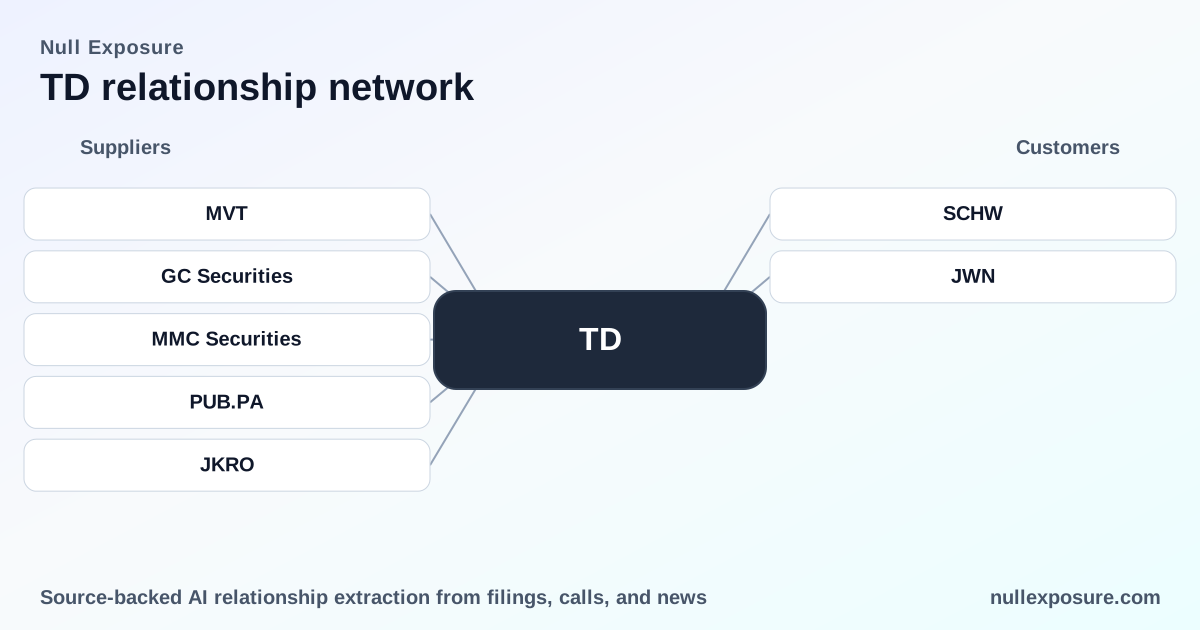
TD’s disclosed supplier set in FY2026 is small but functionally broad: one financial‑instrument acquisition, two bookrunner/advisory providers on a cat bond, and two creative/brand agencies supporting marketing and identity work. That mix signals TD uses external partners for both capital markets execution and brand-intensive customer acquisition while keeping core banking commoditized internally.
The disclosed relationships — one by one
BlackRock MuniVest Fund II, Inc. (MVT)
TD disclosed that a TD subsidiary acquired 100% of the Variable Rate Municipal Term Preferred Shares issued by BlackRock MuniVest Fund II, Inc. in FY2026, reflecting a direct capital‑markets investment and balance‑sheet placement. This was covered by TradingView in March 2026. (TradingView, March 2026)
GC Securities (division of MMC Securities) — joint bookrunner
TD Insurance (TDI) used GC Securities as one of the joint bookrunners on the MMIFS Re Ltd. Series 2026‑1 catastrophe bond, indicating TD leans on established capital‑markets syndication partners for insurance securitizations. MarketScreener reported on the transaction closing in March 2026. (MarketScreener, March 2026)
MMC Securities — joint bookrunner
MMC Securities is named alongside GC Securities and TD Securities as a joint bookrunner on the same TDI‑sponsored cat bond, underscoring TD’s practice of sharing execution risk and distribution with external underwriting desks on insurance risk transfers. (MarketScreener, March 2026)
Publicis Groupe SA — creative and campaign execution
TD contracted branches of Publicis Groupe for creative work across TV, digital, and social channels for a high‑visibility campaign, showing TD outsources large creative productions to global advertising networks for scale and reach. The Globe and Mail covered the marketing push in March 2026. (The Globe and Mail, March 2026)
JKR — visual identity and branding
TD engaged JKR, a global branding agency, to develop a new visual identity in FY2026, marking a strategic brand partnership for customer experience and positioning rather than a short‑term media buy. The Globe and Mail noted this new relationship in March 2026. (The Globe and Mail, March 2026)
What these relationships imply about TD’s operating model
-
Contracting posture: TD uses a hybrid approach: it keeps critical banking operations internal while contracting external specialists for episodic, high‑complexity work — underwriting (bookrunners) and creative/branding (agencies). This is a common posture for large banks that want to manage core risk while leveraging third‑party distribution and expertise.
-
Concentration and redundancy: The FY2026 list shows low supplier concentration in the sense of diverse external partners across functions (capital markets vs. creative). However, within each function TD uses small syndicates (e.g., a few joint bookrunners), creating partial concentration risk if a single counterparty faces operational disruption.
-
Criticality: Relationships with bookrunners and insurance‑securitization partners are operationally critical for executing liability transfers and bond placements; creative and branding agencies are strategically important for acquisition and retention. Disruption in either category can affect fee income and cost of capital differently.
-
Maturity and bargaining power: As a top‑tier bank with a market cap over USD 159 billion and strong metrics such as Return on Equity ~17.8% and Revenue TTM of USD 65.98 billion, TD has significant bargaining leverage with large suppliers but continues to rely on specialized partners for niche capabilities.
Mid‑article invite: get the full supplier map
If you are building a counterparty scorecard for TD, see how these relationships fit into a broader supplier risk framework at https://nullexposure.com/.
Investment implications and risk factors
-
Revenue support vs. balance‑sheet risk. The BlackRock MuniVest stake is a balance‑sheet exposure that can influence TD’s funding and capital usage; by contrast, the bookrunner engagements generate fee income without principal exposure. Investors should separate fee‑driven supplier interactions from inventory or securities holdings when modeling earnings sensitivity.
-
Brand investment amplifies customer metrics. The Publicis and JKR engagements reflect a strategic investment in customer acquisition and brand equity; these are discretionary but can shift customer lifetime value outcomes and marketing ROI.
-
Execution dependence on market partners. Securitizations and cat bonds rely on external distribution. A disruption in underwriting capacity or market appetite could raise funding costs or delay risk transfer, which is material for TD’s insurance sponsorships.
Practical takeaways for investors and operators
- Build two distinct supplier tracks in your diligence: (1) execution partners (bookrunners, underwriters) that affect capital costs and risk transfer, and (2) brand/experience vendors (agencies) that affect customer acquisition and operating expense.
- Monitor disclosures of balance‑sheet investments separately from fee arrangements; the BlackRock MuniVest item indicates TD will use its balance sheet selectively for structured positions.
- Track syndicate breadth on future securitizations to judge concentration risk; the FY2026 pattern shows TD prefers joint bookrunner structures rather than single‑dealer dependence.
Before you build exposure models or counterparty stress tests, get the detailed relationship histories and contract scopes at https://nullexposure.com/.
Closing assessment
TD’s FY2026 supplier snapshot illustrates a pragmatic corporate approach: retain control of core banking economics while outsourcing specialized execution and large creative projects to established market players. For investors, the key is to quantify how these external relationships translate into fee growth, capital allocation, and operational dependence — not just headline partner names. The mix of a balance‑sheet purchase (BlackRock MuniVest), syndicate underwriting (GC Securities, MMC Securities), and strategic agency work (Publicis, JKR) should be treated as complementary levers that can accelerate revenue or amplify risk depending on market conditions.
For continuous supplier intelligence and structured exposure reports, visit https://nullexposure.com/.