TDAC — Supplier relationships and what they mean for investors
Translational Development Acquisition Corp. (TDAC) is a blank‑check acquisition vehicle that monetizes primarily through sponsor and underwriting economics tied to completing a business combination: it holds a large trust account funded by its IPO proceeds, pays ongoing administrative fees to its sponsor, and stands to incur deferred underwriting fees only if it consummates a transaction. For capital allocators evaluating exposure to TDAC, the relevant dynamics are balance‑sheet parked capital, sponsor dependency for execution, and contingent fees that align or stress economics at closing. Learn more about supplier exposures and counterparties at https://nullexposure.com/.
Quick operational thesis for investors
TDAC is a SPAC with no operating revenue and a concentrated operating model: capital is parked in a trust ($174.35m as of 12/31/2024) while the vehicle depends on third‑party sponsor services and underwriting partners to source and close a target. The company’s economics today are driven by the size of the trust, sponsor administrative arrangements ($10,000/month), and a meaningful deferred underwriting obligation ($6,037,500) that will only be paid out on successful deal completion, which concentrates counterparty risk and creates binary outcomes for investors.
What the data shows about the supplier landscape
TDAC’s supplier footprint is limited and transactional. Market capitalization is roughly $230.9m and the SPAC reports zero operating revenue, reflecting that supplier relationships are executional (sponsor, underwriters, transfer agent, trustee) rather than recurring product vendors. According to the company’s filings, the trust balance is the operational lever for closing a deal and paying contingent counterparties; this makes payment and custody relationships material to execution. For further supplier intelligence, visit https://nullexposure.com/.
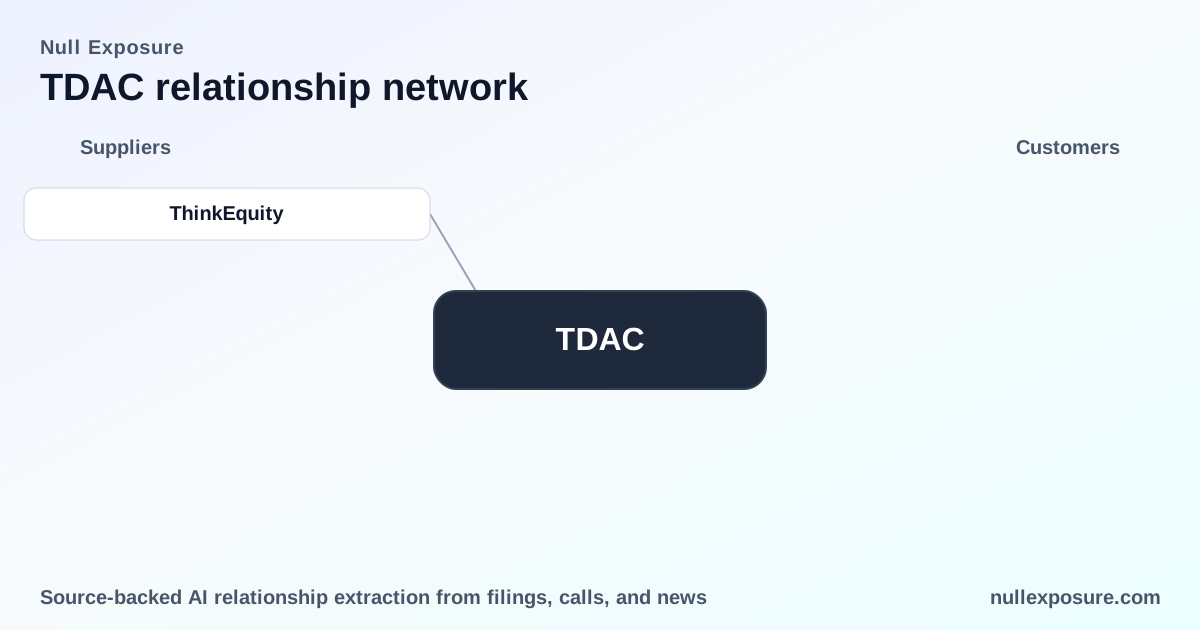
Documented supplier relationship: ThinkEquity
ThinkEquity is listed in news coverage as the sole bookrunner on TDAC’s IPO. Renaissance Capital reported on March 10, 2026, that ThinkEquity served as sole bookrunner for the offering that funded the trust account. This positions ThinkEquity as the primary capital markets intermediary for the IPO execution phase. (Source: Renaissance Capital news, March 10, 2026 — https://www.renaissancecapital.com/IPO-Center/News/94430/Healthcare-focused-SPAC-Translational-Development-Acquisition-files-for-a-$)
All other relationship signals embedded in filings (company-level)
The company’s own public disclosures provide the clearest picture of counterparty economics and contractual posture:
- The trust account held $174,350,346 as of December 31, 2024, and the company intends to use substantially all of those funds, including interest, to complete a business combination — a critical dependency for execution and payer of contingent amounts (company SEC filing, FY2024).
- The sponsor receives about $10,000 per month for administrative/support services starting December 24, 2024, and the company recognized a small payable for those fees as of December 31, 2024 (company SEC filing, FY2024).
- Underwriters are entitled to a deferred underwriting fee of $0.35 per unit (aggregate $6,037,500) payable only if TDAC completes a business combination, making that spend contingent and material to closing economics (company SEC filing, FY2024).
These excerpts are direct contract-level signals from the company’s regulatory filings and should be treated as primary evidence of vendor relationships and contingent obligations.
What the constraints tell investors about TDAC’s operating model
The constraint set in the filings translates into concrete business model characteristics:
- Contracting posture — transactional and contingent. Key supplier payments (deferred underwriting fee) are payable only upon deal completion, creating a conditional liability structure where counterparties are paid upon success.
- Concentration — high. A small set of counterparties (sponsor, underwriters, transfer agent/trustee) control critical functions: administrative execution, capital markets distribution, and trust custody.
- Criticality — very high. The trust account is the fulcrum of TDAC’s ability to close a transaction; custody and administration of those funds are critical single points of failure.
- Maturity — early / pre‑combination. TDAC is an active SPAC that has no operating revenue and is still in the execution phase, with ongoing sponsor fees and outstanding contingent underwriting obligations.
- Spend profile — mid‑range contingent spend. The firm records contingent deferred fees in the $1m–$10m band, which is meaningful relative to anticipated transaction closing economics but does not consume the bulk of the trust balance.
These are company‑level signals drawn from the filing language rather than extrapolations tied to any single named counterparty in the results.
Implications for investors and operators
- Counterparty risk is execution risk. If the sponsor or bookrunner relationships deteriorate, TDAC’s ability to identify, negotiate, and close a business combination will be impaired — that is the single most consequential operational risk for investors.
- Contingent economics align incentives but concentrate downside. Deferred underwriting fees and sponsor admin arrangements reward successful deal completion but create fixed claims on trust proceeds that reduce upside on liquidation.
- Liquidity sizing matters. With roughly $174.35m in trust versus a market cap around $230.9m, the interplay of trust liquidity, contingent fees, and potential redemption behavior by public shareholders determines net proceeds available to a target and post‑deal capital structure.
Key takeaway: TDAC is a classic SPAC play where success hinges on a small set of external suppliers executing under contingent contracts; these suppliers are not commoditized vendors — they are gatekeepers.
Actionable next steps for evaluation
- Review the full underwriting agreement and sponsor administration agreement to quantify timing and conditions of the deferred fee and ongoing service fees. For a consolidated supplier profile and counterparty scoring, visit https://nullexposure.com/.
- Monitor any amendments, payments to the trustee, and press on underwriter roles; changes will alter net transaction economics and counterparty concentration risk.
- Assess sponsor track record and capacity to source targets under the stated fee structure — sponsor strength is the most important qualitative input.
Final assessment and risk summary
TDAC is a pre‑deal SPAC with highly concentrated supplier dependencies, a material trust account, and contingent but meaningful underwriter and sponsor fees that will shape post‑transaction economics. Investors should treat supplier relationships not as peripheral vendor listings but as central execution counterparties whose behavior directly determines whether cash in trust funds a business combination or is returned to public holders. For ongoing supplier monitoring and to operationalize this supplier intelligence, visit https://nullexposure.com/.
Bold summary: TDAC’s value realization is conditional on successful execution by a few named counterparties; the trust account is critical, sponsor and underwriter fees are consequential, and exposure is concentrated and execution‑dependent.