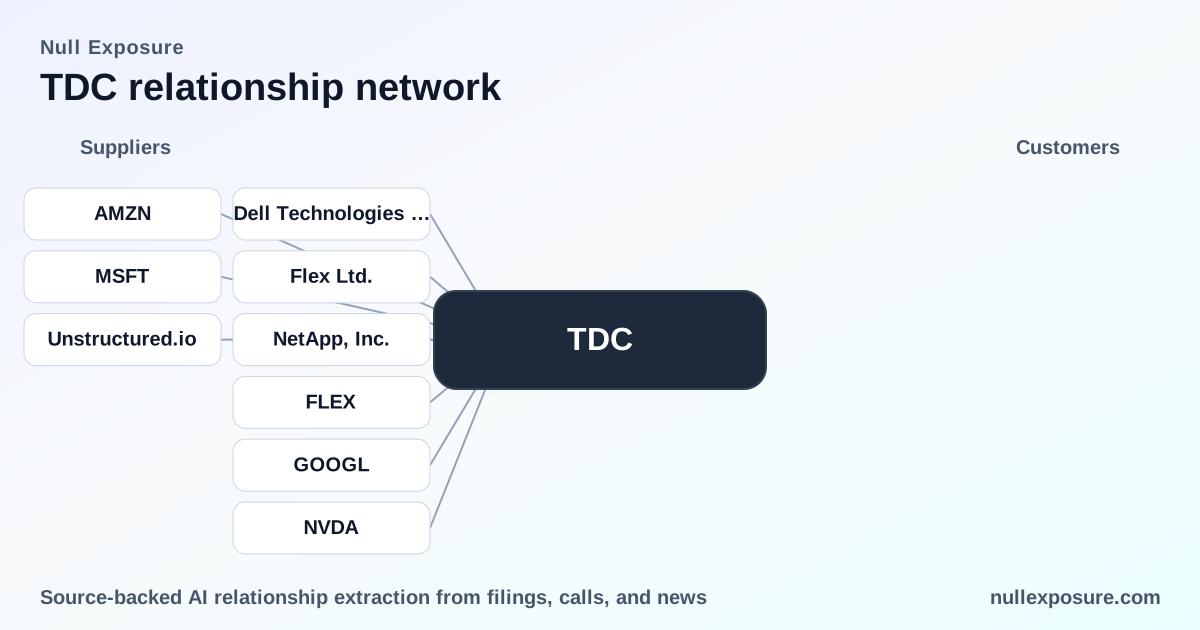
Teradata (TDC) supplier footprint: where risk and opportunity sit
Teradata is a hybrid-cloud analytics vendor that monetizes through software licensing, subscription/ARR on cloud and managed services, plus sales of on‑premises analytics appliances; on‑prem hardware is outsourced to contract manufacturers while the company relies on public cloud partners to deliver hosted offerings. That mix gives Teradata a software gross margin profile but retains operational exposure to a small set of hardware and cloud suppliers, making supplier relationships a strategic lever for growth and a concentration risk to monitor. Explore detailed supplier signals and tooling at Null Exposure.
How Teradata’s operating model forces supplier relationships to matter
Teradata’s corporate profile — enterprise analytics software with a growing cloud ARR base and legacy on‑prem appliances — drives a two‑track supplier posture. The company reduces manufacturing capital needs by outsourcing hardware assembly and component procurement, yet still sells and supports hardware platforms that require discrete parts, assembly and GPU integration. Company filings show Revenue TTM $1.663B and EBITDA $297M, underscoring a software-first economics but with meaningful hardware and partner-enabled product lines that affect execution and margins.
The net effect: software economics on top of a thin layer of hardware dependency. That reduces fixed capex but concentrates execution risk into a few external vendors (assembly, servers, storage, GPUs, and public cloud hosters). If you evaluate Teradata as a vendor or investor, treat supplier resilience and partnership execution as core operational indicators.
Supplier relationships called out in filings and press — what each means
Below I cover every relationship cited in Teradata’s supplier results and the source that mentions it, with a plain-English take for each.
-
Flex Ltd. (Flex / FLEX) — Teradata relies on Flex as its primary contract manufacturer for on‑premises hardware systems; Flex procures components and assembles systems on Teradata’s behalf. This is identified in Teradata’s FY2024 Form 10‑K and explicitly described as a key single‑source contract manufacturer (FY2024 10‑K).
Source: Teradata FY2024 Form 10‑K (tdc-2024-12-31). -
Dell Technologies Inc. — Teradata purchases servers from Dell for certain configurations, meaning Dell is a commercial supplier for server hardware used in Teradata systems (FY2024 10‑K).
Source: Teradata FY2024 Form 10‑K (tdc-2024-12-31). -
NetApp, Inc. — Teradata buys storage disk systems from NetApp, making NetApp a named storage supplier in Teradata’s hardware ecosystem (FY2024 10‑K).
Source: Teradata FY2024 Form 10‑K (tdc-2024-12-31). -
Amazon Web Services (AWS) — Teradata partners with AWS to host its cloud-delivered software; public reporting highlights AWS as one of the major cloud platforms that underpin Teradata’s hosted offerings and cloud ARR growth (SiliconANGLE, Feb 10, 2026).
Source: SiliconANGLE article (Feb 10, 2026). -
Google LLC / Google Cloud — Teradata has an active partnership with Google Cloud to host software and distribute enterprise AI capabilities (including availability of an enterprise-grade data analyst AI agent on Google Cloud Marketplace); press coverage frames Google Cloud as a strategic cloud host (SiliconANGLE, Feb 10, 2026; InsiderMonkey earnings transcript, Q4 2025).
Source: SiliconANGLE (Feb 10, 2026); InsiderMonkey earnings call transcript (Q4 2025). -
Microsoft Corp. — Microsoft is a named public cloud partner used to host and deliver Teradata’s cloud services, alongside AWS and Google (SiliconANGLE, Feb 10, 2026).
Source: SiliconANGLE article (Feb 10, 2026). -
NVIDIA — Teradata announced product integrations that embed NVIDIA’s AI software stack and GPU capabilities into on‑prem platforms (Enterprise Vector Store, MCP Server), signaling a supplier relationship for GPU technology and AI software integration (Finviz news, Mar 10, 2026; InsiderMonkey Q4 2025 transcript).
Source: Finviz news (Mar 10, 2026); InsiderMonkey earnings call transcript (Q4 2025). -
Unstructured.io (unstructured.io) — Teradata announced a partnership with Unstructured.io to automate ingestion and conversion of unstructured content (documents, PDFs, images) into analysis‑ready formats, supporting AI and unstructured data workflows (Finviz and InsiderMonkey coverage, early 2026).
Source: Finviz news (Mar 10, 2026); InsiderMonkey earnings call transcript (Q4 2025).
What the constraints tell you about Teradata’s risk profile
Teradata’s filing includes explicit supplier‑risk language that frames how an investor should think about operational constraints:
-
Supplier concentration is material. The FY2024 10‑K warns that hardware components are assembled primarily by Flex and that Teradata sources certain components from single suppliers; a disruption at Flex or a single supplier could affect shipments and operating results. This is a material concentration signal that elevates operational risk for on‑prem hardware sales.
Source: Teradata FY2024 Form 10‑K (FY2024). -
Manufacturer role is central. Multiple 10‑K excerpts identify Flex as the assembler and procurer of components on Teradata’s behalf, establishing Flex as a critical execution partner rather than a peripheral vendor. This is a relationship where operational continuity at the manufacturer directly maps to Teradata’s time‑to‑revenue for hardware orders.
Source: Teradata FY2024 Form 10‑K (FY2024).
Those constraint excerpts are company-level signals of concentration, criticality and outsourced manufacturing maturity: Teradata has an explicit outsourcing strategy that is mature enough to be disclosed, but concentrated enough to be material.
Investor implications and operational red flags
- Concentration and single‑source risk are the top operational threat. If Flex encounters capacity, quality or geopolitical issues, Teradata’s on‑prem deliveries and related revenue recognition could be delayed. This is a balance‑sheet and go‑to‑market lever to watch.
- Cloud partnerships are growth levers and alternatives. AWS, Google Cloud and Microsoft are distribution and hosting partners that reduce some physical supply‑chain exposure while increasing reliance on cloud commercialization and revenue share economics. SiliconANGLE and other press coverage highlighted public‑cloud momentum in early 2026.
- GPU and AI supplier integration creates both upside and supply risk. NVIDIA’s stack is embedded in new platforms; that accelerates product competitiveness but ties Teradata to GPU supply cycles and vendor roadmaps.
- Small specialist partners accelerate feature delivery. Agreements like the one with Unstructured.io improve product relevance for unstructured data and AI, but commercial execution and integration risk are shorter‑term monitoring points.
For actionable signals, monitor vendor outage reports, Flex manufacturing lead times and backlog disclosures, GPU supply availability, cloud marketplace adoption rates, and Teradata’s disclosed concentration percentages in future filings.
If you want a supplier‑risk dashboard that synthesizes these signals into watchlists and alerts, see Null Exposure for modelled views and vendor scoring.
What to watch next quarter
- Any 10‑Q/10‑K updates that quantify revenue tied to hardware vs cloud ARR, and any changes to supplier concentration language.
- Public statements or press releases about expanded OEM relationships with Dell or NetApp, or changes to Flex’s role.
- Announcements on NVIDIA partnership depth (software licensing vs co‑engineered hardware) and any supply notes.
- Traction for the Unstructured.io integration (customer wins, product availability) and cloud‑marketplace listings moving from pilot to commercial.
Explore supplier scoring and monitoring use cases further at Null Exposure.
Bottom line
Teradata runs a software business with embedded hardware and partner dependencies that materially influence execution. Outsourced assembly to Flex materially reduces capex but concentrates operational risk; public cloud partnerships unlock recurring revenue growth while shifting dependence to AWS/Google/Microsoft. For investors and operators, supplier diligence should be treated as an ongoing operational KPI — not a one‑time checkbox — with Flex, NVIDIA and the three major cloud providers as the priority relationships to monitor.