Trident Digital Tech Holdings (TDTH): supplier relationships that drive risk and runway
Trident Digital Tech Holdings operates as a Singapore‑headquartered provider of digital identity, IT customization and business consulting services and monetizes through government and enterprise platform deployments, consulting engagements, and nascent Web3 product monetization. The company’s commercial model mixes project revenue from identity deployments with platform subscription and transactional ambitions (including stablecoin initiatives), financed intermittently through private placements and public equity. Investors should treat revenue as embryonic, infrastructure partners as strategically critical, and placement agents/IR firms as the company’s operational lifelines. Learn more about supplier intelligence and due diligence at the NullExposure homepage: https://nullexposure.com/.
Snapshot that frames supplier risk
Trident reported TTM revenue of $123,210 with EBITDA negative ~$17.4m and diluted EPS of -$0.26 through June 2025, indicating a pre‑revenue or early‑revenue stage business with outsized operating losses relative to sales. Market valuation is small ($~29.9m market cap) while public multiples are extreme (Price/Sales > 240x), which underlines the company’s dependence on external capital, placement agents, and service partners to execute its roadmap rather than on steady internal cash generation.
How Trident’s operating model shapes supplier posture
Trident’s supplier and advisory relationships reveal several company‑level constraints and characteristics that investors must fold into any operational model:
- Contracting posture: The firm relies on external capital markets and placement agents to fund product expansion and operations; convertible note financings and private placements drive near‑term liquidity rather than operating cash flow.
- Concentration and criticality: Cloud infrastructure partners (notably Tencent Cloud) are operationally critical because platform uptime and sovereignty for identity services depend on them; losing a primary cloud partner would be material.
- Commercial maturity: The business is immature commercially—low recurring revenue, negative margins, and active PR/IR programs signal a company still proving product‑market fit and market trust.
- Capital strategy: Repeated placements and convertible financing indicate capital dependence rather than self‑funding growth; that amplifies counterparty importance (placement agents, bookrunners, investor relations).
These are company‑level signals investors should quantify in supplier concentration and continuity scenarios as they build forecasts.
Supplier and partner relationships you need to model
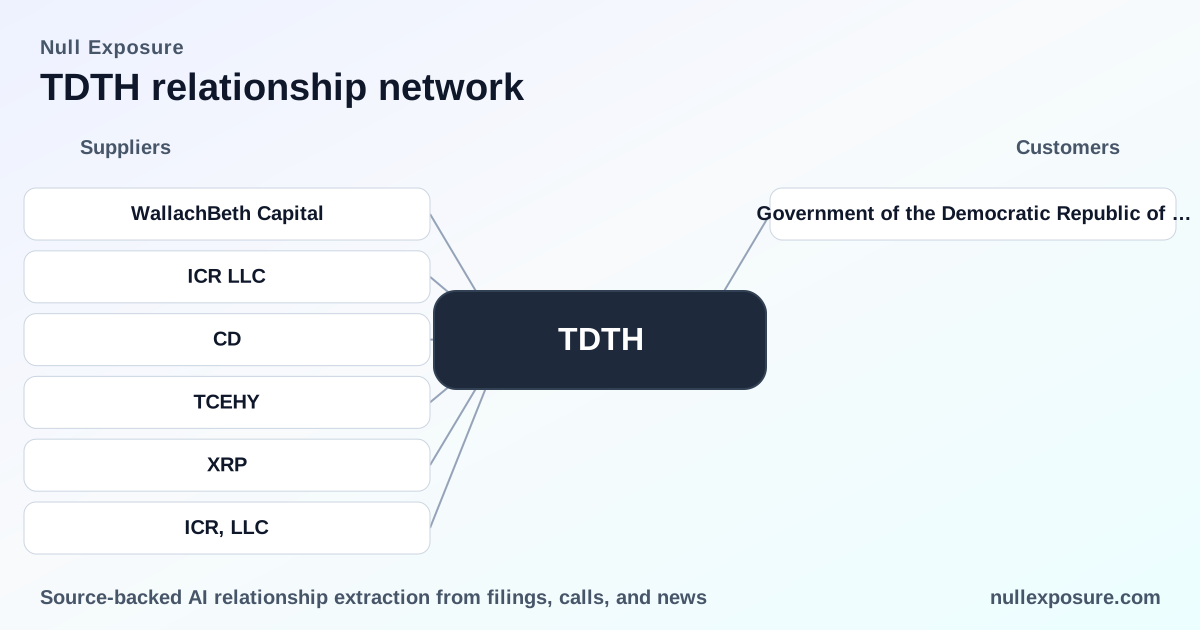
WallachBeth Capital — IPO bookrunner
WallachBeth Capital acted as the sole bookrunner on Trident’s U.S. listing, providing underwriting and market placement services that were central to the company’s access to public capital (reported by Renaissance Capital in March 2026: https://www.renaissancecapital.com/IPO-Center/News/106606/Singapore-based-consulting-firm-Trident-Digital-Tech-prices-US-IPO-at-$5-th).
WallachBeth’s role is a classic signal that Trident outsources capital‑markets execution to boutique underwriters rather than global banks, which affects syndication depth and aftermarket liquidity.
ICR LLC — investor relations and media services
ICR LLC serves as Trident’s investor relations and media relations provider, routinely listed as the company’s contact for investor and media inquiries in multiple press releases describing the Nasdaq listing and government partnerships (GlobeNewswire releases dated Oct 31, 2024; Dec 18, 2024; and Jun 25, 2025: https://www.globenewswire.com/news-release/2024/10/31/2973062/0/en/Trident-Rings-the-Nasdaq-Opening-Bell-Following-Successful-U-S-Listing.html; https://www.globenewswire.com/news-release/2024/12/18/2999100/0/en/Trident-and-the-Democratic-Republic-of-Congo-Office-of-the-President-through-National-Intelligence-Sign-Collabor.html; https://www.globenewswire.com/news-release/2025/06/25/3105136/0/en/Trident-and-Democratic-Republic-of-Congo-Sign-Final-Digital-Identity-Partnership-and-Launch-Nationwide-DRCPass-Deployment.html).
ICR’s sustained engagement signals a public‑market communications strategy designed to support liquidity and narrative while the company scales.
Chaince Securities LLC — placement agent and convertible financing lead
Chaince Securities acted as exclusive placement agent for Trident’s private offerings and convertible note financings, including a US$2.2 million follow‑on convertible note (and a prior US$2.6 million placement) disclosed in a December 1, 2025 press release (GlobeNewswire: https://www.globenewswire.com/news-release/2025/12/01/3197096/0/en/Chaince-Securities-Serves-as-Exclusive-Placement-Agent-for-Trident-Digital-Tech-Holdings-Nasdaq-TDTH-Private-Offering-of-Up-to-US-10-Million-to-Power-Web3-Platform-Expansion.html).
This relationship makes Chaince a financial lifeline: their ability to place future rounds will directly affect Trident’s runway and capacity to execute Web3 projects.
Tencent Cloud — core infrastructure provider
Trident has announced a migration of its entire digital service operations to Tencent Cloud, integrating cloud infrastructure and metaverse services into its flagship Tridentity app (PR Newswire, FY2025: https://www.prnewswire.com/apac/news-releases/tencent-clouds-robust-infrastructure-and-metaverse-innovations-elevate-tridents-flagship-tridentity-app-to-new-level-302389772.html).
This contract elevates Tencent Cloud from mere vendor to mission‑critical infrastructure partner; service level, data governance, and geopolitical considerations related to cloud hosting are direct inputs to operational risk modeling.
Ripple — payments and stablecoin rails partner (market expansion)
Trident is pursuing regulatory approvals to operate stablecoins in several African markets and is leveraging Ripple’s RLUSD as a U.S.‑dollar‑pegged token option in that effort, per coverage of Trident’s Web3 expansion plans (The Armchair Trader, FY2025: https://www.thearmchairtrader.com/crypto/trident-digital-african-stablecoin/).
A payments‑rail partner like Ripple introduces regulatory complexity and platform dependencies; investors must price legal and compliance execution risk into any scenario that assumes token‑based revenue.
What these relationships imply for valuation and operations
- Concentration risk is high: one cloud partner (Tencent) and a small set of capital‑market intermediaries (Chaince, WallachBeth, ICR) mean single‑counterparty failure would be disruptive.
- Capital risk drives dilution and timing: reliance on placement agents and convertible notes implies recurring financing rounds and potential equity dilution; model runs should include financing scenarios to sustain operations.
- Regulatory risk is front‑loaded: stablecoin ambitions create regulatory event risk that is binary for market expansion assumptions.
- Execution risk is operational: platform uptime, data governance and trust are dependent on Tencent Cloud migration success and effective PR/IR to reassure customers and investors.
Mid‑analysis action: if you want a practitioner’s supplier risk scorecard and monitoring feed for TDTH, visit the NullExposure homepage for tailored supplier intelligence: https://nullexposure.com/.
Practical investor takeaways
- Prioritize due diligence on cloud SLAs, data residency and continuity planning because Tencent Cloud is operationally critical.
- Stress‑test cash runway under realistic placement cadence and conversion terms given repeated convertible financings.
- Price regulatory timelines conservatively for any revenue derived from stablecoin or token rails.
- Monitor PR/IR cadence and bookrunner/placement activity as leading indicators of financing and liquidity.
For model templates and up‑to‑date supplier mapping for TDTH, see the NullExposure homepage: https://nullexposure.com/.
Bottom line: Trident’s business is infrastructure‑intensive, externally financed, and early stage; its supplier map identifies concentrated operational and financing dependencies that are the primary drivers of downside risk and the gating factors for realizing any Web3 or identity platform upside.