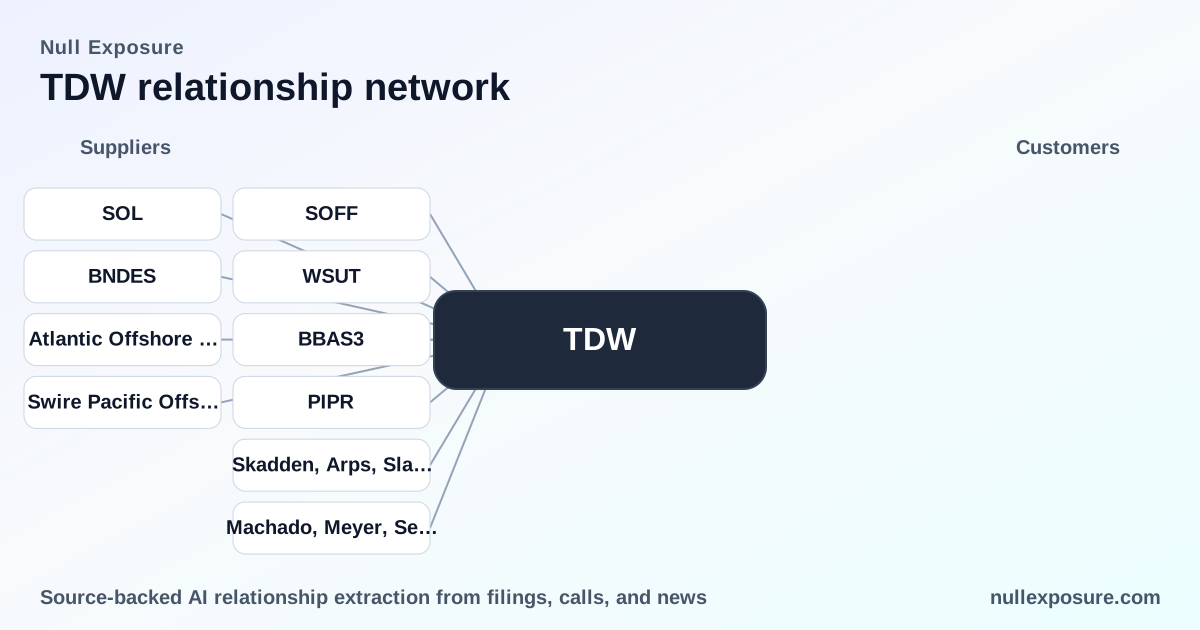
Tidewater Inc (TDW) — supplier relationships and what they signal for investors
Tidewater operates and monetizes a global fleet of offshore support vessels by contracting vessels on day‑rate and term charters to exploration and production customers, capturing revenue through higher utilization and strategic fleet acquisitions that expand capacity and regional reach. The company converts scale and fleet mix into healthy margins — recent results show EBITDA of $426.8M on $1.35B revenue (TTM) and an operating margin near 20%, while management is actively pursuing bolt‑on buys to accelerate growth and geographic diversification. For investors and operators evaluating Tidewater as a supplier partner or counterparty, the tactical picture is consolidation plus disciplined monetization of day‑rates and longer‑term contracts.
Visit nullExposure for more supplier intelligence: https://nullexposure.com/
How Tidewater makes money and what the corporate signals mean
Tidewater’s core revenue engine is offshore vessel utilization at market day‑rates, with incremental margin coming from mix (PSVs vs AHTS vs other vessels) and efficiency in vessel operations. Financial highlights across the last twelve months underline that commercial model: Revenue TTM $1.352B, Profit Margin ~24.7%, Return on Equity ~27%, and a valuation showing EV/EBITDA ≈ 8.7x. Management is using M&A to accelerate capacity rather than build organically, translating to near‑term balance sheet activity and operating leverage on higher day‑rates.
Company‑level operating model characteristics:
- Contracting posture: Tidewater uses a mix of spot and term contracts and supplements internal capabilities with third‑party specialist services; company disclosures note engagement of external security and assessment firms, signaling reliance on outside service providers for non‑core expertise.
- Concentration and criticality: As an offshore services supplier, Tidewater’s fleet is critical to E&P customers’ field operations; the company shows very high institutional ownership (reported ~103.5%), a market signal of concentrated professional ownership and analyst focus.
- Maturity and growth posture: Recent acquisitive activity indicates a maturing operator shifting to consolidation—bolt‑ons to scale fleet and enter new geographies rather than early‑stage organic capacity builds.
- Spend profile: Operational disclosures reference working capital line items such as $1.3M for lubricants, supporting a company signal that supplier spend bands for certain categories sit in the $1M–$10M range.
Explore supplier mapping and counterparty detail at nullExposure: https://nullexposure.com/
What the recent relationship headlines are and why they matter
Below are the counterparties mentioned in recent coverage and what each relationship signifies to investors and operators.
- Solstad Offshore ASA (SOFF) — Tidewater entered a definitive agreement to acquire 37 platform supply vessels from Solstad Offshore ASA for $577 million, a material capacity purchase that accelerates fleet growth. Source: Vinson & Elkins announcement on velaw.com (March 2026).
- Solstad Offshore — Reporting highlighted that Tidewater’s acquisition of more than three dozen PSVs from Solstad contributed directly to the company’s profit improvement and growth profile. Source: coverage on gCaptain (March 2026).
- Solstad (reported as SOL in some coverage) — Industry commentary links Tidewater’s fleet expansion to broader supply shifts after acquiring PSVs (including deals related to Swire and Solstad assets), underscoring competitive repositioning in the PSV market. Source: BairdMaritime column (March 2026).
- Swire Pacific Offshore — Mentioned in industry analysis as another fleet asset pool acquired in the wave of consolidation that includes Solstad PSVs, reinforcing Tidewater’s strategy of buying operating tonnage to capture immediate earnings. Source: BairdMaritime (March 2026).
- Wilson Sons Ultratug Participações S.A. (WSUT) — Tidewater agreed to acquire WSUT (and affiliate Atlantic Offshore Services) in a transaction valued at approximately $500 million, a strategic move to establish scale in Brazil. Source: gCaptain report (March 2026).
- Atlantic Offshore Services S.A. — Identified as an affiliate included in the WSUT purchase, representing local operating assets and contacts in Brazilian waters important for regional penetration. Source: gCaptain (March 2026).
- Banco do Brasil (BBAS3) — WSUT carries approximately $261 million in long‑duration amortizing debt originally provided by BNDES and Banco do Brasil; Tidewater intends to novate and roll this debt, preserving attractive financing terms and implying a negotiated debt transition with Brazilian creditors. Source: MarineLink (reporting on the transaction, March 2026).
- BNDES — Identified along with Banco do Brasil as a primary lender to WSUT; the deal structure contemplates novation/rollover of this long‑dated financing, which is material to the financing profile of the Brazil entry. Source: MarineLink (March 2026).
- Piper Sandler (PIPR) — Serving as financial advisor to Tidewater on the WSUT transaction, indicating institutional advisory support for deal execution and financing strategy. Source: MarineLink (March 2026).
- Skadden, Arps, Slate, Meagher & Flom LLP — Acting as legal counsel to Tidewater on the WSUT acquisition, which highlights reliance on international legal expertise for cross‑border novation and transaction documentation. Source: MarineLink (March 2026).
- Machado, Meyer, Sendacz e Opice Advogados — Brazilian legal counsel to Tidewater on the WSUT deal; local counsel presence is critical for regulatory and creditor negotiations in Brazil. Source: MarineLink (March 2026).
Strategic takeaway for investors and operator partners
The relationship set paints a clear consolidation and international expansion thesis: Tidewater is buying operating vessels and in‑market companies to convert existing day‑rate cycles into durable revenue, while assuming or novating local financing packages to preserve financing economics. Key implications:
- Growth is acquisition‑driven, so short‑term capex is replaced by purchase price and integration work; value creation depends on utilization and cost synergies from combined fleets.
- Balance‑sheet mechanics matter — the WSUT deal includes novation of substantial Brazilian bank debt, which reduces immediate cash requirements but introduces cross‑jurisdiction financing complexity.
- Supplier relationships and service providers are material — Tidewater engages third‑party specialists for technical and security work and incurs mid‑single digit million spend lines in operational categories, signaling predictable supplier spend and the importance of established vendor relationships.
- Regional execution risk exists in Brazil and other markets; legal and advisory teams are already in place (Skadden, Machado Meyer, Piper Sandler), which mitigates but does not eliminate execution complexity.
Investors should view recent deals as a levered roll‑up strategy converting cyclical day‑rate recovery into durable scale benefits, while monitoring integration execution, debt novation outcomes, and utilization sustainability.
For a closer read on Tidewater’s supplier exposures and deal counterparty mapping, start here: https://nullexposure.com/
Conclusion — what to watch next
Monitor utilization and day‑rate trends, the progress of WSUT debt novation with Brazilian lenders, and the operational integration of the Solstad and Swire‑sourced PSVs. If Tidewater sustains higher utilization and captures synergies from purchased fleets, the company will convert current margins into higher free cash flow; conversely, missteps in novation or regional operations will compress returns. For practical supplier and counterparty monitoring tied to strategic events, visit nullExposure and review the transaction timelines and lender interactions: https://nullexposure.com/