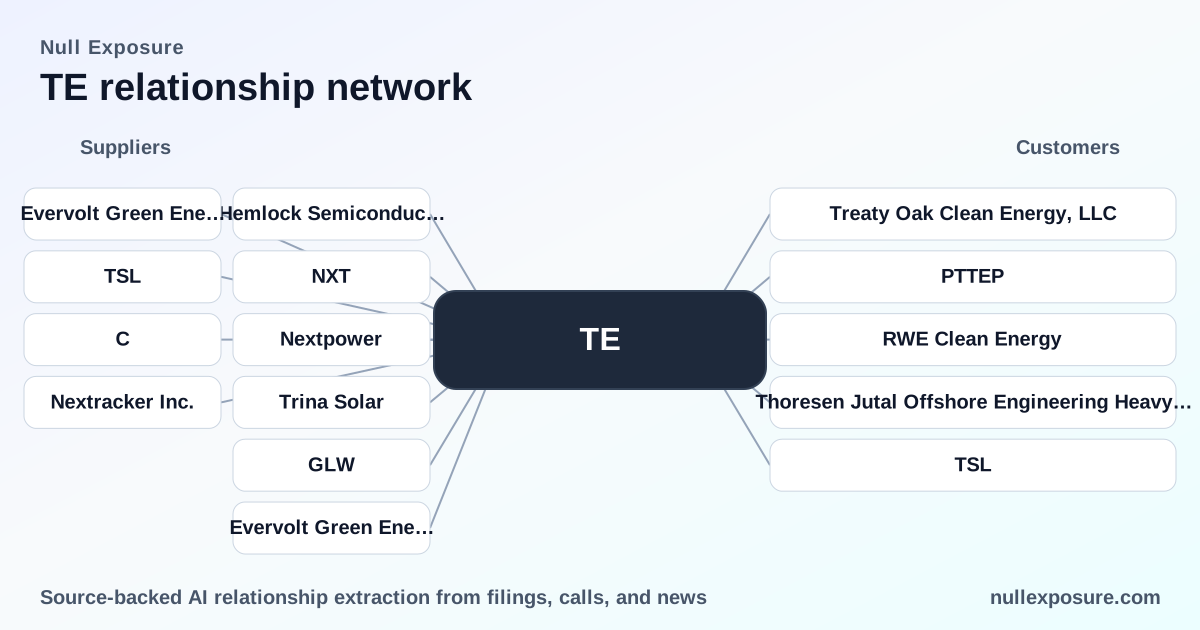
T1 Energy: supplier map, contract posture, and what it means for investors
T1 Energy Inc. builds and monetizes downstream battery and solar manufacturing by assembling a domestic supply chain of upstream inputs, licensing intellectual property, and extracting value from production tax credits and module sales. The company sells cells and modules, contracts to procure key materials (polysilicon, wafers, frames), and has used financial advisory services to monetize tax-credit assets — a hybrid industrial operator that is increasingly positioning its procurement and IP arrangements to qualify for U.S.-centric incentives. That combination of manufacturing revenue plus tax-credit monetization defines the current investment lens on T1.
For a quick read on supplier exposure and related counterparty signals, visit https://nullexposure.com/ for our full supplier intelligence coverage.
Why the supplier map matters for valuation and risk
T1’s announced supplier relationships are not peripheral procurement notes: they are operational levers that determine eligibility for U.S. tax credits, manufacturing continuity, and the robustness of its onshore strategy. Contracts with domestic polysilicon, wafer, and frame providers materially increase the company’s pathway to credit eligibility and reduce reliance on foreign inputs. At the same time, licensing and legacy debt relationships create governance and counterparty complexity that investors must track.
Below I walk through each named relationship found in public releases and market coverage, followed by an investor-focused synthesis of contracting posture, concentration, criticality, and maturity.
Supplier and partner roll call — what the filings and press releases say
-
Hemlock Semiconductor — T1 has contracted to purchase American-produced polysilicon and cites domestic polysilicon as a competitive differentiator in public statements. This is a direct upstream supply relationship for a core raw material that supports T1’s credit-eligibility narrative. Source: GlobeNewswire press release (Dec 30, 2025) and follow-up release (Feb 17, 2026).
-
Corning (NYSE: GLW) — T1 has contracted to purchase domestic wafers from Corning as part of its onshoring efforts, which the company cites as supporting material assistance compliance. Source: GlobeNewswire update on FEOC compliance (Dec 30, 2025) and GlobeNewswire summary (Feb 17, 2026).
-
Nextpower (NASDAQ: NXT) — T1 has contracted for domestic steel frames from Nextpower and identifies frames as part of its supply-chain reconfiguration to meet domestic-content tests. The relationship is disclosed in multiple company statements. Source: GlobeNewswire (Dec 30, 2025) and GlobeNewswire (Feb 17, 2026); EnergyDigital coverage (FY2025/FY2026).
-
Trina Solar (TSL) — Historically, T1 licensed certain patents and other intellectual property from Trina Solar; public disclosures note that T1 previously held licensing arrangements with Trina. Source: EnergyDigital/GlobeNewswire FEOC compliance update (Dec 30, 2025).
-
Evervolt Green Energy Holding Pte Ltd. — Trina Solar sold the licensed IP to Evervolt, and T1 now licenses that intellectual property from Evervolt, replacing the prior Trina arrangement. This is the current IP-licensing counterparty for technology that underpins parts of T1’s manufacturing. Source: GlobeNewswire (Dec 30, 2025) and EnergyDigital coverage (FY2025).
-
Citigroup Global Markets (C) — Citigroup Global Markets acted as financial advisor to T1 on the sale of Section 45X tax credits, signaling the use of investment-bank intermediation to monetize tax-advantaged assets rather than holding those credits on the balance sheet. Source: The Globe and Mail (press release coverage, FY2025).
-
Nextracker Inc. — Market commentary and research coverage referenced a multi-gigawatt module frame supply agreement between T1 and Nextracker that is expected to accelerate adoption of U.S.-made specialty steel frames over imported aluminum alternatives, supporting domestic demand trends. Source: Zacks Research as cited in market coverage (InsiderMonkey, FY2026).
What these relationships reveal about T1’s operating model
-
Contracting posture: T1 is executing written procurement agreements for primary upstream inputs (polysilicon, wafers, frames). The public language emphasizes contracted purchases as part of an intentional onshoring strategy to satisfy regulatory and incentive criteria. That indicates a proactive procurement posture aimed at securing compliance and continuity.
-
Concentration and criticality: The listed suppliers provide critical inputs — polysilicon, wafers, and frames — that cannot be easily substituted without operational disruption or loss of tax-credit eligibility. Supplier concentration is meaningful: a handful of specialized providers cover inputs central to manufacturing economics and policy compliance.
-
Maturity and integration: The mix of long-term supply contracts and IP licenses paired with the use of financial markets to monetize credits shows a company evolving from early-stage commercialization toward integrated manufacturing and financial optimization. Licensing transitions (Trina → Evervolt) show maturation of IP relationships and potential governance risk as counterparties change.
-
Company-level geographic signal: T1 explicitly states it is sourcing polysilicon from the United States, which is a deliberate move to anchor its supply chain domestically and support incentive qualification. This is a company-level operational signal that affects policy exposure, transportation cost, and supplier choice (company statement cited in constraints).
If you want a deeper supplier risk heat map, see our platform at https://nullexposure.com/ for structured counterparty scoring.
Investor takeaways and risk checklist
-
Policy-driven procurement is valuation-relevant. T1’s supplier agreements are materially tied to tax-credit eligibility and therefore directly affect margin and cash-flow prospects. Watch contract confirmations and delivery timelines closely.
-
Operational dependence on a small set of specialized suppliers creates substitution risk. Polysilicon, wafer, and frame suppliers are critical nodes; any production disruption or failure to meet domestic-content requirements would translate into lost credits and revenue impact.
-
IP and legacy financial linkages require continuous monitoring. The shift of licensed IP from Trina to Evervolt and the repayment of debt that impacts foreign-ownership thresholds are governance items investors should track through filings and press releases.
-
Financial engineering is in play. Use of Citigroup to sell Section 45X credits indicates T1 will utilize capital markets to realize tax-linked value rather than booking all benefits on balance sheet — an important factor for free-cash-flow modeling.
Bottom line and how to keep tracking
T1’s supplier relationships form a purposeful, policy-aware supply chain strategy: onshore critical inputs, secure long-form procurement contracts, and convert tax-oriented economic value through financial markets. That strategy reduces some geopolitical exposure while concentrating operational risk among a few specialized suppliers and IP counterparties. Investors should prioritize monitoring delivery confirmations, contract tenors, and any amendments that affect domestic-content tests.
For ongoing supplier monitoring and tailored counterparty intelligence, visit https://nullexposure.com/ — our platform aggregates these signals and tracks changes in real time.
If you want a concise supplier risk memo or a one-page counterparty scorecard for T1, request it via https://nullexposure.com/ and we will prepare a focused briefing.