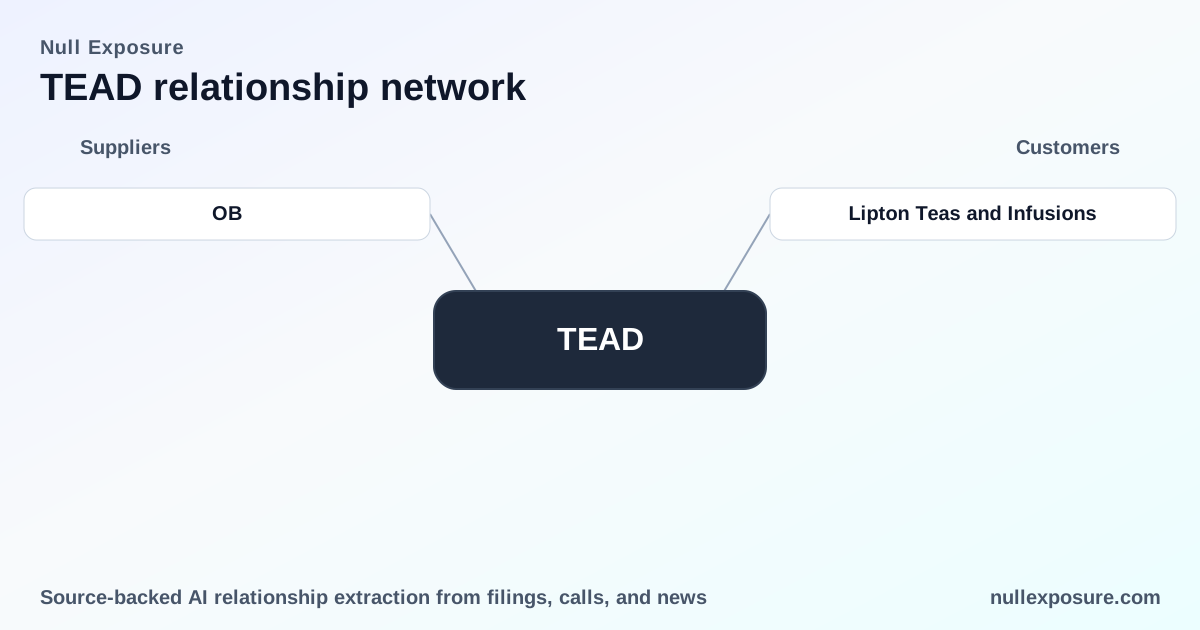
Teads (TEAD): Supplier Relationships, Contracting Posture, and What Investors Should Know
Teads operates a global advertising technology platform that connects media owners and advertisers and monetizes by brokering ad inventory and taking a revenue share on campaigns across web, mobile, and CTV. The business generates advertiser-sourced revenue (reported $1.300 billion TTM) while incurring traffic acquisition and partner share costs; the gap between gross revenues and partner payouts is the primary path to gross profit. For investors and operators evaluating TEAD as a supplier counterparty, the core commercial dynamics are clear: inventory dependence, long‑term contracting behavior with upfront economics, and bilateral roles as both buyer and seller of distribution. Learn more about supplier risk and exposure at https://nullexposure.com/.
How Teads monetizes and where supplier risk lives
Teads records revenue from advertisers and retains a share after paying media partners their agreed portion of ad proceeds. The company reported $1.300 billion in revenue TTM with EBITDA roughly $41.5 million and a negative net profit margin (-39.8%), indicating operating leverage is tight and supplier economics matter to near‑term profitability. Supplier relationships directly determine the available inventory pool, the effective cost of goods sold (through traffic acquisition costs), and the ability to scale higher‑margin programmatic and direct business. With a market capitalization of about $67.7 million and substantial insider ownership, supplier arrangements translate to balance‑sheet and cash‑flow sensitivity.
The single material relationship disclosed in open sources
Teads' public record in the provided results contains one corporate relationship of material consequence:
- Outbrain Inc. — A MarketTech APAC report dated March 10, 2026, documented that Outbrain completed a $900 million acquisition of Teads, creating a combined omnichannel outcomes platform that will operate under the Teads brand and leverage Outbrain’s predictive technology and AI to deliver results across CTV, mobile, and web (source: MarketTech APAC, March 10, 2026, https://marketech-apac.com/outbrain-completes-900m-acquisition-of-teads-creating-omnichannel-outcomes-platform/).
This transaction repositions Teads inside a larger combined company and establishes a new product posture where Teads’ supply relationships feed a broader Outbrain advertising engine.
What the acquisition means for supplier relationships
The Outbrain acquisition changes the counterparty map in two ways: first, Teads becomes part of a larger strategic buyer of media inventory and marketing technology; second, the integrated platform concentrates decision-making for inventory allocation and pricing. For counterparties, that increases the commercial scale of demand but compresses bargaining power for smaller media partners. The combined entity intends to push predictable outcomes across formats, which prioritizes inventory quality and measurement standards over simple volume buys (MarketTech APAC, March 2026).
Contracting posture and company-level constraints investors should factor
Teads’ filings and disclosure excerpts reveal consistent company-level characteristics that shape supplier risk and operational flexibility:
-
Long-term contracting with upfront economics: Company disclosures state that Teads sometimes makes upfront payments to media owners under long‑term contracts and capitalizes those advance payments when capitalization criteria are met. This indicates a contracting posture that trades short‑term cash for guaranteed inventory or pricing stability, which locks in future obligations on the balance sheet and creates fixed commitments to suppliers.
-
Material reliance on media partners: Filings explicitly note that the combined company relies on its media partners for a significant portion of advertising inventory and the company’s ability to generate revenue. This is a concentration signal: inventory is not easily replaceable without revenue disruption.
-
Dual buyer and seller roles: Teads defines traffic acquisition costs (TAC) both as amounts owed to media partners for revenue generated on their properties and as amounts the company pays when users engage with promoted recommendations. That language confirms Teads operates simultaneously as a seller (monetizing publisher inventory) and as a buyer (paying for distribution and recommendations), creating complex cash‑flow dynamics across the supply chain.
These constraints collectively signal an operating model that is commercially mature on contract duration but strategically concentrated and operationally critical: long‑term supplier commitments, material dependence on partner inventory, and bilateral cash flows that require careful working capital and margin management.
Implications for investors and operators
-
Financial sensitivity. With thin EBITDA relative to revenue and negative net margins, supplier economics materially affect profitability. Upfront payments or higher TAC can erode gross margin quickly.
-
Counterparty concentration risk. The stated reliance on media partners creates downside if large partners alter commercial terms or if inventory quality requirements change due to the combined company’s product strategy.
-
Contract maturity and stability. Long‑term contracted inventory reduces short‑term inventory price volatility but transfers risk to the acquirer via capitalized advance payments—this is a tradeoff between predictability and balance‑sheet rigidity.
-
Operational complexity from dual roles. Acting both as a buyer and seller requires integrated settlement systems and careful TAC management to avoid negative cash conversion cycles.
Practical actions for investors and counterparties
-
For investors: stress‑test scenarios around TAC increases and partner renegotiation given Teads’ thin operating cushion; model the impact of a 5–10% TAC step‑up on EBITDA and free cash flow.
-
For media partners and buyers: negotiate clear escalation and measurement clauses in long‑term contracts to protect against unilateral reallocation of inventory under the combined Outbrain‑Teads strategy.
-
For operators inside the combined company: prioritize margin‑accretive inventory and tighten reconciliation processes across buyer/seller flows to reduce settlement leakage.
Middle resources and deeper coverage are available at https://nullexposure.com/ for teams building counterparty risk models.
Relationship-by-relationship close‑up
Outbrain Inc. — The March 10, 2026 MarketTech APAC report states Outbrain completed a $900 million acquisition of Teads and that the combined company will operate under the Teads name while deploying Outbrain’s predictive technology and AI to drive omnichannel outcomes across CTV, mobile, and web (MarketTech APAC, March 10, 2026, https://marketech-apac.com/outbrain-completes-900m-acquisition-of-teads-creating-omnichannel-outcomes-platform/). This transaction centralizes inventory allocation and product strategy across the combined platform.
Final takeaways and next steps
Teads’ supplier profile is defined by concentration, long‑term contractual commitments, and dual buyer/seller economics—factors that are collectively critical to near‑term profitability. The Outbrain acquisition elevates scale and product capability but also consolidates inventory control, which changes counterparty leverage and operational priorities. Investors should prioritize scenarios that stress advertising partner renegotiations and TAC pressure; counterparties should seek contractual clarity on inventory guarantees and measurement.
For comprehensive counterparty risk intelligence and to track updates on TEAD supplier relationships, visit https://nullexposure.com/. If you need a tailored supplier-risk brief for TEAD, see the research and tools available at https://nullexposure.com/.