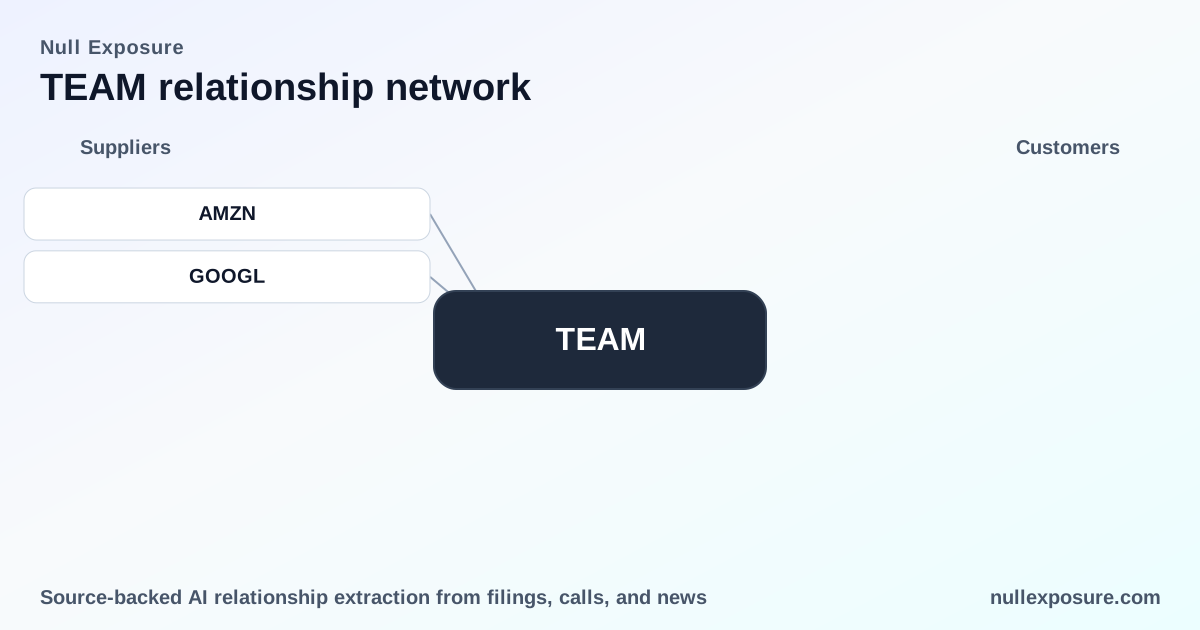
Atlassian (TEAM) — supplier relationships that shape cloud economics and operating risk
Atlassian monetizes collaboration software through a subscription-first model across cloud and self-managed deployments (Jira, Confluence, Trello, and adjacent enterprise products), supplemented by Marketplace revenue and enterprise services. The company drives predictable recurring revenue while outsourcing large portions of its infrastructure and delivery stack to third-party cloud providers, turning supplier arrangements into both commercial levers and operational risk points for investors. For a strategic lens on supplier exposures, start here: https://nullexposure.com/
Why supplier relationships matter to TEAM investors
Atlassian’s go-to-market is software-as-a-service at scale: that business model amplifies supplier effects. When hosting, AI compute, or distribution are controlled by external partners, those partners influence cost, product performance, and customer migration velocity. Investors should view supplier ties as extensions of Atlassian’s operating model — they are commercial catalysts when aligned and single points of failure when concentrated.
- Contracting posture: Atlassian contracts with third-party providers for hosting and cloud infrastructure, implying recurring commercial negotiations and potential price/term exposure.
- Concentration and criticality: Outsourced infrastructure is a high-criticality input because it affects uptime, data security, and product feature delivery.
- Maturity: Public disclosures and press around multiyear agreements indicate these are negotiated, durable partnerships rather than ad-hoc procurement.
For a deeper, actionable supplier risk profile, visit https://nullexposure.com/
The company-level constraint signal you need to know
Atlassian’s public filings disclose that the company relies on third-party service providers to host or otherwise process customer data and uses third-party managed hosting facilities to support its cloud infrastructure. Those excerpts frame the supplier posture: outsourcing is structural to the product delivery model, creating operational dependency on external infrastructure and managed services. This is a company-level signal rather than a comment on any single vendor.
Key business-model implication: reliance on managed hosting converts vendor relationships into strategic assets — they influence cost-per-seat economics, margin expansion, and the speed at which Atlassian can ship AI-enabled cloud features to enterprise customers.
Relationship snapshots — what the press is reporting
Below are concise takeaways for every supplier relationship cited in the collected results. Each entry ties the commercial move to investor-relevant outcomes.
AWS — marketplace expansion (Sahm Capital, Dec 2025)
Atlassian expanded its AWS Marketplace presence to accelerate Data Center-to-cloud migrations by pairing Atlassian’s AI-enabled tools with AWS procurement and integration advantages. According to a Sahm Capital analysis from December 2025, that step deepens commercial integration and could speed enterprise conversions to Atlassian’s cloud offerings. (Sahm Capital, Dec 13, 2025)
Google Cloud — expanded strategic partnership (Yahoo Finance, FY2025)
Atlassian announced an expanded strategic partnership with Google Cloud to combine its AI-powered teamwork platform with Google’s AI-optimized infrastructure, positioning Atlassian to leverage Google Cloud for performance and AI scaling. The news report (Yahoo Finance, reported in FY2025) frames the deal as another major hyperscaler alignment intended to broaden infrastructure options for customers. (Yahoo Finance, FY2025)
Amazon Web Services Inc. — multiyear collaboration for edge and generative AI (SiliconANGLE, Jan 30, 2025)
Atlassian and AWS signed a multiyear collaboration that provides customers access to edge cloud-enabled services, including generative AI, backed by security and compliance controls; the arrangement emphasizes joint product delivery and operational integration. SiliconANGLE’s January 30, 2025 coverage highlighted the collaboration as a strategic execution step to bring AI capabilities to Atlassian’s large enterprise base. (SiliconANGLE, Jan 30, 2025)
How these relationships interact with Atlassian’s financials and strategy
The hyperscaler ties are commercial and operational levers: they lower friction for enterprise procurement (marketplace listings), enable scale for AI workloads, and support global delivery. For investors, three points matter:
- Revenue acceleration vector: Marketplace placement and hyperscaler co-selling can accelerate migrations from self-managed Data Center to subscription cloud, supporting ARR expansion.
- Margin tension: Outsourced compute and managed services introduce variable cost that competes with software margin expansion; cost-of-cloud is a direct input to gross and operating margins.
- Operational risk: Dependence on external infrastructure increases exposure to price changes, outages, and regulatory demands around data residency and security.
Bottom line: the hyperscaler relationships are revenue enablers and cost drivers simultaneously; assess contracts, margin sensitivity, and customer migration metrics when modeling TEAM.
Practical investor checklist
When you evaluate Atlassian through the lens of supplier relationships, prioritize these items:
- Contract duration and termination terms with major cloud providers.
- Cost pass-through or fixed-price components that affect gross margin per customer.
- Evidence of co-selling or marketplace-driven ARR acceleration.
- Controls for data security and compliance embedded in supplier agreements.
If you want supplier-level detail and scenario modeling for Atlassian, see our analytic resources at https://nullexposure.com/
Final view and recommended next steps
Atlassian’s supplier relationships with AWS and Google Cloud are strategic — they enable AI delivery and enterprise migrations while creating concentrated exposure to cloud infrastructure economics. Investors should treat these relationships as core inputs to any valuation or risk model for TEAM: they directly affect growth pacing, margin profiles, and operational resilience.
To translate this into investment actions: review the company’s most recent filing for vendor concentration disclosures, quantify cloud cost sensitivity in your margin forecasts, and track marketplace and co-selling announcements quarter-over-quarter.
For deeper supplier-focused intelligence and scenario playbooks, explore our platform: https://nullexposure.com/