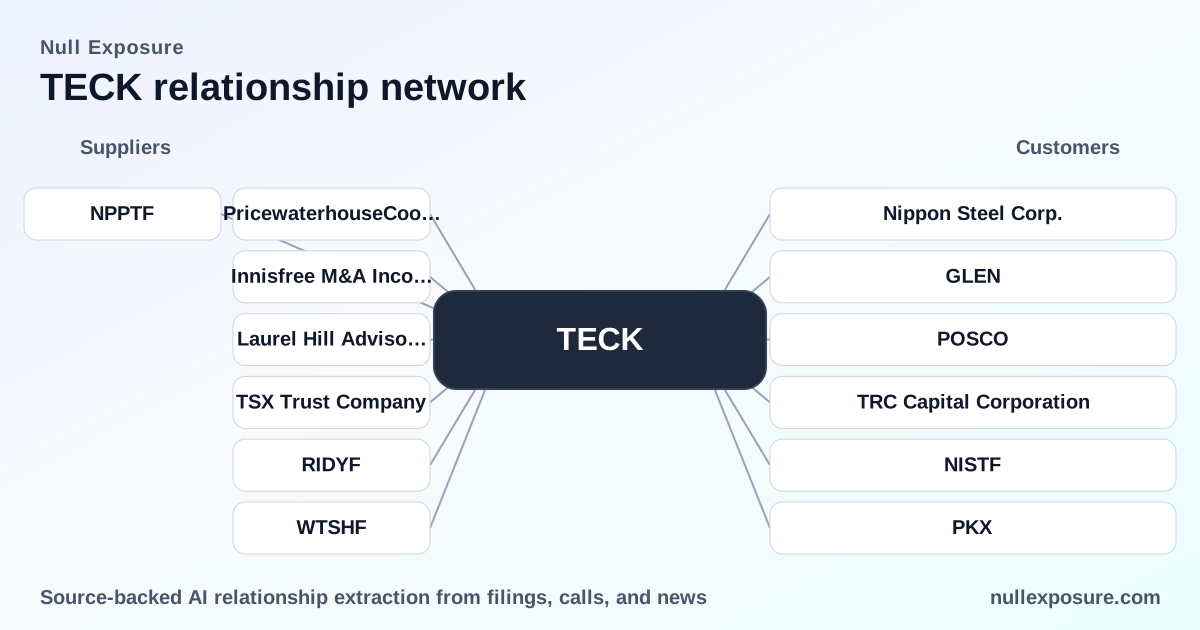
Teck Resources (TECK) — Supplier relationships that shape operational leverage and governance outcomes
Teck Resources monetizes through exploration, development and production of base and specialty metals and metallurgical coal, selling commodity volumes into global markets and capturing margin through scale and asset integration. Revenue flows come from commodity sales (coking coal, copper, zinc, etc.), while corporate service suppliers—auditors, transfer agents, proxy solicitors and port operators—enable capital transactions, shareholder votes and physical distribution. Investors should evaluate these supplier links for governance continuity, transaction execution risk and regional logistics concentration. For deeper supplier intelligence on TECK, visit https://nullexposure.com/.
Why suppliers matter for a mining operator’s value chain
Mining is capital- and logistics-intensive. Supplier relationships that look peripheral on the income statement are operationally critical: auditors validate financial statements used in capital markets, transfer agents execute corporate reorganizations, proxy solicitors drive shareholder outcomes on M&A, and port operators control export capacity for commodity sales. Those roles directly influence Teck’s ability to transact major corporate events and to monetize production abroad.
- Governance and capital markets exposure is elevated when active M&A or share structure changes are underway; specialized proxy and transfer agents become high-leverage suppliers.
- Logistics concentration across regional ports is an operational risk if volumes cluster on a few terminals.
- Service maturity matters: large, established providers (Big Four auditors, national transfer agents) reduce execution risk compared with ad hoc providers.
For ongoing monitoring and supplier risk scoring, see more at https://nullexposure.com/.
The supplier relationships we found — concise, source-backed summaries
Below are every supplier relationships surfaced in our review, each with a plain-English takeaway and source reference.
PricewaterhouseCoopers LLP
Teck’s shareholders re-appointed PricewaterhouseCoopers LLP as auditor, receiving 97.04% of votes at the annual meeting, signaling continuity in financial reporting oversight. According to Teck’s shareholder meeting results filed in 2023, PwC remains the external auditor for Teck (FY2023; Teck news release).
Innisfree M&A Incorporated
Innisfree is engaged as a proxy solicitation and shareholder information agent for Teck’s special meeting materials related to the proposed merger with Anglo American, with contact numbers provided for shareholders outside Canada (FY2025 filings announced in November 2025 via press release). The engagements show Teck is using established proxy advisors for a high-stakes corporate vote (GlobeNewswire, Nov 2025).
Laurel Hill Advisory Group
Laurel Hill is acting as Teck’s Canadian-based proxy solicitation agent, providing voting assistance and contact channels for Canadian shareholders during the merger approval process (FY2025 communications, GlobeNewswire, Nov 2025). This indicates Teck is mobilizing domestic investor outreach alongside international solicitation.
TSX Trust Company
TSX Trust Company served as Teck’s registrar and transfer agent in the Class A to Class B share conversion program following a court-approved plan, distributing Class B subordinate voting shares to Class A holders in mid‑May 2023 (reported in InvestingNews coverage of Teck’s plan of arrangement, FY2023). The transfer agent role is central to executing structural share conversions.
Ridley (RIDYF)
Ridley is one of the B.C. west coast ports used to export Teck’s metallurgical coal production, confirming Ridley’s role in the physical logistics chain for coal shipments (resource-world reporting on the asset sale and regional port use, FY2024). Port capacity and scheduling at Ridley materially affect export timing.
Westshore Terminals (WTSHF)
Westshore Terminals is listed among the three key terminals (Ridley, Neptune and Westshore) that handle Teck’s coal exports, underscoring Westshore’s significance to outbound logistics from British Columbia (resource-world, FY2024). Terminal throughput at Westshore impacts Teck’s delivery certainty to customers.
Neptune (NPPTF)
Neptune is identified as another critical west coast export terminal used for coal shipments, indicating that Teck’s export flows are distributed across Neptune as well as Ridley and Westshore (resource-world, FY2024). Neptune’s operational availability contributes to Teck’s shipping resilience.
What these relationships imply about Teck’s operating model and supplier posture
No explicit contractual constraints were identified in the available supplier relationship signals, so company-level inferences are necessary. Teck exhibits a contracting posture that favors established, high‑maturity service providers (Big Four auditor, national transfer agent, and prominent proxy solicitors), reducing counterpart execution risk for corporate governance and financing events. The presence of three distinct west-coast terminals indicates some logistical diversification but geographical concentration in B.C., which creates exposure to regional port disruptions.
Key operational characteristics:
- Concentration: Export logistics are regionally concentrated in British Columbia ports; this concentrates geopolitical and weather-related operational risk even though three terminals are used.
- Criticality: Audit and transfer-agent relationships are critical for capital markets credibility and the execution of mergers, share conversions and dividend/record-date actions.
- Maturity: Suppliers are mature, established firms, which lowers counterparty execution risk for governance and capital transactions.
- Contracting posture: Teck uses specialist advisors for shareholder engagement, consistent with active corporate activity (merger of equals with Anglo American), implying high reliance on external expertise during major transactions.
For a focused view on supplier counterparty risk and governance wiring, explore our platform at https://nullexposure.com/.
Investment implications and next steps for investors
Bottom line: Teck’s supplier set is weighted toward mature, governance‑critical partners and regionally concentrated logistics providers. For investors, that implies reduced execution risk on reporting and shareholder processing but continued operational exposure to B.C. port capacity and regional disruptions. The active engagement of proxy solicitors and a transfer agent signals major corporate events that will materially influence valuation and shareholder returns.
Recommended investor actions:
- Monitor port throughput and regional infrastructure news for Ridley, Westshore and Neptune to anticipate export bottlenecks.
- Track proxy statements and solicitation materials from Innisfree and Laurel Hill for shareholder vote outcomes tied to the Anglo American merger.
- Confirm auditor continuity and any audit committee disclosures around PwC for potential governance issues.
To get supplier-centric risk intelligence that ties these signals to financial impact, visit https://nullexposure.com/ and request a tailored supplier risk briefing.
Bold suppliers, clear implications: Teck’s operational success depends as much on port throughput and proxy execution as it does on commodity prices. Investors should therefore treat supplier relationships as part of the company’s material risk and governance profile.