TE Connectivity (TEL): How its capital partners shape liquidity, suppliers, and investor risk
TE Connectivity designs and manufactures connectors and sensors across automotive, industrial, aerospace, medical and data-communications markets, monetizing through product sales, aftermarket services and long-term OEM contracts. The company funds that manufacturing and working capital profile with a mix of bank facilities and bond issuance, giving investors visibility into liquidity flexibility and suppliers a clear pathway to financing receivables. TE is large (Revenue TTM $18.1B; Market Cap ~$59.7B) with investment-grade-style access to banks and capital markets, which directly influences supplier payment dynamics and counterparty risk for operators and investors.
Explore integrated counterparty intelligence and supplier exposure tools at https://nullexposure.com/ for a deeper look.
Why these capital relationships matter to investors and supplier managers
The recent transactions establish two complementary liquidity channels for TE: a $3.0 billion five-year senior revolving credit facility that functions as a working-capital backstop, and a $750 million senior notes issuance that extends term funding from the capital markets. These moves reduce short-term refinancing pressure and demonstrate market appetite for TE paper and syndication. From a supplier perspective, the existence of a revolving facility and a supply-chain financing program gives suppliers optionality to accelerate cash flow without changing TE’s payment obligations.
Company-level disclosures also reveal that TE operates a supplier finance program where suppliers can request early payment through a financial institution and TE does not set the supplier-bank terms, and outstanding obligations under that program remain recorded in accounts payable. That is a signal of a supplier-friendly operating posture that offloads credit terms negotiation to banks while retaining the company's own payment schedule on the balance sheet (company disclosure, FY2026).
- Contracting posture: TE uses bank-administered credit lines and market debt rather than captive financing, which concentrates negotiation with a small set of tier-one banks.
- Concentration: A single administrative agent role and a handful of bookrunners concentrate execution risk but streamline access to large liquidity pools.
- Criticality: These relationships are critical for short-term liquidity and for preserving supplier confidence in on-time payment.
- Maturity: The revolver’s five-year tenor and the dated note issuance establish a clear medium-term funding runway that reduces immediate rollover exposure.
If you want a structured view of how these counterparties interact with supplier payments and balance-sheet exposure, visit https://nullexposure.com/ for provider-specific analysis.
Counterparty map: the FY2026 relationships every investor and operator should log
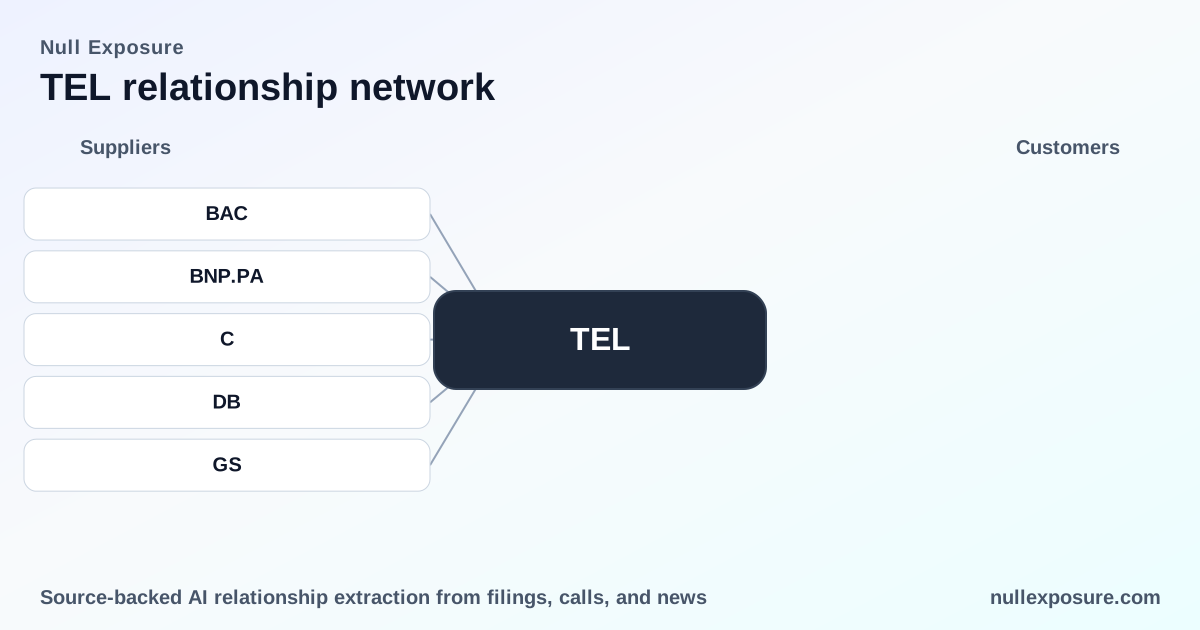
Bank of America — TE entered a $3.0 billion five-year senior revolving credit facility on February 13, 2026, with Bank of America acting as administrative agent for a syndicate of lenders, providing a committed working-capital backstop. Source: TradingView report citing the Feb 13, 2026 facility announcement (reported Mar 2026).
BNP Paribas Securities Corp. — BNP Paribas was named as a joint book-running manager on TE’s $750 million senior notes offering that was priced and expected to close on February 9, 2026, signaling BNP’s role in underwriting and distribution for TE’s debt. Source: PR Newswire announcement dated Jan 27, 2026.
Citigroup Global Markets Inc. — Citi served as a joint book-running manager on the $750 million senior notes, placing it among the lead syndicate that handled TE’s bond execution and investor distribution for the February 2026 offering. Source: PR Newswire announcement dated Jan 27, 2026.
Deutsche Bank Securities Inc. — Deutsche Bank participated as one of the joint book-running managers for the $750 million senior notes, giving TE access to Deutsche’s European and institutional investor networks for the deal that closed in February 2026. Source: PR Newswire announcement dated Jan 27, 2026.
Goldman Sachs & Co. LLC — Goldman Sachs was also a joint book-running manager on the $750 million senior notes, highlighting top-tier bulge bracket support for TE’s debt issuance and broad underwriting coverage. Source: PR Newswire announcement dated Jan 27, 2026.
What these relationships imply for supplier dynamics and investor risk
The combination of a syndicated revolver and a marketed bond demonstrates disciplined treasury execution: the revolver is a liquidity floor for working capital, while the notes provide term diversification away from bank-only funding. For suppliers, TE’s disclosed supplier finance program is significant: it permits suppliers to accelerate cash conversion through third-party financing, but that financing is governed by supplier-bank agreements independent of TE’s payment schedule. According to TE’s disclosure, the company does not post collateral with the financing bank and supplier decisions to finance do not change TE’s obligations (company disclosure, FY2026).
From an investor’s perspective, key implications:
- Liquidity and refinancing risk are materially mitigated by the $3 billion revolver and successful access to the bond market, reducing the probability of forced supplier payment deferrals.
- Counterparty quality is high: Bank of America and the listed bookrunners are top-tier institutions, which reduces execution risk for syndication and distribution.
- Operational leverage to suppliers is mixed: TE’s practice of keeping outstanding supply-chain financing on its balance sheet (accounts payable) preserves transparency on cash obligations but also indicates that supplier financing choices can affect reported payables timing and working-capital metrics.
For treasury and procurement teams, the architecture is straightforward: TE retains payment timing control; banks provide optional early payment for suppliers under separate terms. That structure preserves supplier liquidity without transferring credit negotiation into the company’s core operations.
If you evaluate counterparty concentration, supplier finance exposure, or operational criticality in your model, detailed counterparty profiles are available at https://nullexposure.com/.
Practical checklist for investors and procurement operators
- Confirm the revolver commitment and covenant package to assess headroom under stress scenarios. The administrative agent role implies contractual centralization—understand what events accelerate or restrict access.
- Model the impact of the supplier finance program on accounts payable and days payable outstanding, since outstanding financed payables remain on TE’s balance sheet per company disclosure.
- Monitor bookrunner activity as a forward indicator of capital-market access; repeated use of the same banks signals relationship depth and lower marginal cost of issuance.
- Stress-test scenarios where the revolver is drawn and notes are outstanding to quantify interest and covenant sensitivity.
Bottom line
TE Connectivity’s FY2026 financing transactions — a $3.0 billion five-year revolver (Bank of America as administrative agent) and a $750 million senior note issuance (BNP Paribas, Citigroup, Deutsche Bank, Goldman Sachs as bookrunners) — materially strengthen the company’s liquidity profile and provide suppliers optional early-payment channels via third-party banks. Company disclosures make clear that supplier-finance arrangements are external to TE’s negotiation of supplier terms and that outstanding amounts are reported in accounts payable, which has direct implications for working-capital analytics and supplier cashflow planning.
For a downloadable, stakeholder-focused breakdown of TE’s counterparty exposure and supplier finance architecture, visit https://nullexposure.com/ and see the supplier relationships toolkit.