Tela Bio: supplier map and what it means for investors
Tela Bio designs and commercializes tissue reinforcement materials (branded OviTex) and monetizes via product sales and revenue-sharing contracts tied to third‑party manufacturing and IP licenses. The company sells medical devices through a specialty salesforce and augments its go‑to‑market with distribution and licensing partners, while financing operations with a mix of equity raises and credit facilities. For investors and operators, the key risk levers are manufacturing concentration, usage‑based supplier economics, and reliance on external capital providers.
For a practical view of supplier exposures and contracting posture, visit NullExposure: https://nullexposure.com/.
How Tela's operating model allocates risk and margin
Tela's economics are anchored in two linked features: proprietary IP/license economics and an outsourced manufacturing model. The company holds exclusive commercial rights to OviTex products in major markets while Aroa operates as both licensor and exclusive contract manufacturer, and Tela pays Aroa on a revenue‑sharing / cost‑based formula. That structure creates low fixed capital for Tela, but high supplier concentration and a direct pass‑through to COGS, so margins and supply continuity depend on the Aroa relationship and its manufacturing footprint.
- Contracting posture: Tela uses long‑term licensing with revenue‑sharing and transfer‑cost pricing rather than vertical integration, indicating a strategic choice to preserve capital but accept counterparty concentration.
- Concentration and criticality: The relationship with Aroa is critical and exclusive, creating single‑source risk for finished‑product supply and regulatory continuity because manufacturing is anchored in Aroa’s New Zealand facility.
- Maturity and predictability: Long‑dated license terms extend to patent expiration with renewal options, providing predictability for the product portfolio but locking Tela into third‑party manufacturing economics.
These characteristics shape how to evaluate Tela as a supplier partner or as an investment: investors must price concentrated manufacturing risk and monitor capital markets access because Tela supplements operations with debt and equity raises. See more supplier risk intelligence at NullExposure: https://nullexposure.com/.
Capital and distribution counterparties you need on your radar
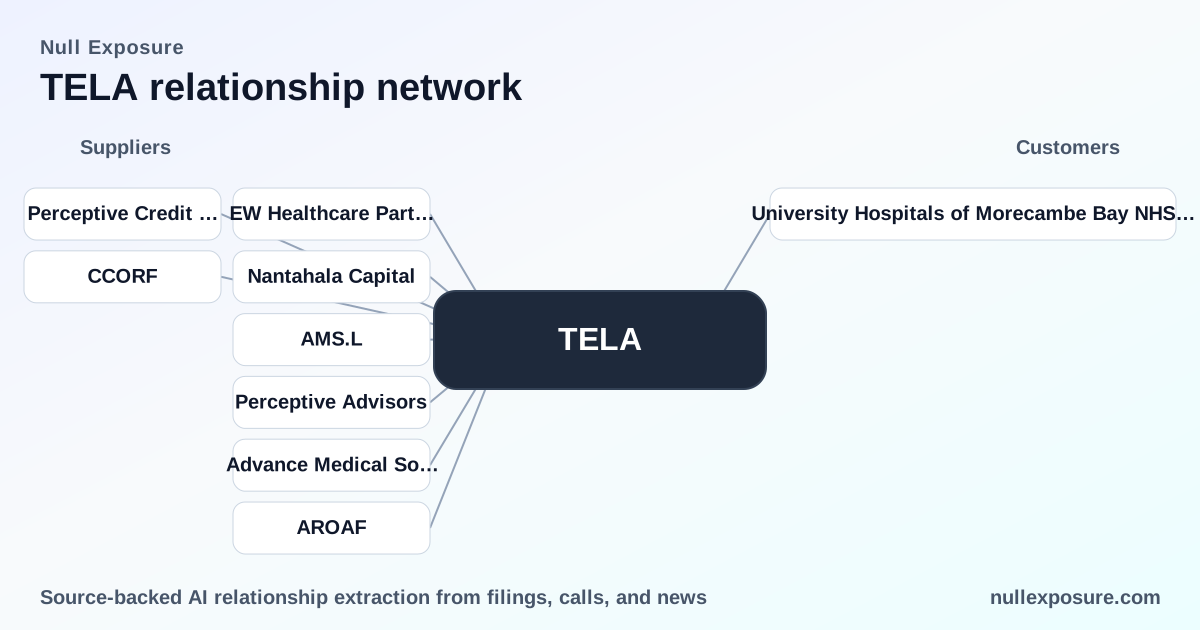
The public record shows distinct counterparties across capital markets, distribution/commercialization, and manufacturing. Below I cover each relationship found in regulatory and news sources and explain its role for Tela.
Aroa — exclusive manufacturer and licensor (critical)
Tela is highly dependent on Aroa, which is the exclusive manufacturer and supplier of OviTex and OviTex PRS; Tela pays Aroa under a revenue‑sharing arrangement as part of a long‑term license that includes exclusive IP rights in multiple markets and manufacturing at Aroa’s FDA‑registered facility in Auckland, New Zealand. According to Tela’s 2024 Form 10‑K, the Aroa Agreement includes a license through patent expiration (current last patent date March 9, 2031) and a payment structure equal to roughly 27% of net sales with specific true‑up mechanics. (Tela 2024 10‑K)
Perceptive Advisors / Perceptive Credit Holdings V, LP — credit provider
Tela closed a credit facility for up to $70 million with Perceptive Advisors, and filings show a related Credit Agreement and Guaranty with Perceptive Credit Holdings V, LP, indicating that Perceptive is the primary credit counterparty supporting liquidity and refinancing actions in late 2025. (GlobeNewswire, Nov 13, 2025; MarketScreener, Nov 14, 2025)
Nantahala Capital and EW Healthcare Partners — backers in an equity offering
Nantahala Capital and EW Healthcare Partners led a registered direct offering that raised $13 million in common stock and pre‑funded warrants, making them material equity placement participants that provided near‑term dilutive capital to sustain operations. (QuiverQuant, March 10, 2026)
Canaccord Genuity — placement agent / bookrunner
Canaccord Genuity acted as the sole bookrunner on the $13 million registered direct offering, serving as Tela’s underwriting and placement agent for that equity raise and influencing transaction pricing and distribution. (QuiverQuant, March 10, 2026)
Advanced Medical Solutions / Advance Medical Solutions Limited — U.S. commercialization partner
Tela entered into an agreement with Advanced Medical Solutions (AMS) to commercialize the LIQUIFIX fixation products in the U.S., leveraging AMS’s specialty hernia repair salesforce and focus on new technologies; Tela cites this alignment as a strategic commercialization partnership supporting product adoption. (Yahoo Finance, FY2024 announcement; InsiderMonkey Q3 2025 transcript)
Perceptive Advisors (again) — investor and potential lead creditor
Beyond the $70 million facility, Perceptive is referenced in public filings and vendor notices as a consequential investor/credit counterparty that underwrites leverage and liquidity, underscoring the firm’s dual role as lender and financial sponsor in Tela’s capital structure. (GlobeNewswire, Nov 13, 2025)
What the contracts tell investors about risk and optionality
Tela’s documented constraints are informative and consistent: the Aroa License is long‑term, includes licensing rights, exposes Tela to usage‑based cost mechanics, and centralizes manufacturing in APAC (Auckland, New Zealand). Those contract features produce a predictable royalty‑style cost base tied to sales volumes, but create single‑point supply risk that is material and company‑level critical. (Tela 2024 Form 10‑K; internal excerpts)
- Long‑term licensing provides product exclusivity and protects market position through patent coverage and renewal options, which is a strategic asset for revenue durability.
- Usage‑based/percentage‑of‑sales costing aligns supplier incentives with growth but compresses leverage in high‑volume scenarios and constrains gross margin expansion.
- APAC manufacturing concentration creates geopolitical, logistics, and regulatory continuity exposures that require mitigation planning (dual sourcing or inventory buffers) from management.
Calls to action for investors and operators
- If you are modeling Tela’s downside scenarios, stress‑test revenue growth against supplier disruption and the 27% net‑sales cost mechanics in your margin forecast; for supplier intelligence tools visit NullExposure: https://nullexposure.com/.
- For diligence teams assessing counterparty concentration, prioritize contract expiration clauses, transfer‑pricing true‑ups, and manufacturing contingency plans documented in the Aroa agreement; further supplier mapping is available at NullExposure: https://nullexposure.com/.
Final read: positioning Tela for investors
Tela’s structure is clear: commercial IP and product sales externally manufactured under an exclusive license, financed through a mix of equity placements and credit facilities. The combination yields upside through product adoption but creates a concentration‑driven downside tied to Aroa and to capital markets access. Investors should treat the Aroa relationship as the primary operational risk, and view Perceptive, Nantahala, EW Healthcare, and Canaccord as the principal financial counterparties that shape Tela’s near‑term liquidity and market access. Monitoring contract extensions, manufacturing qualification, and the cadence of capital raises is essential to convert Tela’s product promise into durable investor returns.