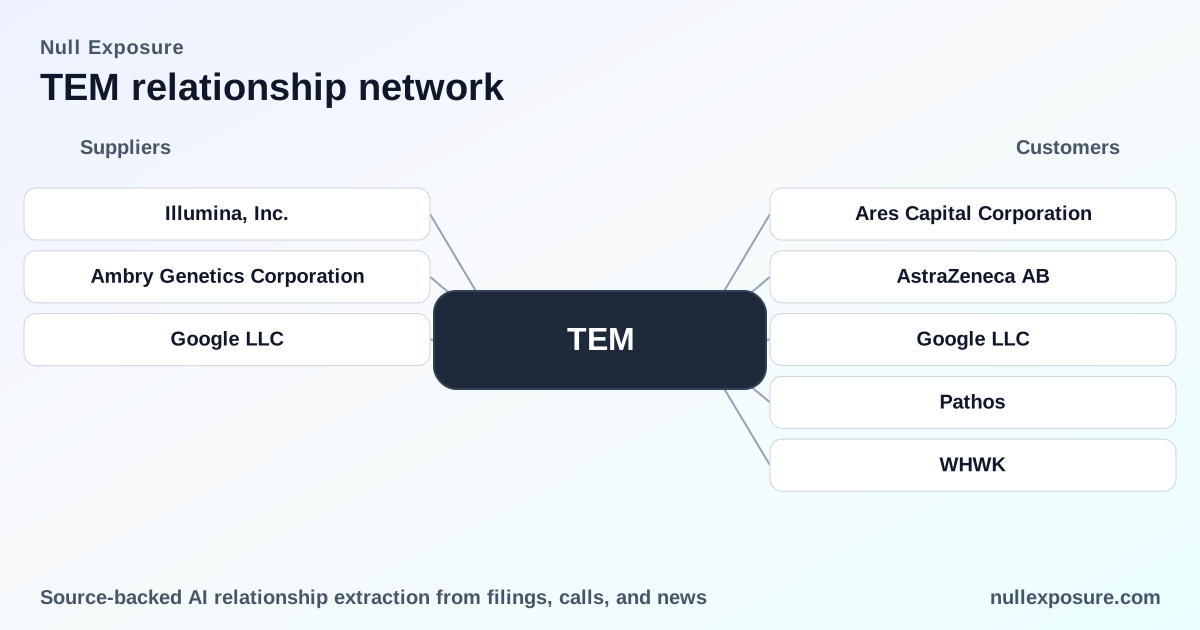
Tempus AI (TEM) — Supplier map, concentration risk, and operational levers investors should price
Tempus is a data-and-lab healthcare company that monetizes by selling next‑generation sequencing (NGS) and clinical tests, licensing analytics and real‑world evidence to biopharma, and providing clinical‑trial matching and data services to hospitals and life‑science customers. The firm generates revenue from testing and software/services with scale in oncology; revenue TTM was roughly $1.27 billion against a negative EBITDA, while market value sits near $9.1 billion—a profile that rewards growth and network effects but penalizes operational fragility. For investors evaluating TEM as a supplier to healthcare ecosystems or as a buyer of lab technologies, the supplier map directly drives both single‑point failure risk and service continuity economics. For a broader supplier risk view, visit https://nullexposure.com/.
Why suppliers matter for Tempus: concentrated inputs and regulated outputs
Tempus operates as a regulated service provider to hospitals, oncologists and biopharma, which sets its contracting posture and risk profile. The company describes itself as a direct service provider with approximately 700 direct data connections across ~3,000 hospitals, handling clinical and sequencing workflows either as a covered entity or a business associate; that establishes sticky B2B relationships and high compliance requirements for data governance and uptime (Tempus FY2024 10‑K). The firm also reports connection to more than 50% of U.S. oncologists, a distribution advantage that supports recurring demand for its testing and analytics.
At the same time, Tempus discloses reliance on a limited number of suppliers or sole suppliers for certain laboratory instruments, reagents and consumables, which creates critical single‑vendor exposure in its lab operations (FY2024 Form 10‑K). Those two dynamics—high commercial concentration and supplier concentration—are the central tradeoff for investors: networked demand and pricing power versus operational vulnerability if a key supplier is constrained.
The supplier list you need on your checklist
Below are the supplier relationships that the company discloses in public filings, with plain‑English takeaways and source references.
Illumina, Inc.
Illumina is described as Tempus’s primary supplier of sequencers and laboratory reagents, and Tempus identifies Illumina as the sole supplier of its sequencers and the sole provider of maintenance and repair services for those sequencers; Tempus also purchases other lab supplies from Roche, Integrated DNA Technologies and PerkinElmer (Tempus FY2024 Form 10‑K). This relationship constitutes a material operational dependency because sequencers are central to Tempus’s core testing throughput.
Source: Tempus FY2024 Form 10‑K (filed for fiscal year 2024), supplier disclosures and the June 29, 2021 supply agreement referenced in that filing.
Ambry Genetics Corporation
Tempus acquired Ambry Genetics in February 2025, integrating a provider of hereditary cancer screening and the supplier of Tempus’s germline sequencing product (Tempus|xG). The acquisition reduces external supplier exposure for germline tests and brings that capability in‑house.
Source: Tempus FY2024 10‑K disclosure noting the Ambry acquisition and its role as the supplier of germline sequencing (acquisition dated February 2025 in the company filing).
Google LLC
Tempus issued Google a convertible promissory note on June 22, 2020 in connection with an agreement to use Google Cloud Platform; the note reflects a capital/partner relationship tied to cloud services rather than laboratory inputs. The arrangement signals a strategic cloud dependency and an investor/partner dynamic with a major hyperscaler.
Source: Tempus FY2024 Form 10‑K referencing the June 22, 2020 convertible promissory note tied to Google Cloud Platform use.
(Each relationship above comes directly from Tempus’s FY2024 Form 10‑K filing and associated disclosures.)
For an interactive map of supplier concentration and criticality, see https://nullexposure.com/.
Investment implications: concentration, dependency, and optionality
- Concentration risk is real and quantifiable. Illumina’s role as the sole sequencer supplier and service provider for those instruments represents a single point of failure for lab throughput and maintenance. Operational disruption at Illumina or contractual friction could materially constrain Tempus’s testing capacity and revenues.
- Acquisition strategy reduces some supplier risk. Bringing Ambry in‑house for germline sequencing is a deliberate de‑risking step that converts a supplier relationship into an owned capability, improving control over marginal cost and continuity for hereditary‑cancer testing lines.
- Cloud/partner capital relationships influence execution rather than core lab input costs. The Google convertible note evidences an embedded cloud partnership that underpins data services and analytics delivery, with implications for OpEx and strategic alignment rather than reagent flow.
- Contracting posture increases switching costs and creates recurring revenue potential. As a covered entity/business associate with direct hospital integrations and a large oncologist footprint, Tempus enjoys sticky demand that underpins long‑term revenue growth—but that same posture mandates high compliance and operational uptime.
Tempus’s financials amplify these operational themes: Revenue TTM of $1.27B and gross profit of roughly $798M sit against negative EBITDA (~–$150M) and negative net margins, and valuation metrics (Price/Sales ~7.15; Price/Book ~18.5) price sustained growth and execution rather than near‑term profitability. Investors should balance network effects and client stickiness against supplier concentration and execution risk.
What to watch next — practical triggers for investors and operators
- Supplier contracts and service agreements with Illumina: look for renewal terms, exclusivity clauses, and service‑level commitments in future filings. A change here materially affects capacity risk.
- Integration progress and cost synergies from the Ambry acquisition: monitor how quickly Tempus transitions germline workflows into its labs and whether that reduces per‑test cost and vendor spend.
- Cloud and strategic partner terms with Google or alternative hyperscalers: watch for changes in cloud spend, vendor discounts, or equity conversions related to the 2020 note that could affect OpEx and strategic flexibility.
- Operational continuity metrics: lab throughput, instrument uptime, and reagent inventories are the proximate indicators of supplier stress.
Key operational mitigants are already visible: Tempus lists additional suppliers for laboratory supplies (Roche, Integrated DNA Technologies, PerkinElmer) which diversify non‑sequencer inputs, and the Ambry buy brings a once‑external capability inside the company. Still, sequencer dependence remains the principal supplier vulnerability to price into valuation.
If you want a deeper supplier‑and‑risk map tailored to trading or underwriting decisions, start here: https://nullexposure.com/.
Bottom line for investors
Tempus combines valuable clinical reach and data‑service scale with material supplier concentration risk that is concentrated in sequencing hardware and maintenance. Strategic moves—particularly the Ambry acquisition—reduce parts of that dependence, while cloud partnerships like the Google note support the analytics side of the business. The stock valuation reflects a premium for growth and network effects; investors should underwrite that premium against the firm’s ability to preserve lab throughput and supplier continuity under stress. For tools and supplier intelligence for due diligence and counterparty monitoring, visit https://nullexposure.com/.