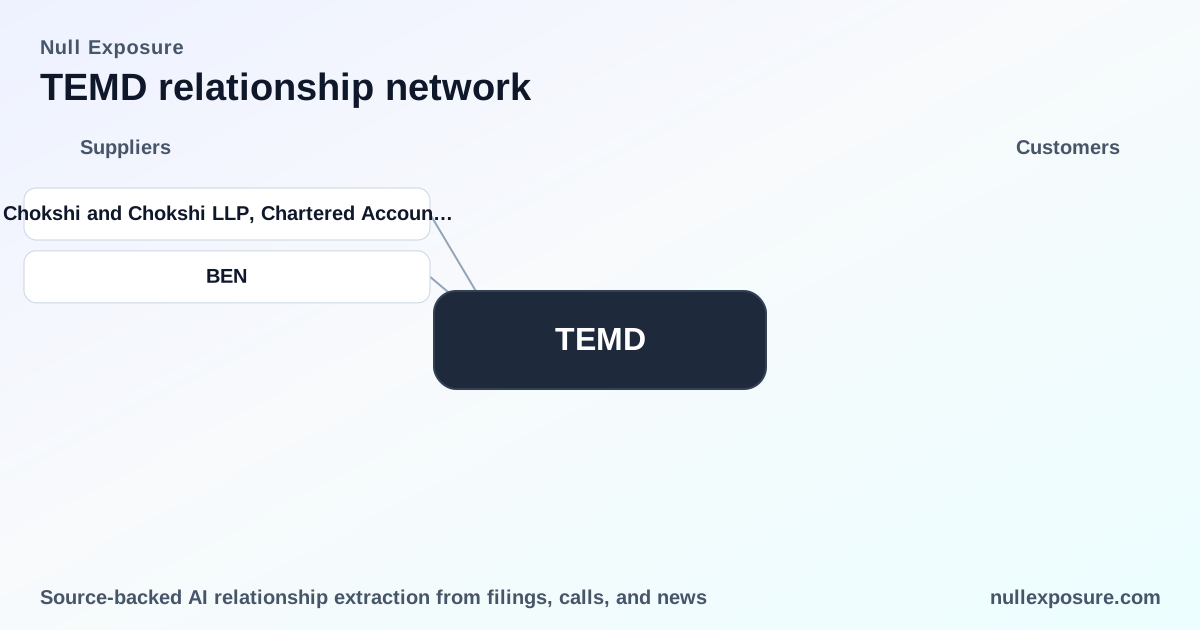
TEMD as a Supplier: How the Templeton Emerging Markets Debt ETF Fits Into Counterparty Risk and Operational Footprints
Thesis: TEMD is an exchange-traded fund product launched by Franklin Templeton that generates revenue through management fees and distribution of emerging-market debt exposure to investors, while relying on Franklin Templeton’s institutional infrastructure (trading, custody, compliance) and third‑party service providers for day‑to‑day operations. For investors and counterparties evaluating TEMD relationships, the core commercial reality is simple: the product’s credit and operational profile tracks its issuer and their service chain, not a standalone corporate balance sheet — so diligence must focus on issuer strength, regulatory context, and supplier ties. Learn more at https://nullexposure.com/.
What TEMD is, and how it monetizes value
TEMD is the Templeton Emerging Markets Debt ETF, introduced by Franklin Templeton as a vehicle to give investors liquid access to emerging‑market sovereign and quasi‑sovereign debt strategies. The fund monetizes through an expense ratio charged to shareholders and the efficient aggregation of investor capital, which drives management fees for Franklin Templeton and creates distribution economics across broker/dealer networks. According to a market brief, Franklin Templeton introduced the Templeton Emerging Markets Debt ETF (TEMD) on January 22 (Ad‑Hoc‑News, March 2026: https://www.ad-hoc-news.de/boerse/ueberblick/franklin-templeton-shares-hold-steady-ahead-of-earnings-report/68513374).
TEMD’s economics are product economics, not corporate: revenue accrues to the asset manager; counterparty exposure is concentrated in the issuer and its service providers (custodian, transfer agent, authorized participants). For a practical investor checklist and supplier mapping, visit https://nullexposure.com/.
Two named relationships you must account for
Below are every relationship surfaced in the available results, each boiled down to what matters for counterparties.
-
Franklin Templeton
Franklin Templeton is the issuer and sponsor of TEMD and executed the product launch on January 22; investors should treat Franklin Templeton’s governance, distribution channels, and balance‑sheet support as the primary supplier relationship for TEMD (Ad‑Hoc‑News, March 2026: https://www.ad-hoc-news.de/boerse/ueberblick/franklin-templeton-shares-hold-steady-ahead-of-earnings-report/68513374). -
Chokshi and Chokshi LLP, Chartered Accountants
The Securities and Exchange Board of India ordered a forensic audit (FY2021) and appointed Chokshi and Chokshi LLP to audit Franklin Templeton’s Indian mutual fund operations in connection with six debt schemes; this appointment signals regulatory scrutiny and forensic review exposure within Franklin Templeton’s affiliate operations, a factor for investors assessing regional operational risk (Times of India, reported FY2021: https://timesofindia.indiatimes.com/business/india-business/sat-stays-sebi-order-on-franklin-templeton/articleshow/83932429.cms).
How these relationships change the operating model picture
TEMD’s supplier risk is defined by who delivers the product rather than by TEMD as an independent corporate actor. From the available relationships, the following company‑level signals define the operating model:
-
Contracting posture — issuer‑centric: TEMD contracts and operational authority flow through Franklin Templeton, so counterparties negotiate with the asset manager and not the ETF as a standalone contracting entity. This centralization concentrates legal and performance risk at the issuer level.
-
Concentration — high single‑issuer concentration: The fund’s supplier footprint is dominated by a single asset manager. That creates a dependency where any issuer‑level disruption propagates to TEMD investors and counterparties.
-
Criticality — product critical to distribution and fee generation: TEMD is a revenue‑generating product for Franklin Templeton and a distribution point for emerging‑market debt exposure; loss of access to the issuer or its service chain would materially impair the ETF’s operations and investor liquidity.
-
Maturity — product is newly launched: With a January product introduction, TEMD is in early operational maturity, which implies lower historical liquidity, limited track record, and reliance on Franklin Templeton’s execution capabilities to establish market depth.
Note: the dataset provided contains no separate constraints entries; those characteristics derive from relationship context and the product launch timing.
Risk implications for investors and operators
Regulatory and operational signals from the relationships translate into actionable risk considerations:
-
Regulatory risk: The forensic audit in India (Chokshi and Chokshi LLP appointed by SEBI, FY2021) signals that regulatory issues have affected Franklin Templeton affiliates; investors should treat regulatory remediation and oversight as a continuing governance factor (Times of India, FY2021).
-
Concentration and counterparty risk: Issuer concentration is the principal single point of failure — custodial arrangements, authorized participants, and trading counterparties are secondary but dependent on Franklin Templeton’s contracts and credit standing.
-
Execution and liquidity risk: A newly launched ETF requires ramping of authorized participants and market makers to deliver consistent liquidity; investors should monitor spreads, AUM progression, and primary market creation activity as leading indicators.
-
Reputational and operational spillovers: A forensic audit of affiliate operations raises the probability of operational improvements or remedial action that can change workflows, documentation, or reporting cadence, all of which matter to institutional counterparties.
Practical due diligence checklist for counterparties and operators
To convert these insights into operational action, prioritize the following steps:
- Confirm issuer contracts and counterparty lists: verify custodian, transfer agent, and authorized participants that service TEMD.
- Monitor regulatory filings and regional enforcement actions tied to Franklin Templeton affiliates, especially in jurisdictions with prior scrutiny.
- Track liquidity metrics (bid/ask spreads, creation/redemption activity) and AUM growth to assess market acceptance.
- Review fee schedule and structural documents (prospectus/SAI) for fee flows and revenue waterfall to understand monetization dependencies.
For a structured vendor‑risk view and ongoing monitoring tools, see https://nullexposure.com/ — the resource is useful for mapping issuer and supplier concentration.
Final takeaways and next steps
TEMD is a product-level exposure that derives its operational and counterparty risk from Franklin Templeton and the professional services an asset manager engages. The two named relationships in the record — Franklin Templeton as issuer and Chokshi and Chokshi LLP as a forensic auditor appointed by Indian regulators — underline two core themes: (1) issuer concentration dictates supplier risk; (2) regulatory scrutiny in affiliate jurisdictions is a live risk vector. Investors and operators should prioritize issuer‑level governance checks, monitor regulatory filings, and watch liquidity and fee dynamics as primary indicators of operational health.
If you are evaluating counterparty exposure or building a monitoring program for ETF suppliers, begin the process at https://nullexposure.com/ — the site consolidates issuer‑level relationship mapping and regulatory signal feeds that matter for product‑level diligence.
For portfolio teams and operations managers preparing contracts or custody arrangements, integrate the risk checklist above and reassess relationships if regulatory remediation activity becomes public; further guidance and tailored monitoring options are available at https://nullexposure.com/.