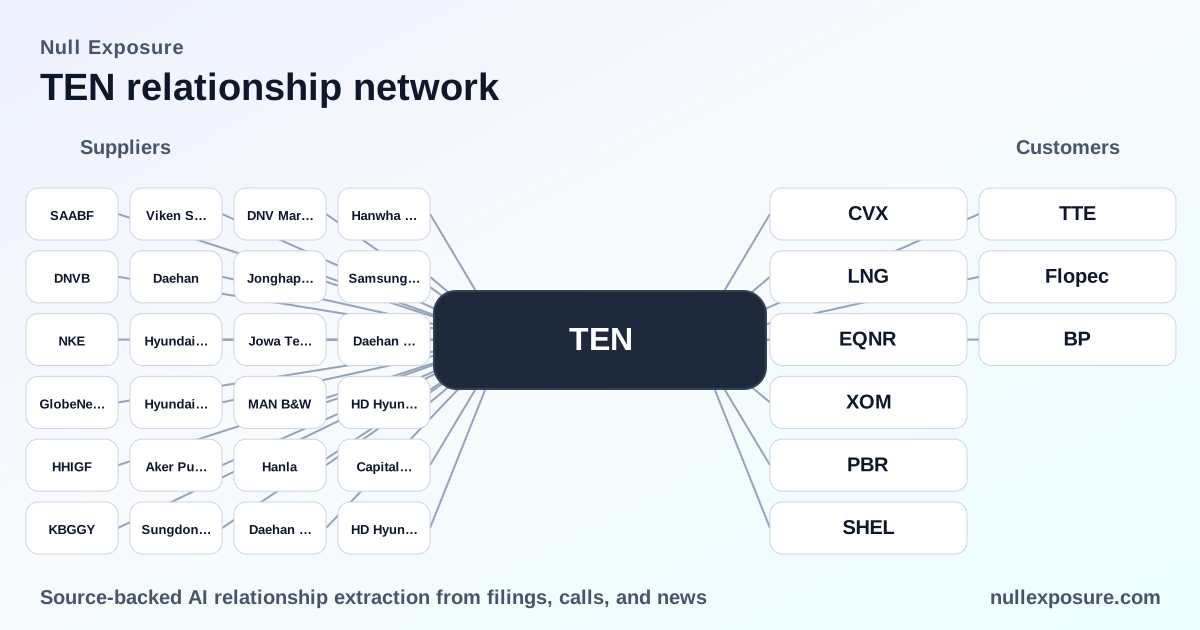
Tsakos Energy Navigation (TEN): supplier map and what it means for investors
Tsakos Energy Navigation (TEN) is a New York–listed, Greek shipowner that monetizes a diversified tanker fleet through long-term time charters, voyage contracts with oil majors, and selective asset renewal and sales; capital returns are visible via consistent dividends and preferred share distributions. This review isolates the company’s supplier relationships—shipyards, classification societies and equipment vendors—that drive TEN’s capital expenditure cycle and operational continuity, and highlights the strategic implications for investors. For a broader view of TEN’s counterparty network and risk signals, visit https://nullexposure.com/.
Why supplier relationships matter for a tanker operator
TEN’s business model is capital intensive and lifecycle-driven: newbuild orders, eco retrofits and classification surveys directly determine capacity, charter revenue and compliance with charterer requirements. The supplier universe for TEN is concentrated in South Korean shipyards and a handful of global classification and equipment vendors, which means shipyard performance and delivery schedules are critical to revenue visibility. The public signals captured do not include supplier-imposed contractual constraints at the document level; this absence itself is a company-level disclosure signal rather than a relationship-specific condition.
- Contracting posture: TEN uses a mix of firm newbuilds and options with leading yards, and secures long-term charters with oil majors that underpin investment economics.
- Concentration: Repeated engagement with Korean yards and established classification societies suggests a procurement pattern that favors scale and proven partners.
- Criticality and maturity: Relationships date back to 2014 and run through 2026, indicating mature, repeat engagements that support fleet renewal.
For more analysis of how counterparty networks affect equity and credit outcomes, see https://nullexposure.com/.
Relationship-by-relationship: concise investor notes
Below are each of the supplier relationships surfaced in public coverage, with a one-line investment-relevant summary and source.
-
Hanwha Ocean — TEN expanded its VLCC newbuilding programme at Hanwha Ocean, adding a firm vessel and securing an option for another, underscoring ongoing fleet expansion at that yard (Splash247, FY2025: https://splash247.com/tsakos-adds-to-vlcc-orderbook-at-hanwha-ocean/).
-
Samsung Heavy Industries — TEN recently took delivery of the Paris 24 from Samsung Heavy Industries, which immediately commenced a seven‑year charter with an oil major, evidencing Samsung’s role in delivering revenue‑accretive assets (Splash247, FY2025: https://splash247.com/tsakos-adds-to-vlcc-orderbook-at-hanwha-ocean/).
-
Daehan Shipbuilding Co. Ltd — TEN has contracted multiple DNV-classed shuttle tankers at Daehan, including early deliveries of newbuilds, highlighting a multi-year shipyard cooperation (VesselFinder, FY2022: https://www.vesselfinder.com/news/23989-Tsakos-Energy-Navigation-shuttle-tanker-PORTO-delivered-with-DNV-class).
-
HD Hyundai Ocean Services — Hyundai’s service arm is delivering an eco scrubber-fitted suezmax (Silia T) to TEN with a three-year charter to a US oil major, reflecting retrofit and environmental equipment coordination (Splash247, FY2025: https://splash247.com/tsakos-adds-to-vlcc-orderbook-at-hanwha-ocean/).
-
Capital Link, Inc. — Capital Link is the investor relations contact cited in TEN dividend and financial releases, serving as the company’s external communications and IR conduit (GlobeNewswire/press releases, FY2024–FY2026: https://www.globenewswire.com/ and https://finance.yahoo.com/news/ten-ltd-declares-dividend-series-210500003.html).
-
HD Hyundai Heavy Industries Co., Ltd. — Hyundai Heavy delivered eco‑friendly, scrubber-fitted suezmax tankers (e.g., Dr Irene Tsakos), indicating strategic newbuilds tied to environmental compliance (TEN press release via GlobeNewswire, FY2025: https://www.globenewswire.com/news-release/2025/06/12/3098721/0/en/TEN-Ltd-Announces-Delivery-of-Dr-Irene-Tsakos-an-Eco-Friendly-Suezmax-From-Hyundai-Heavy-South-Korea.html).
-
DNV Maritime / DNV — DNV supervised construction and classed several TEN newbuilds, confirming reliance on established third‑party classification for regulatory and commercial acceptance (VesselFinder/Marinelink, FY2014–FY2022: https://www.vesselfinder.com/news/23989-Tsakos-Energy-Navigation-shuttle-tanker-PORTO-delivered-with-DNV-class).
-
Jonghap Machinery — Listed as the provider of certain onboard utility systems (e.g., sewage plant) on TEN shuttle tankers, indicating reliance on specialized Korean equipment suppliers (Marinelink, FY2014: https://www.marinelink.com/news/shuttle-tanker-great362771).
-
Jowa Technology — Cited for diesel switching systems on specific shuttle tankers, representing part of TEN’s propulsion and fuel-system vendor base (Marinelink, FY2014: https://www.marinelink.com/news/shuttle-tanker-great362771).
-
MAN B&W — Identified as the supplier of main engines (6S70ME‑C8.2) for TEN vessels, signaling dependence on major marine engine OEMs for core propulsion assets (Marinelink, FY2014: https://www.marinelink.com/news/shuttle-tanker-great362771).
-
Hanla — Responsible for fire detection systems on at least one TEN shuttle tanker, showing vendor-level sourcing for safety-critical systems (Marinelink, FY2014: https://www.marinelink.com/news/shuttle-tanker-great362771).
-
Viken Shipping — TEN acquired second‑hand vessels from Viken Shipping (including a 2019-built scrubber-fitted aframax), demonstrating opportunistic fleet build via acquisitions as well as newbuilds (Splash247, FY2024: https://splash247.com/ten-continues-fleet-renewal-push-with-aframax-and-lng-carrier-sale/).
-
Daehan (repeat entries) — Beyond individual newbuilds, Daehan has supplied multiple aframax and LNG-capable vessels under multi-year engagements, reinforcing a strategic supply partner status (Splash247, FY2019–FY2021: https://splash247.com/daehan-secures-order-for-up-to-six-lng-fuelled-tankers-from-ten/ and https://splash247.com/tsakos-energy-navigation-seals-long-term-aframax-charter/).
-
Hyundai Heavy Industry — TEN has used Hyundai yards for LNG carrier construction and other large projects, further concentrating major newbuilding exposure in Korean heavy industry (Splash247, FY2019: https://splash247.com/tsakos-energy-navigation-seals-long-term-aframax-charter/).
-
Hyundai Samho — TEN ordered two 158,000 dwt suezmax tankers at Hyundai Samho, underscoring multiple Hyundai affiliates in the newbuild pipeline (Splash247, FY2019: https://splash247.com/tsakos-orders-suezmax-pair-at-hyundai-samho/).
-
Samsung Heavy Industries (repeat) — Linked to a nine‑ship shuttle tanker tender associated with Petrobras/Transpetro, illustrating Samsung’s role in larger tendered programs that support TEN’s chartering strategy (Splash247, FY2025: https://splash247.com/tsakos-readies-nine-shuttle-tankers-at-samsung-heavy/).
-
Aker Pusnes AS — Cited as supplier of bow loading systems for shuttle tankers, highlighting integration with contractors that provide specialized offshore transfer systems (Marinelink, FY2014: https://www.marinelink.com/news/shuttle-tanker-great362771).
-
Sungdong Shipbuilding & Marine Engineering — Designed vessels for TEN and has a long history of relationship with the company, reflecting engineering and design continuity in past projects (Marinelink, FY2014: https://www.marinelink.com/news/shuttle-tanker-great362771).
-
Saab — Provided cargo control systems on shuttle tankers, indicating TEN’s procurement of electronic cargo management from established marine technology suppliers (Marinelink, FY2014: https://www.marinelink.com/news/shuttle-tanker-great362771).
-
NK (Nippon Kaiji Kyokai / Class NK) — Supplied fire extinguishing systems and classification-related services cited on early shuttle tankers, another classification/vendor touchpoint (Marinelink, FY2014: https://www.marinelink.com/news/shuttle-tanker-great362771).
-
GlobeNewswire — Served as the distribution channel for TEN press releases and dividend announcements, used by TEN to publicize corporate actions to investors (GlobeNewswire press releases, FY2024: referenced in QuiverQuant summaries).
-
HHI (ticker HHI / Hyundai Heavy Industries Group) — Referenced for generator supply and heavy equipment, reinforcing the broader Hyundai group’s role in TEN newbuild and equipment sourcing (Marinelink, FY2014).
-
Kongsberg — Provided integrated bridge systems on TEN shuttle tankers, confirming procurement of turnkey navigation and automation systems from leading OEMs (Marinelink, FY2014: https://www.marinelink.com/news/shuttle-tanker-great362771).
Investment implications and risk posture
-
Fleet renewal is vendor‑dependent. TEN’s revenue profile is tied to timely deliveries from a concentrated set of South Korean yards and to classification approvals from DNV/NK; shipyard delays or capacity constraints would directly compress future charter revenue timelines.
-
Environmental retrofits and scrubber-fitted newbuilds are central to commercial acceptability. Multiple suppliers are noted for scrubber or LNG-capable builds; capital allocation evidence shows TEN investing for regulatory and charterer preferences.
-
Disclosure signal: no supplier-level contractual constraints are recorded in the captured public sources; this is a company-level signal about the public record rather than a supplier-specific condition.
For investors seeking deeper counterparty mapping or deal‑level verification, explore the full platform at https://nullexposure.com/.
Bottom line
TEN runs a highly active, shipyard‑centric procurement model with repeat engagements across major Korean yards and a stable set of equipment and classification providers — a structure that supports fleet modernization but concentrates delivery risk. Monitor shipyard delivery schedules, classification outcomes and TEN’s IR releases as primary leading indicators for earnings cadence and dividend sustainability. For a consolidated counterparty risk snapshot and ongoing monitoring, visit https://nullexposure.com/.