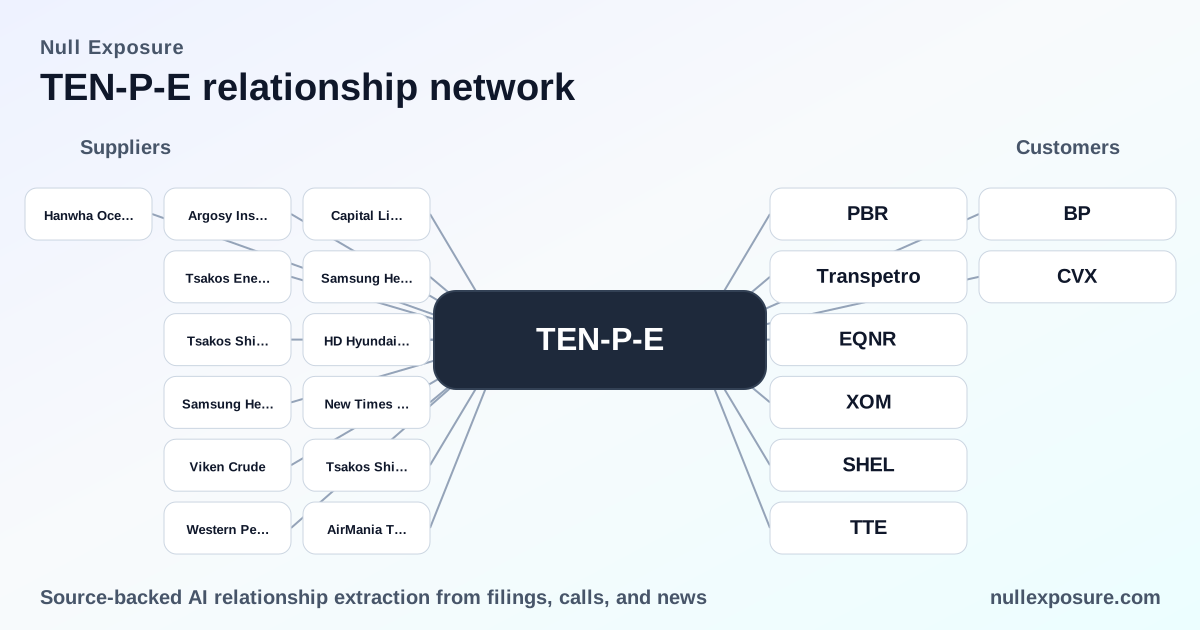
TEN-P-E (TEN Ltd.) — Supplier relationships that drive a capital-intensive fleet strategy
TEN-P-E operates as an owner-operator of modern tankers and LNG-capable tonnage, monetizing through ownership, time/long-term charters and fixed management fees while using affiliated service companies and captive insurance to lower operating volatility. The company’s supplier footprint skews toward South Korean shipyards for newbuilds, long-term charter counterparties for revenue visibility, and internal affiliates for administration and risk transfer — a model that prioritizes predictable cash flows and control over third-party suppliers. Learn more about supplier risk and counterparty mapping at https://nullexposure.com/.
Why supplier relationships matter for an investor in TEN-P-E
TEN’s economics are dominated by two levers: capital deployment into newbuilds and fleet acquisitions, and charter contracts that lock in revenue over multi-year horizons. That makes shipbuilders and charter counterparties functionally equivalent to suppliers whose performance and creditworthiness directly shape asset utilization, capex timing, and free cash flow. The company also relies on internal service providers and a captive insurer to manage costs and counterparty exposure, which compresses external vendor risk but introduces related-party concentration issues.
If you want a clear supplier map for underwriting or operational diligence, start with the yard partners and the internal management/insurance relationships outlined below. For a consolidated view of TEN’s counterparties and supplier health visit https://nullexposure.com/.
The supplier and affiliate relationships investors should catalogue
Below are every counterpart referenced in the reporting captured for TEN‑P‑E, with a concise plain-English description and a source citation for follow-up.
-
Capital Link, Inc. — TEN uses Capital Link as its investor relations/media contact and routes press and shareholder communications through the firm; multiple press releases in FY2025–FY2026 list Capital Link contacts for IR. (See GlobeNewswire press releases and related FY2026 notices.)
-
Samsung Heavy Industries (SHI / Samsung Heavy Industries Co. Ltd.) — TEN has signed major newbuild contracts at Samsung Heavy Industries for shuttle/Suezmax tankers, with deliveries scheduled for 2027–2028 and expected gross revenues tied to long-term employment. (Reported by Splash247, Riviera and ShippingTelegraph in FY2025–FY2026.)
-
HD Hyundai Heavy Industries — TEN received a new eco-scrubber Suezmax from HD Hyundai (delivered October 1, 2025) that entered a minimum three‑year employment to a large U.S. oil company; industry sources also link Hyundai to discussions on LNG carrier newbuilds in 2028. (See GlobeNewswire FY2025 results release and iMaritimeNews / iMarineNews FY2026 coverage.)
-
New Times Shipbuilding — TEN ordered four LR1 product tankers from New Times Shipbuilding, an exception to its South Korean yard concentration and a tactical choice to diversify construction sources. (Referenced in iMarineNews FY2026.)
-
Tsakos Shipping and Trading S.A. (TST) — TST provides technical management services to TEN’s vessels under contractual arrangements; this relationship places key operational control in an affiliated technical manager. (Noted in the company’s FY2025 interim Form 6‑K / MarketScreener coverage.)
-
AirMania Travel S.A. — TEN uses AirMania, an affiliated travel services provider, to handle travel arrangements outside third‑party agents, indicating internalization of certain corporate support functions. (Disclosed in the FY2025 interim report summarized by MarketScreener.)
-
Argosy Insurance Company Limited — TEN places hull & machinery, increased value and war risks through Argosy, a captive insurance entity affiliated with TST, reflecting a strategy to retain insurance risk within the group. (Documented in FY2025 communications captured by MarketScreener.)
-
Tsakos Energy Management Limited — TEN pays fixed per‑vessel management fees to Tsakos Energy Management under a management agreement, establishing a steady cost line and centralized commercial oversight. (Reported in the FY2025 interim report / MarketScreener.)
-
Tsakos Shipmanagement S.A. (TSM) — TSM provided technical management to TEN’s vessels until February 2023, representing part of the historical operational backbone for the fleet. (Mentioned in the FY2025 interim filing summarized by MarketScreener.)
-
Viken Crude — TEN acquired a five-vessel modern fleet from Norway’s Viken Crude in early 2024, accelerating TEN’s exposure to dual-fuel LNG technology and modern tonnage. (Covered by ShippingTelegraph FY2025 reporting.)
-
Western Petroleum — A 2007 acquisition and newbuild program with Western Petroleum produced nine ice-strengthened vessels, which established TEN’s early presence in ice-class tanker markets and remains part of its legacy fleet profile. (Described in ShippingTelegraph FY2025 coverage.)
-
Hanwha Ocean — Industry reports link TEN to multiple VLCC newbuilds at Hanwha Ocean’s Okpo yard, reflecting further yard diversification and longer delivery pipelines toward 2027. (Discussed in Splash247 FY2025 shipping news.)
Mid‑analysis takeaways: what these relationships mean for risk and upside
- Long-term chartering posture is a structural strength. The 15‑year shuttle tanker employment deals and multi-year charters tied to recent newbuilds provide predictable revenue streams that support debt capacity and dividend policy. (See Riviera, Splash247 FY2025 reporting.)
- Supplier concentration is material but managed. South Korean yards (Samsung, Hyundai, Hanwha) are primary partners, delivering scale and technical capability, while targeted orders at New Times and yard options at Hanwha reduce single‑vendor dependency. This is a balanced concentration profile for a shipowner executing fleet renewal.
- Affiliated services compress operating variability and shift risks in-house. Use of Tsakos‑affiliated management, AirMania travel, and the Argosy captive reduces external vendor cost volatility but increases related‑party oversight demands for governance-sensitive investors.
- Modernization and dual-fuel expansion are growth drivers. The Viken Crude acquisition and LNG-capable newbuild talks indicate a strategic tilt toward fuel-flexible assets that command premium employment in transitional energy markets.
For deeper supplier signal analysis and counterparty scoring, visit https://nullexposure.com/.
No explicit constraints were returned — how to interpret that
The dataset supplied no formal constraints entries. That is itself an informative governance signal: there are no flagged contractual restrictions, vendor freezes, or explicit supplier constraints recorded in the retrieved material. Investors should treat this absence as neutral, then layer the relationship evidence above into credit and operational models. Practically, that means valuing: (1) revenue visibility from long-term charters, (2) capex and delivery risk tied to shipbuilders, and (3) governance scrutiny on related‑party services and captive insurance.
Final read: action points for investors and operators
- Map yard delivery risk to cashflow timelines. Prioritize monitoring deliverables at Samsung, Hyundai and Hanwha for schedule slippage that would compress projected earnings.
- Apply related‑party governance checks. Review contracts and transfer pricing with Tsakos affiliates and Argosy to ensure arm’s-length economics and capital adequacy of the captive insurer.
- Model downside scenarios with charter breakpoints. While long-term charters reduce volatility, terminal charter renewals and counterparty credit deserve scenario testing.
If you are evaluating TEN-P-E for portfolio inclusion or counterparty exposure, start with a supplier audit that emphasizes yard delivery timelines and related‑party contractual terms. For an organized supplier intelligence briefing and templated counterparty checklists, visit https://nullexposure.com/ and request the TEN supplier dossier.
Concluding: TEN-P-E’s supplier network shows a deliberate strategy to secure long-term revenue via contracted employment while internalizing key services and insurance, delivering predictable cash flow in exchange for concentration risk clustered in major South Korean yards and related-party service providers. Investors should prioritize yard performance and governance on affiliate arrangements when assessing credit and operational risk.