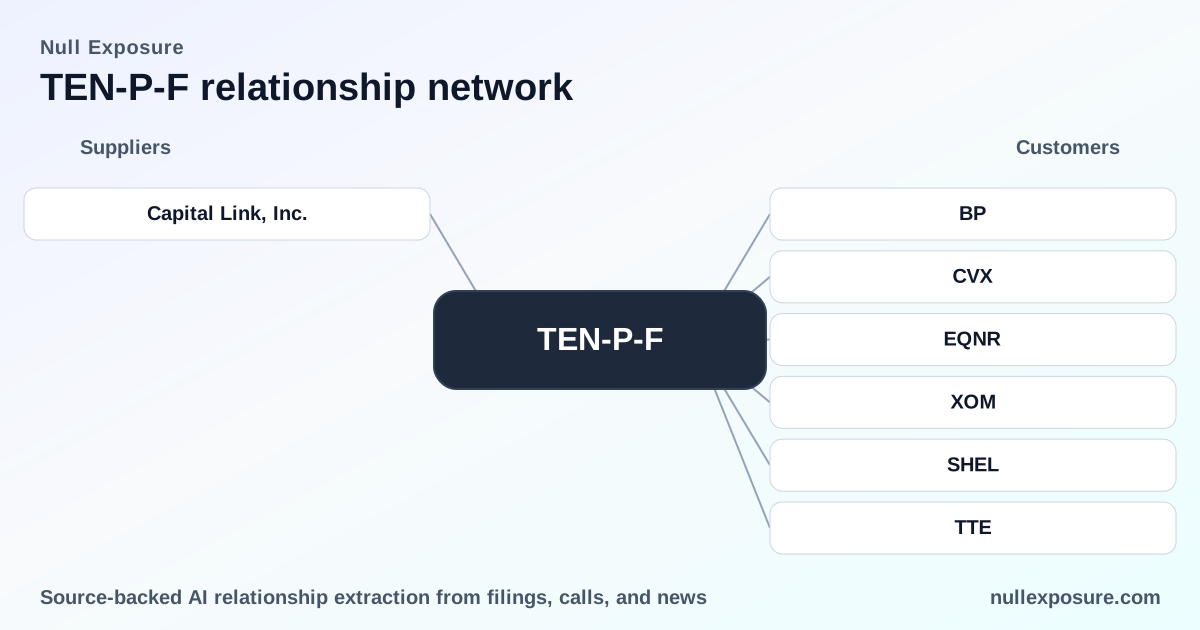
TEN-P-F (Tenet Healthcare): Supplier relationships, constraints, and what investors should act on
Tenet Healthcare (TEN-P-F) operates a large U.S. healthcare services platform built around hospitals, outpatient centers, and post-acute services, and it monetizes through fee-for-service and managed-care reimbursement, ancillary service lines, and facility-based revenue streams tied to patient volume and payer contracts. For investors evaluating supplier relationships, the core investment thesis is simple: supplier performance and contracting posture directly influence operating continuity, cost structure, and margin stability across Tenet’s care network. Learn more about the coverage and tools we use at https://nullexposure.com/.
Why supplier relationships matter for a healthcare operator like Tenet
Tenet’s business model depends on a mix of high-frequency operational suppliers (clinical supplies, IT, facility services) and strategic advisors (capital markets, communications, system integrators). Supplier concentration and contracting terms translate into operational leverage: long-term fixed contracts reduce volatility but create exit friction; spot-market procurement reduces fixed commitments but increases price exposure. For investors, that dynamic is a core driver of margin variability and continuity risk across the system.
- Contracting posture: Tenet’s operating model combines recurring operational procurement with periodic strategic engagements. Contracts tend to be a blend of multi-year agreements for critical services and transactional arrangements for consumables.
- Concentration: Single-source or highly concentrated suppliers for critical clinical or IT services create outsized operational risk; diversified vendor rosters reduce single-point failures.
- Criticality: Suppliers that support care delivery (clinical supplies, EMR, facilities maintenance) are mission-critical and directly impact service continuity and regulatory compliance.
- Maturity: Longstanding supplier relationships suggest established procurement governance; newer or ad hoc suppliers imply negotiation risk and onboarding cost.
These are company-level signals that investors should evaluate as part of operational due diligence.
What the record shows: the supplier relationships in this file
The provided supplier data includes one listed supplier relationship. Each relationship below is summarized with source context.
Capital Link, Inc. — investor relations / media advisor
Capital Link, Inc. is listed in a press release as Tenet’s investor relations/media contact for the fiscal year-end reporting cycle, with named contacts and an email address for the FY2026 results call and webcast. This is a communications/IR engagement rather than a clinical or supply contract, but it affects market access and investor communications. Source: press release posted on Sahm Capital, March 10, 2026 (FY2026 investor relations notice) — https://www.sahmcapital.com/news/content/ten-ltd-announces-date-for-the-fourth-quarter-and-year-end-2025-results-conference-call-and-webcast-2026-02-18
(That entry is the only supplier relationship recorded in the supplied file.)
What the Capital Link relationship implies for investors
Capital Link’s role is to manage investor-facing communications and to coordinate webcasts and calls. For investors, an outsourced IR/media engagement is a liquidity and narrative management instrument: properly executed, it supports transparent disclosure and controlled messaging; poorly executed, it increases reputational and execution risk around earnings and guidance events. Given the relationship type, the operational risk to clinical service delivery is low, but market signaling risk is material around earnings releases and investor outreach.
Midway reminder: for a broader look at supplier exposure across healthcare operators, visit https://nullexposure.com/.
Constraints and disclosure signals
The supplied record contains no supplier-specific constraints or contractual excerpts. That absence is itself a signal: public supplier-level constraints are not documented in this file, which means investors must obtain contracting detail through direct diligence rather than relying on the provided relationship list. Treat this as a company-level disclosure characteristic rather than a statement about any individual supplier.
- No listed supplier constraints or procurement caveats are present in the dataset.
- Absence of constraints increases the importance of targeted enquiries on vendor concentration, continuity plans, and termination provisions during diligence.
Key risk factors investors should prioritize
Tenet operates in a regulated, operationally intensive sector where supplier failures translate into clinical and financial consequences. Focus due diligence on these points:
- Supplier concentration for clinical and IT services — single vendors for EMR, sterile supplies, or critical maintenance services create outsized risk.
- Contract tenor and exit terms — long-term fixed-price contracts lock in supply but limit flexibility; short-term spot buys increase price exposure.
- Continuity and disaster recovery — verify SLAs, redundancy, and contingency staffing for mission-critical suppliers.
- Disclosure and governance — ensure IR and corporate communications accurately reflect operational realities; outsourced IR providers influence market perception.
Practical investor actions
Investors evaluating TEN-P-F supplier exposure should execute a short checklist:
- Request a supplier register or material vendor summary covering contract tenors, concentration, and last-renegotiation dates.
- Confirm critical vendor continuity plans and SLA performance metrics for clinical and IT suppliers.
- Review public filings and earnings call transcripts for vendor-related cost pressure or one-time supplier events.
- Validate investor communications controls and timing around earnings events with the IR provider listed.
Final takeaways and next steps
Tenet’s supplier profile matters because procurement outcomes directly affect margins, regulatory compliance, and care continuity. The single supplier record in the supplied file—an investor relations/media engagement with Capital Link—is important for market-facing communications but does not substitute for granular procurement transparency on clinical or technology suppliers. The absence of supplier constraints in the record is itself a signal that direct diligence is required.
If you are conducting operational due diligence or monitoring supplier concentration for TEN-P-F, start with requests for vendor lists, contract summaries, and contingency plans, and track investor communications around earnings events closely. Access broader supplier-exposure research and tools at https://nullexposure.com/ to deepen your analysis.
Bold action: prioritize verification of critical clinical and IT supplier contracts and confirm that investor communications reflect operational realities before making allocation changes.