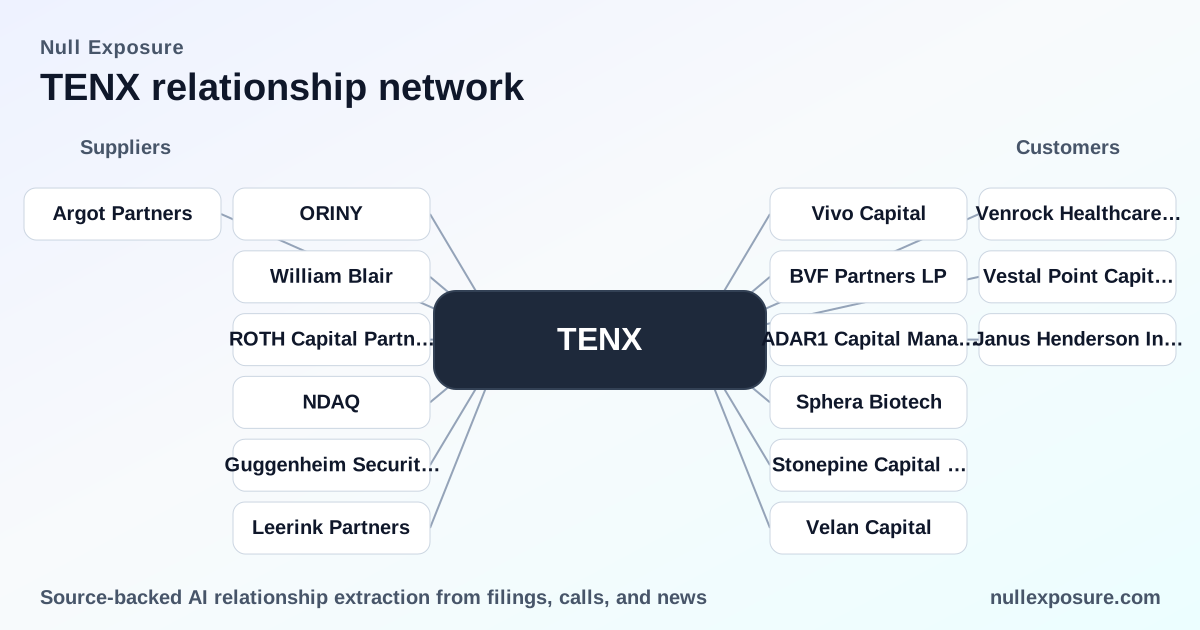
Tenax Therapeutics (TENX): The supplier map that underwrites a single-asset biotech bet
Tenax Therapeutics operates as a specialty pharmaceutical developer focused on levosimendan formulations—principally TNX‑103—with a business model built on licensed intellectual property, outsourced development and manufacturing, and capital raises to fund Phase 3 development and regulatory work. Revenue will derive from future product sales and potential licensing, while near-term value is driven by clinical readouts and the strength of third‑party relationships that underpin manufacturing and capital markets access. For a deeper look at counterparty exposure and supplier risk, visit https://nullexposure.com/.
How Tenax actually runs the program and where it makes money
Tenax is a small, development‑stage biopharma that does not own manufacturing capacity and relies on licensing and third‑party service contracts to move drug candidates from clinical trials into commercialization. The company monetizes by acquiring or licensing assets (notably levosimendan rights), advancing those assets through clinical development, and preparing for commercial launch or partner monetization. That operating posture produces concentrated supplier and capital‑market dependencies—critical factors for investors to price into valuation.
Key company-level signals from Tenax’s disclosures:
- Contracting posture: Tenax outsources nearly all clinical, preclinical and manufacturing work to external CROs and CMOs, which keeps capital intensity low but creates operational dependency.
- Concentration and criticality: The license with Orion establishes a single, contractually defined manufacturing source for TNX‑103, creating a high‑criticality single point of failure for commercialization.
- Geographic rights and commercialization scope: Amendments to the Orion license have expanded rights to oral and subcutaneous formulations and broadened territory to global rights for those forms; the original license covered the U.S. and Canada.
- Maturity and contingent obligations: As of the latest reporting, Tenax has not yet met license milestones that would trigger contingent payments to Orion, so near‑term cash outflows tied to milestones are not reflected on the balance sheet.
These dynamics shape both operational risk and upside: low fixed manufacturing cost and flexible development spending, balanced against high execution risk if a single supplier relationship is disrupted.
Supplier and advisor relationships every investor must catalog
Orion Corporation — licensing partner and sole manufacturer
Orion is the licensor of levosimendan rights and, per Tenax disclosures, is contractually the sole manufacturing source for TNX‑103; Tenax holds exclusive, sublicensable rights that have been amended to expand formulation and territorial scope. According to Tenax press releases and license descriptions (GlobeNewswire releases, Aug 12, 2024; Dec 17, 2025), Orion supplies both the regulatory history and manufacturing backbone for the program.
Leerink Partners — lead placement agent on the 2024 financing
Leerink acted as lead placement agent on Tenax’s $100 million private placement that financed acceleration of the oral levosimendan Phase 3 program, providing capital markets distribution and strategic placement services (GlobeNewswire, Aug 12, 2024).
Guggenheim Securities — joint placement agent
Guggenheim joined as a joint placement agent on the same $100 million private placement, supporting syndication of the equity raise that underwrote development spending (GlobeNewswire, Aug 12, 2024).
William Blair — joint placement agent participation
William Blair participated as a joint placement agent in the $100 million private placement, complementing Leerink and Guggenheim on the transaction that materially altered Tenax’s cash runway (GlobeNewswire, Aug 12, 2024).
ROTH Capital Partners — financial advisor to Tenax
ROTH served as financial advisor to Tenax in connection with the financing activity and strategic planning around the Phase 3 acceleration (GlobeNewswire, Aug 12, 2024).
The Nasdaq Stock Market LLC — listing venue and liquidity channel
Tenax’s common stock trades on The Nasdaq Stock Market under the ticker TENX, providing public market liquidity and analyst coverage that drive investor access and valuation (InvestingNews and Tenax press releases; GlobeNewswire, Mar 3, 2026; InvestingNews article on the KOL call).
Argot Partners — investor/IR communications
Argot Partners functions as Tenax’s investor and media contact for program outreach, including promotion of virtual KOL calls to discuss TNX‑103 clinical data and engagement with the investment community (InvestingNews, FY2025).
If you want a consolidated counterparty view and compliance checks on these relationships, see https://nullexposure.com/ for tailored supplier exposure reports.
What these relationships mean for risk and upside
- Single‑source manufacturing is the dominant operational risk. The explicit contractual designation of Orion as the sole manufacturer for TNX‑103 elevates supply chain concentration to a top investment risk; any disruption at Orion or failure to meet quality/regulatory standards would directly delay commercialization. This is not a theoretical exposure—Tenax’s own filings and press material document this arrangement (GlobeNewswire, multiple filings in 2024–2025).
- Capital markets relationships reduced near‑term financing risk in 2024. The $100 million private placement underwritten by Leerink, Guggenheim and William Blair materially extended Tenax’s ability to fund Phase 3 work, reducing the immediate need for dilutive short‑term raises (GlobeNewswire, Aug 12, 2024). Monitor cash burn and milestone timing as the next determinant of financing needs.
- Advisor and IR partners increase visibility but do not mitigate operational concentration. ROTH and Argot improve market access and message control, but they do not alter manufacturing or clinical execution risk.
- Regulatory upside remains concentrated on clinical success. The global license provisions and broader formulation rights expand addressable markets if TNX‑103 clears pivotal endpoints and obtains FDA approval; however, realization of that upside depends on timely trial execution and uninterrupted manufacturing.
For operational diligences, track manufacturing confirmations from Orion, milestone status disclosures (which trigger contingent payments), and any CRO/CMO contract changes. If you want a vendor exposure brief tailored to portfolio weightings, visit https://nullexposure.com/ to request a supplier concentration analysis.
Conclusion — watch three yardsticks
- Orion manufacturing confirmations and quality audits — any red flags here directly threaten launch timelines.
- Clinical readouts and blinded sample size assessments — these inform the probability of approval and trigger next‑stage financing decisions. (See Tenax press releases reporting a prespecified blinded sample size assessment, GlobeNewswire, Dec 17, 2025.)
- Cash runway versus milestone cadence — private placement proceeds extended operations, but new trials and potential commercial scale‑up will change capital needs.
Bottom line: Tenax is a classic single‑asset, outsourced biotech where partner strength and financing arrangements determine value more than internal manufacturing capability. Investors should underwrite the business with conservative assumptions about supply continuity and milestone timing while valuing upside to the extent global licensing and successful Phase 3 outcomes de‑risk commercialization. For supplier‑level exposure that maps onto portfolio scenarios, go to https://nullexposure.com/.