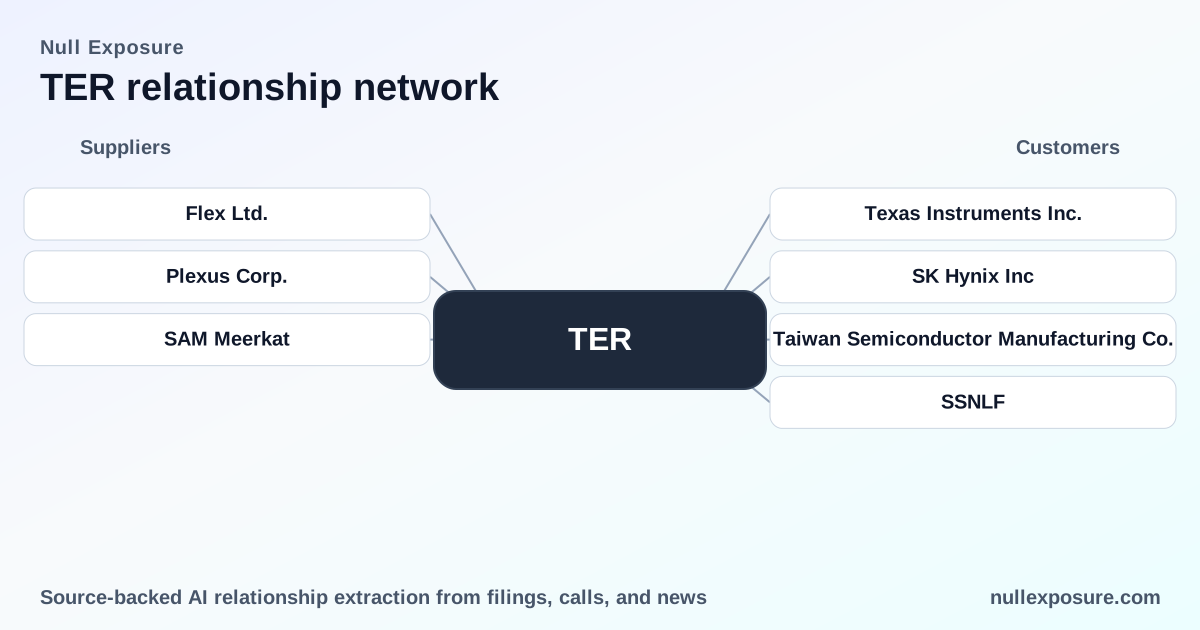
Teradyne’s contract-manufacturing footprint: Flex, Plexus and SAM Meerkat
Teradyne builds and sells automatic test equipment (ATE) and related services that underpin semiconductor and storage supply chains. The company monetizes through hardware sales, recurring service and spare parts, and outsourced manufacturing partnerships that allow it to scale production without equivalent capital investment in global factories. For investors evaluating supplier risk, Teradyne’s 2024 disclosures show a deliberate reliance on contract manufacturers concentrated in Southeast Asia for test products, complemented by in‑house robotics production in Europe and North America. For a concise supplier-risk view and to benchmark counterparties, visit NullExposure.
Why supplier relationships matter to Teradyne investors
Teradyne’s business model balances high-margin proprietary test systems with outsourced manufacturing to control capital intensity. Outsourcing raises both operational leverage and supplier concentration risk: efficient partner lines enable rapid volume scaling and margin preservation, while reliance on a small set of manufacturers concentrates execution and geopolitical exposure. Teradyne’s financials—strong operating margins and high institutional ownership—reflect an operating model that depends on reliable contract manufacturing and short-term procurement flexibility to meet cyclical demand swings.
Key operational signals to watch include contract duration, geographic concentration of manufacturing, and the size of purchase commitments. These factors directly affect lead times, inventory funding, and the company’s ability to capture demand spikes. Investors should treat supplier disclosures as leading indicators of supply-chain resilience and capital deployment choices.
Explore Teradyne supplier analytics at NullExposure to map contract counterparties and payment exposure.
Who the suppliers are and what they do (plain-English summaries)
Flex Ltd.
Teradyne outsources assembly and test for its FLEX and J750 product families to Flex Ltd., which operates a Malaysian manufacturing and testing facility. According to Teradyne’s 2024 Form 10‑K, Flex is a designated contract manufacturer for those product lines, making it a critical production partner in APAC. (Teradyne 10‑K FY2024)
Plexus Corp.
Plexus Corp. manufactures and tests Teradyne’s Magnum products in Malaysia and Thailand, and handles ETS family production in Malaysia, per Teradyne’s 2024 annual filing. Plexus therefore supports multiple product families across more than one ASEAN site, implying operational breadth for Teradyne’s test hardware. (Teradyne 10‑K FY2024)
SAM Meerkat
SAM Meerkat is named as the contract manufacturer responsible for Teradyne’s storage test family, with facilities in Malaysia and Thailand; Teradyne’s filing also notes other contract manufacturers perform additional product manufacturing. SAM Meerkat is thus a specialist partner for storage-focused systems in the same regional cluster. (Teradyne 10‑K FY2024)
Company-level constraints and what they signal
Teradyne’s 2024 disclosures include several constraint signals that apply at the company level rather than to a single supplier. These constraints shape the contracting posture and risk profile:
-
Short‑term purchase commitments dominate: Teradyne reported non‑cancelable purchase commitments totaling approximately $419.8 million as of December 31, 2024, with about $409.6 million due within one year. This indicates a procurement strategy focused on short-duration commitments, which preserves flexibility but increases exposure to spot-market price and volume volatility. (Teradyne 10‑K FY2024)
-
APAC manufacturing concentration: The company states that manufacturing for its test businesses is primarily executed via subcontractors with significant operations in Malaysia. Geographic concentration in Malaysia and neighboring ASEAN locations is a core feature of Teradyne’s supply chain. (Teradyne 10‑K FY2024)
-
Regional diversification for Robotics: By contrast, Teradyne’s Robotics production is centered in Denmark and the U.S., signaling a split manufacturing model—outsourced APAC for test systems versus in-house or regional production for robotics. This lowers systemic exposure for the robotics line but leaves test hardware more concentrated. (Teradyne 10‑K FY2024)
-
Manufacturer role and active contracts: Balance‑sheet line items show contract manufacturer and supplier prepayments, supporting the conclusion that these relationships are active, operational, and funded in advance. The procurement posture is transactional and ongoing rather than passive. (Teradyne 10‑K FY2024)
-
Material spend magnitude: The magnitude of purchase obligations (~$420 million) qualifies as a large spend band for operational sourcing, representing meaningful short‑term cash flow commitments that investors should overlay with the company’s working capital and margin profile. (Teradyne 10‑K FY2024)
These constraints together produce a clear investor signal: Teradyne runs a high‑frequency procurement model in APAC for its test businesses, backed by material short‑term commitments and active manufacturer relationships. That structure supports rapid scaling but concentrates supply-chain and geopolitical risk.
Assess how these supplier dynamics affect valuation at NullExposure.
Investment implications and risk considerations
From an investment lens, the supplier footprint drives three practical conclusions:
-
Execution risk is concentrated. With core test product manufacturing clustered in Malaysia/Thailand through a handful of contract manufacturers, any disruption—logistics, labor, natural disaster, or policy—has outsized implications for near‑term revenue and margins.
-
Financial flexibility offsets some operational risk. Teradyne’s margins, EBITDA and institutional ownership profile indicate the company has room to absorb temporary supply shocks, but the short‑term nature of purchase commitments means cost volatility and supply tightness will transmit quickly to results.
-
Scale benefits are real. Outsourcing non‑proprietary assembly and test operations enables Teradyne to focus R&D and capital on core test systems and robotics, preserving gross margins on proprietary technology while letting partners handle volume manufacturing.
For operators negotiating with Teradyne, emphasize reliability, dual‑sourcing options, and regional continuity plans; for investors, prioritize monitoring purchase-obligation trends and any shifts in supplier geography or contract length disclosed in future filings.
Bottom line and recommended next steps
Teradyne’s supplier relationships are strategically structured for scalable production but are materially concentrated in Southeast Asia with short-term purchase exposure. That combination accelerates growth capture but elevates supply-chain resilience as a primary operational risk.
If you evaluate supplier counterparty risk or are assessing Teradyne as a portfolio holding, start by tracking quarterly changes in purchase commitments and any disclosure on supplier diversification or multi‑site sourcing strategies. For ongoing supplier-mapping and exposure analytics, see NullExposure’s supplier intelligence.
Key actions:
- Monitor Teradyne’s next quarterly filing for changes to purchase obligations and supplier geography.
- Evaluate scenario impacts on margins under short-term supplier strain.
- Use third-party supplier intelligence to validate continuity plans for Malaysia/Thailand operations.
For a concise, investor-focused supplier risk briefing and to map these relationships against cash-flow exposure, visit NullExposure and request the Teradyne supplier pack.