Terns Pharmaceuticals: commercial relationships, contract posture, and what investors should price in
Terns Pharmaceuticals is a clinical-stage biopharmaceutical company that develops small-molecule therapies for NASH and chronic liver disease. The company monetizes through licensing agreements, milestone and royalty streams on partnered territories, and capital markets activity (equity offerings and placements) to fund clinical programs; operating cash and future revenue depend heavily on third‑party partnerships and licensing economics rather than product sales today. For investors evaluating supplier and advisor exposure, the combination of licensing economics, short-term manufacturing sourcing, and recent capital-market activity defines both upside and operational risk.
Explore a focused analysis and counterparty map at our site: https://nullexposure.com/
Executive takeaway: capital markets and licensing drive valuation today
Terns’ public-market valuation and near-term runway are driven by two levers: license and royalty arrangements that create future asymmetric upside on approved products, and access to capital through equity offerings to sustain R&D. The company holds sublicensing rights acquired in 2019 and has structured commercial arrangements in APAC; meanwhile, it relies on third‑party contract manufacturers on short-term purchase‑order terms for clinical supply. This combination produces high operational leverage—significant upside if clinical results succeed, and concentrated operational risk if suppliers or partners fail to deliver.
Investors who want a rapid counterparty snapshot can follow this page for ongoing updates: https://nullexposure.com/
Counterparty map: the relationships you need to know
Below are the counterparties identified in recent public reporting and news coverage. Each entry is a plain-English summary with the public source.
Investment banks that ran the recent equity offering
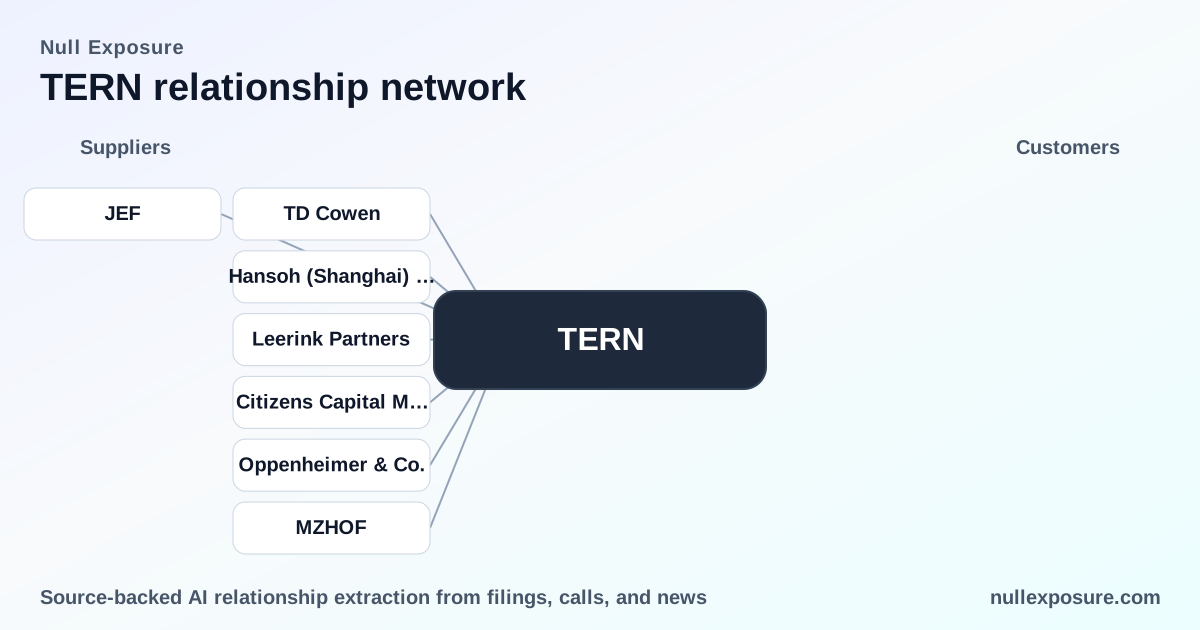
- Jefferies, TD Cowen, and Leerink Partners acted as lead book‑running managers on Terns’ closing public offering, a capital markets action that expanded the company’s cash runway and diluted equity while supporting clinical development financing (Yahoo Finance, March 10, 2026: https://finance.yahoo.com/news/terns-announces-closing-public-offering-210500697.html).
- Mizuho, Citizens Capital Markets, and Oppenheimer & Co. served as co‑managers on the same offering, providing distribution reach and syndicate support for the transaction (Yahoo Finance, March 10, 2026: https://finance.yahoo.com/news/terns-announces-closing-public-offering-210500697.html).
Strategic licensing partner in Greater China
- Hansoh (Shanghai) Healthtech Co., Ltd. — Terns amended an agreement under which it will pay Hansoh a one‑time upfront license fee of $1.0 million and tiered royalties of 0.75%–1.25% on annual net sales for covered products, reflecting a typical royalty structure for regional licensing deals (InsiderMonkey, 2026: https://www.insidermonkey.com/blog/terns-pharmaceuticals-tern-eyes-expansion-beyond-china-amid-strong-analyst-sentiment-1686724/?amp=1).
How Terns contracts and sources its operations (company-level signals)
Terns’ public disclosures and contract excerpts reveal a distinct operating profile:
- Licensing is a formal, documented element of the business model. The company holds sublicensing rights resulting from a 2019 assignment agreement with Vintagence, which included a $0.7 million upfront payment and potential development milestones up to CNY 205 million; that arrangement allows Terns to grant sublicenses to affiliates and contractors for development, manufacture, and commercialization.
- Manufacturing procurement is predominantly spot‑market. Terns states that it currently obtains finished drug product via individual purchase orders and does not have long‑term manufacturing contracts in place; this creates supply concentration risk and price exposure until commercial agreements are secured.
- Office/real‑estate commitments are multi‑year but modest in spend. The company extended its Foster City lease through October 31, 2027, with annual lease payments approximately $0.5 million—placing property spend in a $100k–$1m annual band.
- Geographic footprint is both APAC and global. Suppliers and some manufacturers are located in China while clinical programs run across the United States, Europe, and other countries—indicating cross‑jurisdictional regulatory and supply‑chain complexity.
- Third‑party services are critical to operations. Terns relies completely on third parties for clinical supply manufacture and for execution of trials; failure of those partners to secure regulatory approval, provide quality supply, or scale for commercialization is a critical operational risk.
These signals point to a business model with high upside on successful clinical readouts and commercial licensing, paired with high dependency on external counterparties for execution.
Investment implications and risk calibration
Investors should weigh the following factors when building a thesis or sizing exposure:
- Royalty economics versus control. The Hansoh amendment demonstrates willingness to trade regional rights for upfront cash and a modest royalty rate (0.75%–1.25%), which conserves capital but caps upside per-unit revenue in the licensed territory.
- Supply risk and timing. Reliance on spot purchase orders for manufacturing means timing and quality of supply are contingent on third parties, and cost control is less certain until long‑term commercial contracts are negotiated.
- Capital markets activity impacts dilution and runway. The recent public offering led by Jefferies, TD Cowen and Leerink Partners increased liquidity but also diluted existing holders; bank syndicate composition is relevant for future capital strategy and market access (Yahoo Finance, March 10, 2026).
- Operational concentration across vendors and geographies. Manufacturing links to China introduce geopolitical and regulatory complexity that investors must price into scenario analyses.
If you want a concise, actionable counterparty dashboard for portfolio due diligence, see our platform: https://nullexposure.com/
Final read: what to watch next
Monitor three areas to update valuation and operational risk: (1) progress on negotiations for long‑term manufacturing agreements (reduces supply and price risk); (2) clinical milestone readouts that unlock material milestones or accelerate royalty streams; and (3) execution on regional licensees (such as Hansoh) that deliver upfront cash and formalize commercialization pathways.
For investors and operators, Terns trades as a classic high‑upside clinical‑stage biotech with concentrated supplier exposure and active capital‑markets financing—a profile that rewards binary clinical success but penalizes supplier disruption. For continued tracking and deeper counterparty visibility, visit our hub: https://nullexposure.com/