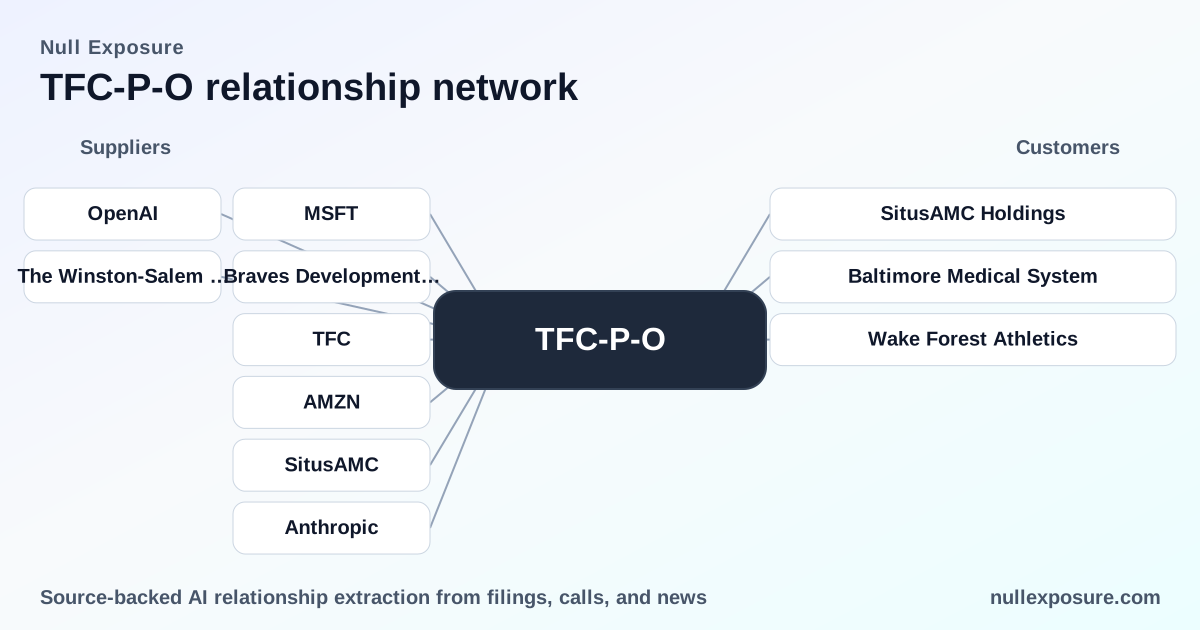
Truist (TFC-P-O) — supplier relationships that shape operations and risk
Truist Financial monetizes a broad banking franchise through consumer and commercial deposits, lending, wealth management and payment card services; the preferred security ticker TFC-P-O sits above that operating base and is exposed to the bank’s counterparty ecosystem rather than direct product metrics. Operational value is delivered through strategic supplier relationships—cloud and AI vendors for data and productivity, payment networks for card products, real estate partners for occupancy, servicing partners for legacy platforms, and a foundation partner for charitable administration. Investors evaluating counterparty risk should read supplier ties as a map of operational dependencies that influence cost, resilience, and regulatory exposure. For a deeper look across peers and counterparties visit https://nullexposure.com/ for more analysis.
What the supplier list tells investors about Truist’s operating model
Truist’s visible suppliers reflect an operating model that balances scale providers with specialized third parties. The bank integrates large cloud and AI vendors into customer-facing and back-office workflows, retains global payment networks for card products, and uses external partners for real estate and loan-servicing transitions. From an investor standpoint this implies:
- Contracting posture: Truist relies on enterprise-level arrangements with major platform providers that are structured for scale and continuity.
- Concentration profile: Supplier exposure is dispersed across technology, payments, real estate and servicing, reducing single-vendor concentration risk but creating multi-domain dependency.
- Criticality: Cloud/AI platforms and payment rails are mission-critical to customer experience and transaction processing, while real estate and servicing partners are materially important for cost and execution.
- Maturity: Relationships reflect both legacy transitions and modern technology adoption, indicating a hybrid operating state that blends established vendor arrangements with accelerating AI integration.
Dive into the full supplier picture and model implications at https://nullexposure.com/ while you evaluate counterparty exposure.
Relationship snapshots you need on your diligence checklist
Below are concise, investor-oriented summaries of every supplier relationship identified in the source material, each with a direct citation.
Microsoft
Truist references Microsoft 365 Copilot as an example of application-level AI tooling used within its environment, indicating direct operational use of Microsoft productivity and AI services in FY2025. According to an MIT Sloan Review audio interview (FY2025/FY2026 coverage), Truist lists Microsoft 365 Copilot among applications in its AI stack (https://sloanreview.mit.edu/audio/overcoming-ai-hallucinations-truists-chandra-kapireddy/).
Amazon
Truist discusses using services such as Amazon Bedrock as part of its approach to cloud-hosted AI services, signalling integration of Amazon’s cloud AI APIs in FY2025. The MIT Sloan Review audio cites Bedrock among the service-layer options Truist uses for model access and application development (https://sloanreview.mit.edu/audio/overcoming-ai-hallucinations-truists-chandra-kapireddy/).
Anthropic
Anthropic is noted as an upstream model provider behind service-layer AI platforms that Truist consumes, highlighting a multi-vendor model sourcing for advanced language models in FY2025. The MIT Sloan Review audio documents Anthropic being used behind managed services such as Bedrock (https://sloanreview.mit.edu/audio/overcoming-ai-hallucinations-truists-chandra-kapireddy/).
OpenAI
OpenAI is listed among the model providers accessible through managed services in Truist’s AI architecture, reflecting exposure to leading large-language-model suppliers in FY2025. MIT Sloan Review’s discussion of Truist’s AI approach names OpenAI as part of the model ecosystem the bank accesses (https://sloanreview.mit.edu/audio/overcoming-ai-hallucinations-truists-chandra-kapireddy/).
Visa
Truist issues Visa-branded debit cards and references Visa in product descriptions, demonstrating that the bank routes retail debit transactions through Visa’s payments network as part of its consumer card offering in FY2026. A Truist product review mentions the standard Visa Debit Card option (https://wallethacks.com/truist-bank-review/).
Delta SkyMiles
Truist partners with Delta to offer a Delta SkyMiles-branded debit card that earns miles and charges an issuer fee in certain tiers, confirming co-branded card relationships in FY2026. A consumer-facing review highlights the Delta SkyMiles® Debit Card option and associated fees and rewards (https://wallethacks.com/truist-bank-review/).
Braves Development Company
Truist has a 15-year lease arrangement to occupy about half of a new tower developed by Braves Development Company, with initial employee occupancy slated for 2025 and construction on schedule in FY2024 reporting. An Atlanta Urbanize article describes the lease terms and planned occupancy timeline (https://atlanta.urbanize.city/post/braves-truist-park-battery-securities-new-tower-shines-photos).
SitusAMC
SitusAMC will maintain servicing partnership ties with Truist following Truist’s sale of a legacy CRE loan-servicing platform, signaling an outsourced servicing arrangement continuing after a transaction in FY2020. American Banker coverage of the FY2020 sale notes that SitusAMC will preserve existing servicing links (https://asreport.americanbanker.com/news/truist-sells-off-legacy-suntrust-cre-loan-servicing-platform).
The Winston-Salem Foundation
Truist’s charitable fund is administered by The Winston-Salem Foundation, establishing an external administrator for donor-advised fund operations reported in FY2026. A regional release documents the Truist Charitable Fund and its administration by the foundation (https://i95business.com/releases/3733).
What investors should watch next
These supplier ties create clear operational levers and risk vectors. Payment networks and card partners directly affect transaction economics; cloud and AI vendors govern data access, model reliability and vendor lock-in; real estate leases create fixed-cost commitments; servicing partners affect legacy portfolio execution; and foundation administration governs reputational and philanthropic channels.
- Operational risk: Monitor SLAs, failover and data governance with cloud/AI suppliers because model failures or service interruptions translate to client-facing incidents.
- Contract risk: Long-term leases and multi-year vendor contracts create cash flow rigidity; track lease occupancy schedules and any subleasing options.
- Concentration risk: While supplier mix is diversified, the bank’s reliance on major cloud and model providers is a strategic concentration worthy of covenant and continuity review.
If you are modeling counterparty sensitivity or constructing scenario analyses, review the primary sources above and cross-check contractual disclosures in company filings. For additional supplier intelligence and comparative supplier maps, visit https://nullexposure.com/.
Bottom line and actionable items
Truist’s supplier footprint blends big-tech AI providers, global payment rails, real-estate partnerships, servicing vendors and philanthropic administrators—each with distinct operational impacts. For preferred security investors in TFC-P-O, that footprint translates into an exposure profile tied more to counterparty execution and operational resilience than to direct revenue metrics from the preferred instrument. Final diligence steps: validate contract tenors, confirm criticality and redundancy for cloud/AI services, and model lease and servicing transition timelines.
For an extended supplier-risk playbook and comparative supplier research, go to https://nullexposure.com/ and register for updates.