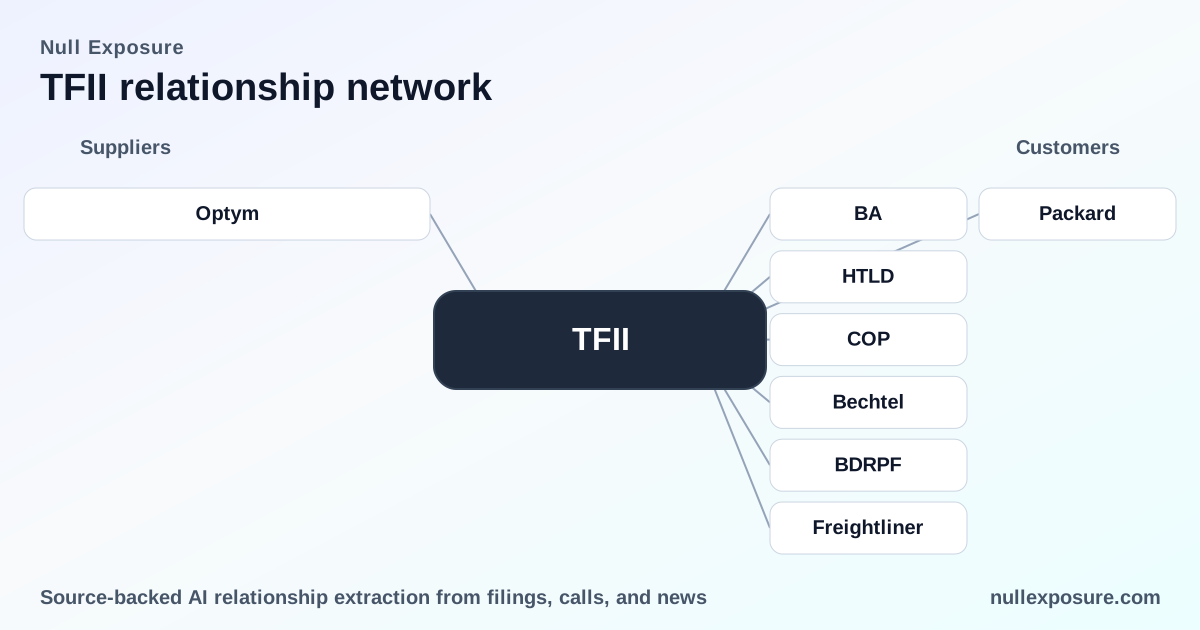
TFI International (TFII): supplier map and what investors should price in
TFI International is an asset-light and asset-heavy hybrid logistics platform that monetizes through freight hauling, contract logistics, courier and last‑mile services, brokerage and value‑added logistics across North America. The company converts scale into predictable cash flow by blending owned assets with technology-enabled third‑party integrations, fuel surcharges and contracted network services, producing roughly $7.88 billion in revenue and $983.7 million in EBITDA on a trailing‑twelve‑month basis (latest quarter 2025-12-31). For investors evaluating supplier exposure, the key question is how third‑party integrations and vendor relationships affect network reliability, cost structure and future margin improvement.
Explore deeper supplier intelligence on TFI at https://nullexposure.com/ to supplement due diligence.
Why supplier relationships matter for a transport consolidator
TFI's business is fundamentally operational: trucks, terminals, drivers and scheduling are the product. Suppliers and software partners therefore influence utilization, unit cost, on‑time performance and the company’s ability to scale acquisitions without margin erosion. When a carrier integrates third‑party routing or capacity platforms, the vendor's reliability becomes a lever on operating margin and customer satisfaction. Conversely, strong vendor partnerships can unlock route density and yield accretion through better matching and reduced empty miles.
What the data shows on supplier constraints
The reviewed supplier-level data contains no recorded supplier constraints for TFII. That absence is itself a company-level signal: there are no flagged contractual restrictions, supplier‑related contingent liabilities or disclosed supplier concentration constraints in the available materials supplied with this review. This dataset signal should be treated as an input to diligence, not a substitute for primary legal and contract review.
The single reported supplier relationship and its immediate implications
Optym — a routing/optimization integration under rollout
TFI has implemented Optym software for inbound freight and is rolling the vendor into pickup workflows in a staged program; the vendor moved into Phase 1 for incoming freight with Phase 2 planned for pickups. According to a FreightWaves article dated March 10, 2026, TFI’s implementation is an explicit multi‑phase deployment inside the operating network. (Source: FreightWaves, March 10, 2026).
Operational takeaway: this is a strategic operational integration. A phased rollout indicates Optym is material to TFI’s efforts to reduce empty miles and improve pickup/delivery sequencing, which directly influences unit economics.
How that single relationship shapes risk and opportunity
- Concentration versus optionality: a multi‑phase deployment of a specific routing optimizer creates an operational dependence that is visible and traceable; investors should track whether Optym becomes a network standard or one of several tools. The FreightWaves note confirms a clear vendor choice for at least inbound flows.
- Execution premium: staged implementation signals an execution approach to reduce integration risk while capturing route optimization benefits. Investors should value this as a margin upside lever if rollout accelerates without disruption.
- Operational criticality: routing software sits at the center of yield and utilization. A successful rollout reduces operating cost per mile and increases capacity leverage; failures create scheduling friction and customer SLA exposure.
Contracting posture, maturity and concentration as company-level signals
The dataset does not include supplier constraints excerpts naming specific relationships, so the following are company-level signals derived from the absence of recorded constraints:
- Contracting posture: TFI’s public information and the single vendor mention suggest a pragmatic, phased supplier contracting posture—experiment first, expand on success. This approach reduces short‑term vendor lock risk while preserving the option to standardize.
- Supplier concentration: current evidence shows a targeted use of third‑party optimization rather than wholesale vendor concentration across all operating domains. That reduces single‑point-of-failure supplier risk today, but a successful Optym rollout could shift that balance over time.
- Criticality and maturity: implementing a sophisticated optimizer implies an operational maturity where the business can absorb advanced tools and manage change across terminals and fleets; this is consistent with TFI’s scale and acquisition-led growth model.
Investment implications and what to watch next
TFI’s financials (market cap roughly $8.39 billion, forward P/E ~20.9, EV/EBITDA ~9.7) price a combination of stable asset leverage and execution‑dependent margin expansion. Supplier relationships are a lever that can move the valuation multiple:
- Monitor the Optym rollout milestones and realized cost reductions: concrete metrics such as empty‑mile reduction, utilization uplift and scheduling compliance are the measurable outputs investors should demand.
- Track additional vendor disclosures or procurement aggregation: a move to a single, company-wide optimizer would increase both upside and supplier concentration risk.
- Watch integration cadence after acquisitions: TFI’s M&A strategy typically migrates acquired fleets to centralized systems; vendor standardization choices will materially affect near‑term integration costs.
If you are building a supplier risk view for TFII, combine this relationship intelligence with contract sightlines and operational KPIs. See the TFII supplier overview and other carrier supplier mappings at https://nullexposure.com/ for portfolio-level context.
Practical checklist for investor diligence
- Request vendor‑level KPIs tied to the Optym deployment (empty‑mile %, route density, pickup on‑time %).
- Confirm contracting terms and escape provisions for mission‑critical software integrations.
- Stress‑test the operational fallback plan if a phased vendor implementation underperforms during peak volumes.
Conclusion and next steps
TFI’s supplier picture in the available materials is narrow but meaningful: a deliberate, phased adoption of Optym for routing signals a focused investment in optimization that should translate into improved unit economics if executed cleanly. The data shows no recorded supplier constraints, which is a company-level signal of limited disclosed supplier liabilities in these sources. Investors should press for outcome metrics from the Optym rollout and monitor whether vendor standardization increases supplier concentration risk.
For a full supplier risk assessment and comparable carrier mappings, visit https://nullexposure.com/ — the homepage has the supplier intelligence and templates useful for investment and operational diligence.