Triumph Financial (TFIN): supplier relationships, concentration and what investors need to know
Triumph Financial operates as a hybrid financial and technology platform that earns through interest margin and fee income across Payments, Factoring and Banking—serving freight, supply chain finance and commercial clients while levering balance-sheet funding and platform services to capture transaction economics. The company monetizes by originating short-duration receivables, collecting servicing and network fees inside an integrated stack, and funding activity through bank liquidity and structured capital vehicles.
If you evaluate counterparty exposure or vendor concentration for underwriting or procurement decisions, this supplier map and implications review compresses the public record into investor-grade takeaways. For deeper supplier-level dashboards and alerts, visit https://nullexposure.com/.
How Triumph’s operating model drives supplier choices and risk
Triumph’s business blends service delivery (payments and factoring platforms) with traditional banking. That hybrid model forces a mix of software/service providers, audit and market-data vendors, and secured funding counterparties. Expect a contracting posture that favors operational flexibility: a significant portion of lending and platform exposure is short-term, and internal notes document a predominance of service-provider relationships rather than long-term vendor lock-in. Funding and capital structures are executed through a range of trust and capital instruments rather than a single lender, which spreads but does not eliminate counterparty credit and operational risk.
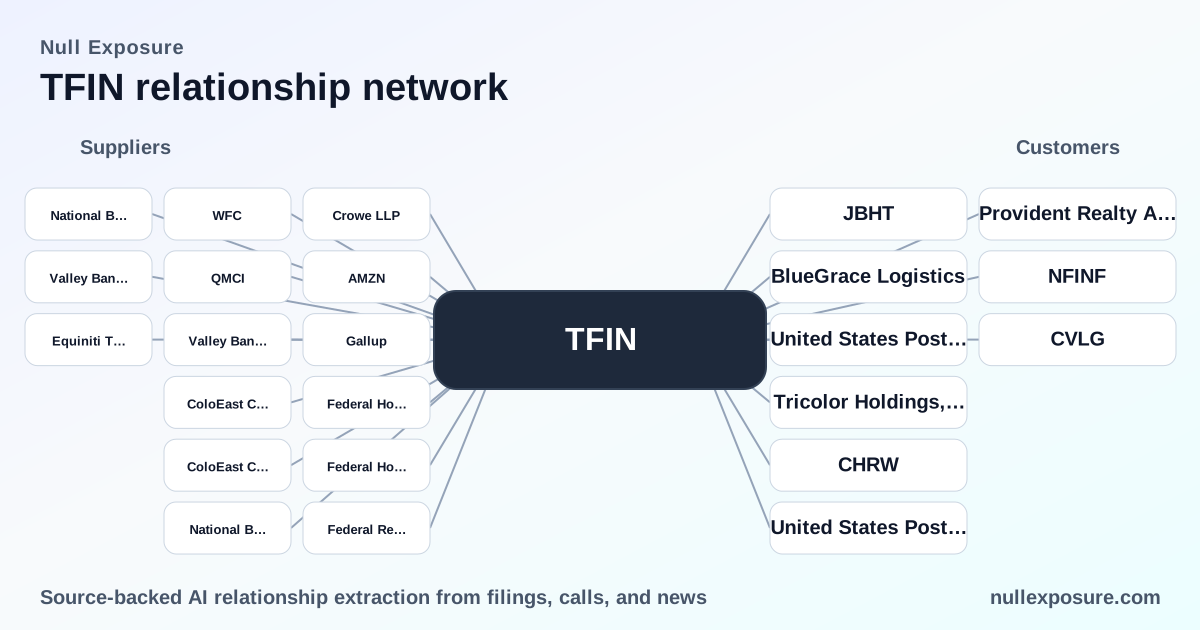
Supplier map: every named relationship and what it means for investors
Crowe LLP
Crowe LLP is Triumph’s independent registered public accounting firm and has audited the company since 2012; the firm also issued an attestation on internal control over financial reporting in the FY2026 Form 10‑K. This establishes audit continuity and external control validation. Source: Triumph 2025 Form 10‑K filing (FY2026) — https://ir.triumph.io/sec-filings/all-sec-filings/content/0001539638-26-000007/tfin-20251231.htm
Amazon Web Services (AWS)
Triumph primarily relies on Amazon Web Services to deliver its Payments and Factoring platforms, and its 10‑K explicitly warns that a disruption at AWS could impair operations—flagging meaningful cloud concentration for core production systems. Source: TradingView summary of Triumph 10‑K and Triumph 10‑K language (FY2026) — https://www.tradingview.com/news/tradingview:45e32539bb83f:0-triumph-financial-inc-sec-10-k-report/ and https://ir.triumph.io/sec-filings/all-sec-filings/content/0001539638-26-000007/tfin-20251231.htm
Gallup
Triumph uses Gallup engagement surveys to measure employee satisfaction and development feedback; this is an HR/vendor relationship intended to support retention and culture. Source: Triumph 2025 Form 10‑K filing (FY2026) — https://ir.triumph.io/sec-filings/all-sec-filings/content/0001539638-26-000007/tfin-20251231.htm
Federal Home Loan Bank (FHLB)
Triumph borrows from the Federal Home Loan Bank as part of its funding and liquidity program; FHLB advances are collateralized by a blanket pledge of certain loans, indicating an on‑balance-sheet secured funding line. Source: Triumph 2025 Form 10‑K filing (FY2026) — https://ir.triumph.io/sec-filings/all-sec-filings/content/0001539638-26-000007/tfin-20251231.htm
Federal Reserve Bank of Dallas
The company has agreements with the Federal Reserve Bank of Dallas to borrow from the discount window, which provides an emergency liquidity backstop and reflects the banking charter’s access to central bank facilities. Source: Triumph 2025 Form 10‑K filing (FY2026) — https://ir.triumph.io/sec-filings/all-sec-filings/content/0001539638-26-000007/tfin-20251231.htm
Wells Fargo Bank, National Association
An indenture dated September 30, 2016 lists Wells Fargo as trustee for certain issued instruments, evidencing Wells Fargo’s role in Triumph’s capital markets documentation and trust administration. Source: Triumph 2025 Form 10‑K filing (FY2026) — https://ir.triumph.io/sec-filings/all-sec-filings/content/0001539638-26-000007/tfin-20251231.htm
QuoteMedia
Triumph’s IR pages and press releases show that market data and delayed quotes are powered by QuoteMedia, a standard vendor for investor relations displays. Source: Triumph press release and IR calendar references (Q4 2025 and FY2025 pages) — https://ir.triumph.io/news-events/press-releases/detail/312/triumph-releases-fourth-quarter-2025-financial-results and https://ir.triumph.io/news-events/ir-calendar
Capital trusts and preferred funding sponsors (ColoEast, National Bancshares, Valley Bancorp)
Triumph lists multiple capital trust counterparties—ColoEast Capital Trust I & II, National Bancshares Capital Trust II & III, and Valley Bancorp Statutory Trust I & II—with specific outstanding amounts and SOFR-based spreads, reflecting structured capital and trust-issued funding used to support regulatory capital or liability management. These instruments show diversified trust funding across maturity profiles and floating-rate coupons. Source: Triumph 2025 Form 10‑K filing (FY2026) — https://ir.triumph.io/sec-filings/all-sec-filings/content/0001539638-26-000007/tfin-20251231.htm
Equiniti Trust Company
Triumph references a deposit agreement with Equiniti Trust Company (dated June 19, 2020) for depositary receipt administration, indicating a third‑party agent role for equity recordkeeping. Source: Triumph 2025 Form 10‑K filing (FY2026) — https://ir.triumph.io/sec-filings/all-sec-filings/content/0001539638-26-000007/tfin-20251231.htm
What these relationships reveal about Triumph’s contracting posture and exposure
- Contracting posture: Triumph’s public disclosures and constraint excerpts emphasize numerous third‑party service relationships and short-duration lending lines. The company-level signal shows a service-provider orientation—operational functions are outsourced or supported by external vendors rather than fully captive infrastructure.
- Concentration and criticality: AWS is a single-point production dependency for Payments and Factoring platforms; that is the clearest operational concentration risk. Audit and control assurance come from a long-term relationship with Crowe (since 2012), which supports financial reporting credibility.
- Funding profile and maturity: The presence of multiple trust vehicles and FHLB advances signals diversified funding sources with varying maturities, but they are all sensitive to short-term rate movements given their SOFR-linked coupons. The company notes that some lending exposures average less than 30 days, underscoring a largely short-term asset base that requires continual funding access.
- Spend and internal transfers: Evidence shows modest intersegment payments (example: $3,643 in factoring receipts from Payments), suggesting vendor/spend lines in the low millions in certain areas rather than large, multi-year outsourcing contracts.
For practitioners tracking counterparty risk, these patterns recommend prioritizing cloud‑service continuity, funding counterparty health, and audit/controls stability. If you need automated monitoring of these vectors, explore our supplier analytics at https://nullexposure.com/.
Investment implications and near-term watchlist
- Operational risk: Cloud concentration with AWS places operational availability and cybersecurity at the top of the watchlist; any major cloud outage would have outsized effects on transaction volumes.
- Funding and rate sensitivity: SOFR‑linked trust instruments and FHLB access tie Triumph’s cost of capital to short-term rates; rising SOFR increases coupon bills and compresses net interest spread.
- Control environment: Continuity with Crowe and an attestation on internal controls are positive governance signals for investors underwriting earnings quality.
- Vendor dependency vs. flexibility: The service-provider posture provides agility but creates vendor management overhead—contracts are often shorter and more tactical, so contract renewal and third‑party resilience require active oversight.
If you evaluate TFIN exposure for procurement, risk or investment decisions, our platform maps these dependencies and delivers alerts when counterparties shift. Learn more at https://nullexposure.com/.
Bottom line for investors
Triumph’s supplier footprint matches a hybrid fintech-bank model: mission‑critical cloud infrastructure, diversified but rate‑sensitive funding partners, and established external audit and investor‑relations providers. The principal investment risks are operational concentration on AWS and funding cost variability via SOFR‑linked instruments; the principal governance strength is longstanding audit coverage and documented internal control attestation. For active evaluation of these relationships and to receive alerts when critical supplier signals change, visit https://nullexposure.com/.