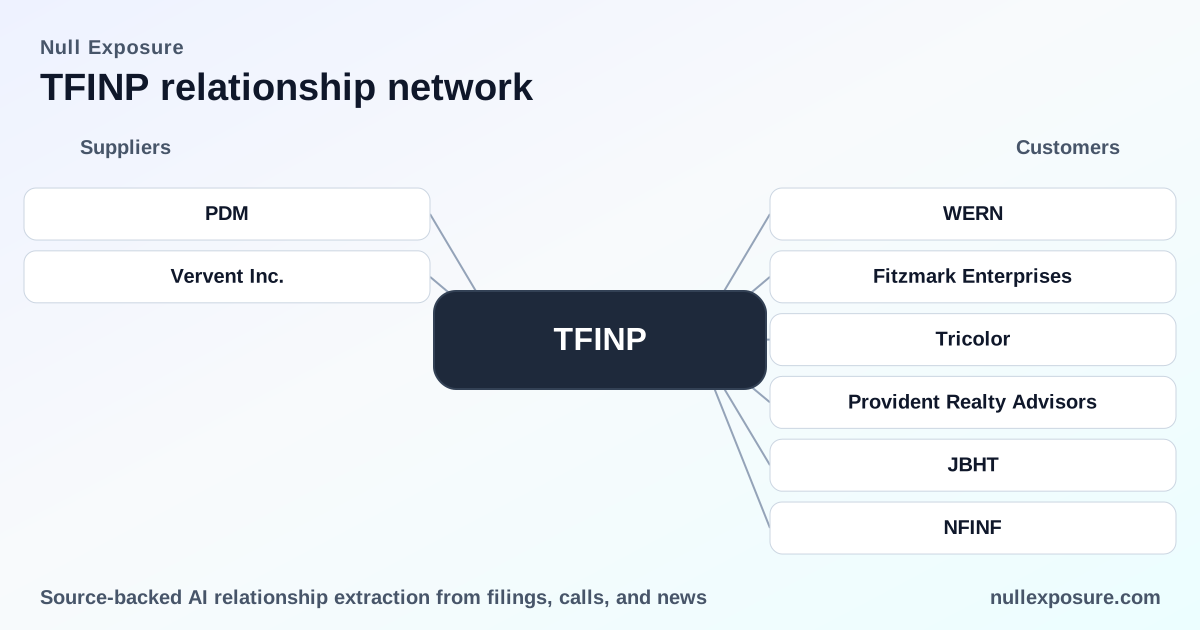
Triumph Financial Inc (TFINP): Supplier relationships that move capital and collateral
Triumph Financial Inc operates as a regional financial and technology platform that monetizes through payments processing, factoring, and bank-like deposit and lending services, extracting fee income from transaction flows and interest spread from credit products. For investors and operations teams, Triumph’s supplier relationships—real estate sellers and third‑party servicers—translate directly into balance sheet placement, collateral control, and operational risk that affect capital deployment and recovery economics. Learn how these external links influence credit exposure and operational resilience at https://nullexposure.com/.
Market-facing facts matter: Triumph reported roughly $409 million in trailing revenue, a 13.9% operating margin, but a modest 3.33% net margin and low ROE, indicating a business that generates meaningful top-line scale but operates with thin net returns that amplify supplier and servicer risk.
Why suppliers matter for Triumph
- Triumph’s business model concentrates on asset-backed flows—factoring and vehicle financing—so third‑party control of collateral and physical assets directly affects recovery timelines and loss severity.
- Real estate transactions shape the firm’s operational footprint and fixed-cost base; property acquisitions shift liquidity and capital allocation.
- Servicers and trustees handle the practical enforcement of collateral rights; disruptions or contested control escalate costs and extend recovery periods.
Explore supplier exposure and mapping at https://nullexposure.com/.
What the supplier relationships say (two live signals)
Piedmont Office Realty Trust, Inc. (PDM)
- Triumph purchased an office building from Piedmont Office Realty Trust for $54 million, which represents a direct real‑estate investment that expands Triumph’s property holdings and alters its capital allocation profile. According to a Dallas News report in December 2025, Atlanta‑based Piedmont had owned the building for about a decade before the sale to Triumph.
- This acquisition converts a supplier interaction (seller) into an owned asset, increasing Triumph’s fixed‑asset base and concentrating capital into real estate rather than pure lending or payments infrastructure; investors should treat the purchase as a capital redeployment with real‑estate risk. Source: Dallas Morning News coverage of the transaction, December 2025.
Vervent Inc.
- A trustee instructed Triumph to stop relocating vehicles and advocated that Vervent Inc. assume control of both the fleet and the related loans, signaling an adjudicated operational hand‑off from Triumph to an external servicer. A BadCredit news article covering FY2025 described a trustee order that pushed for a third‑party servicer, Vervent, to take operational control of the fleet and loans.
- This is a classic servicer intervention: control of physical collateral and cash collection moved externally, increasing short‑term operational friction and likely raising collection costs while preserving legal enforcement. Source: BadCredit article on collateral protection issues, FY2025.
Operational constraints and company-level signals
There are no supplier‑specific constraint excerpts in the available source feed; however, company‑level characteristics derive directly from Triumph’s operating model and public metrics:
- Contracting posture: Triumph operates with a servicer‑dependent posture for asset enforcement—outsourced or trustee‑mediated servicer relationships matter for realization timing and operational continuity. This is a structural feature of asset-backed finance rather than an episodic exposure.
- Concentration: The company’s strategy includes material exposure to on‑balance-sheet assets and selected real‑estate investments, which elevates counterparty and asset concentration risk relative to a pure fee‑income payments firm.
- Criticality: Supplier functions tied to collateral control (vehicle servicers, trustees) are highly critical; loss of a servicer or contested custody actions will directly impair cash flow and increase loss severity.
- Maturity and governance signals: As a NASDAQ‑listed regional financial operator with established revenues and dividend history, Triumph shows corporate maturity sufficient to engage institutional sellers and servicers, but its modest ROE and low net margins mean the firm has limited buffer against unexpected supplier‑driven shocks.
These company‑level signals guide how procurement, counterparty monitoring, and contingency planning should be structured for both credit and operational teams.
What investors and operators should watch next
- Collateral control trends: Any trustee orders or servicer transitions, like the Vervent case, shorten or lengthen recovery timelines—model both outcomes and price stress scenarios accordingly.
- Capital allocation tradeoffs: The $54 million property purchase shifts liquidity and may compress capacity for originations or reserve buffers; treat property acquisition as a strategic decision with measurable opportunity cost.
- Counterparty durability: Vet servicers for legal standing, insurance, and claims handling proficiency; a robust servicer reduces loss severity and turnaround time.
- Disclosure cadence: Monitor Triumph’s filings and local press for additional property or servicer actions—these events are operable signals that translate quickly into balance sheet impacts.
Key takeaways (bold for emphasis)
- Supplier actions are not peripheral: they materially alter asset control, liquidity, and recovery economics.
- Real estate purchases convert supplier transactions into fixed assets, concentrating balance‑sheet risk.
- Servicer or trustee interventions change operational control and escalate collection costs.
If you evaluate counterparties or run operational risk for credit portfolios, map servicer contracts and escalation clauses now; our platform provides the supplier‑level traceability to do that efficiently—start at https://nullexposure.com/.
Final operational guidance
For credit officers: incorporate servicer‑change scenarios into loss models and set requirements for immediate notification when trustees or courts intervene. For operations teams: maintain playbooks for rapid transition of custody, secure chain‑of‑title, and vendor redundancy. For investors: price Triumph’s exposure to supplier disruption as part of overall leverage and liquidity cushions—thin net margins and modest ROE increase sensitivity to supplier incidents.
To review supplier relationships and trace how each external party influences recovery outcomes across your portfolio, visit https://nullexposure.com/ and connect supplier signals to credit models and operational playbooks.
Bold conclusion: Supplier and servicer dynamics are determinant variables for Triumph’s credit performance—treat them as primary drivers, not secondary details.