Terra Income Fund 6 (TFSA): who runs the fund, who gets paid, and what that means for investors
Thesis: Terra Income Fund 6 is an externally-managed commercial real-estate income vehicle that monetizes primarily through interest and equity positions in income-producing CRE and distributes a targeted yield (7.00% stated distribution). The economics depend on external management and intercompany cost- and fee-sharing with Terra REIT and affiliates, and recent corporate actions have engaged dealer and exchange agents to restructure securities. For investors evaluating supplier risk, the essential questions are concentration of management, fee flow to the external adviser, and the operational impact of recent exchange offers. Learn more at https://nullexposure.com/.
A compact description of how TFSA makes money and how it is organized
Terra Income Fund 6 purchases senior secured loans and equity stakes in commercial real estate and returns cash to investors through periodic distributions funded by interest, loan repayments and asset-level cash flows. The fund is externally advised and relies on Terra REIT Advisors (an affiliate of Mavik Capital Management) to source, underwrite and manage assets, while Terra REIT serves as the parent and counterparty in cost-sharing and fee reimbursement arrangements. That external-management model concentrates operational control — fee flows are a principal channel through which value and expenses are allocated across the group.
Visit the firm homepage for supplier intelligence: https://nullexposure.com/.
Who the key suppliers and counterparties are (and why they matter)
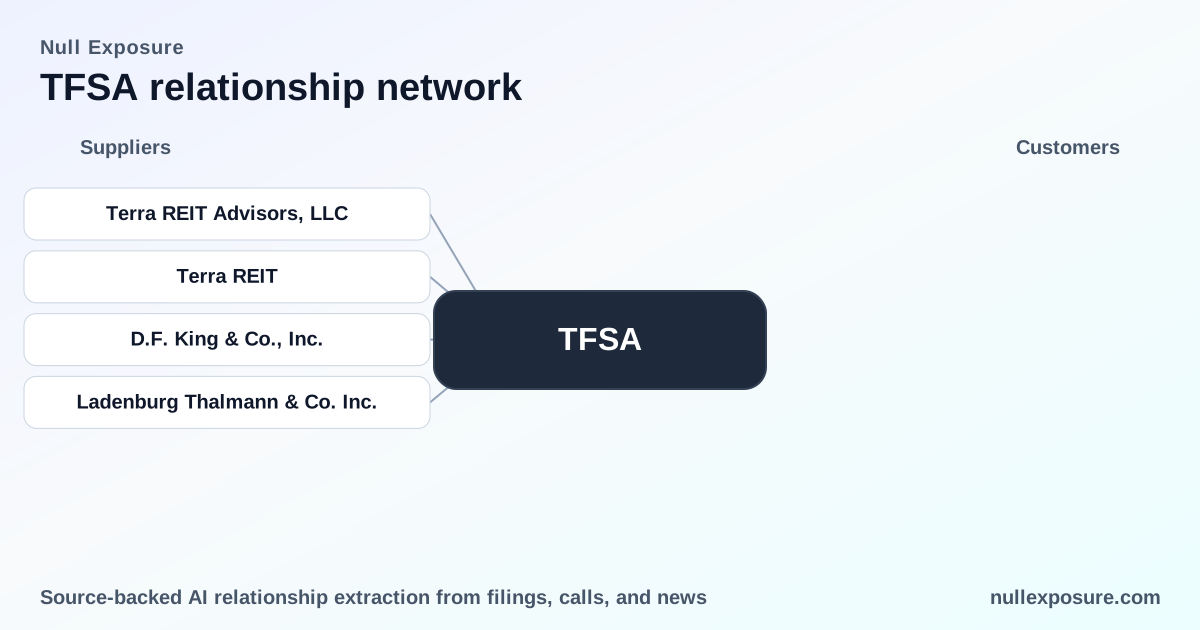
Below I cover every identified supplier relationship in available reporting. Each entry is a plain-English take and the reporting that supports it.
Terra REIT Advisors, LLC — external manager and day-to-day operator
Terra REIT Advisors is the external manager that handles asset management and ongoing operations for the combined business, and management fees are contractually payable by the parent (Terra REIT) under the amended management agreement. According to a CityBiz write-up on the merger closing, Terra REIT Advisors will continue to manage the combined company (reporting first seen March 2026), and SahmCapital filings in FY2026 describe the adviser relationship explicitly. The management-fee language in public filings confirms that the external manager is the principal operational provider and a concentrated service point for the fund.
Sources: CityBiz coverage of the merger closing (reported March 2026); SahmCapital filing summaries referencing the management agreement (FY2026).
Terra REIT — parent, cost-sharing and fee recipient
Terra REIT is the parent and a central counterparty in cost-sharing and reimbursement arrangements, with public commentary noting lower operating expenses driven by reduced asset-management and reimbursement fees paid to Terra REIT in FY2025. TradingView’s summary of the fund’s SEC filing highlights a cost-sharing agreement between Terra LLC and parent Terra REIT that governs reimbursements for management and transaction fees. These arrangements mean intra-group economics materially influence TFSA’s expense base and distributable cash.
Sources: StockInvest summary of FY2025 results noting decreased operating expenses and lower fees to Terra REIT (FY2025); TradingView synopsis of the SEC 10-Q (FY2025).
D.F. King & Co., Inc. — exchange agent and information agent on corporate actions
D.F. King functioned as the exchange agent and information agent for the registered exchange offers and consent solicitation, which signals a formal corporate restructuring or liability management process in FY2026. SahmCapital’s notice of the exchange offers lists D.F. King as the agent handling communications and processing.
Source: SahmCapital release on Terra Property Trust’s registered exchange offers and consent solicitation (FY2026).
Ladenburg Thalmann & Co. Inc. — dealer manager for exchange offers
Ladenburg Thalmann acted as dealer manager for the same exchange offers and consent solicitation, meaning the firm led solicitation and distribution activities to holders during the restructuring process in FY2026. That role places Ladenburg at the center of investor outreach and placement logistics for the corporate action.
Source: SahmCapital release on the exchange offers and consent solicitation (FY2026).
What the contractual signals and constraints tell investors about operational risk
The public constraint evidence explicitly names Terra REIT Advisors and establishes that management fees are payable by the parent to the external manager under an amended and restated Management Agreement. That fact carries four investor-relevant implications:
- Contracting posture — externalized and concentrated. The fund relies on a single external manager for sourcing and running assets, a classic externally-managed REIT-style posture that creates vendor concentration risk and limits internal fallback options.
- Concentration risk — single counterparty for management. Because fees flow to the adviser and the adviser is an affiliate of Mavik Capital, the operational and economic fate of TFSA is tightly linked to that entity’s incentives and capacity.
- Criticality — high operational dependence. The adviser performs core functions (asset management, transaction execution). Any disruption in that relationship would directly affect asset performance and distributions.
- Maturity and governance signal. The presence of a formal, amended management agreement and cost-sharing arrangements shows a mature, documented governance structure but also signals that expense and fee allocations are executory levers the sponsor can adjust to preserve distributions.
The constraint excerpt therefore functions as a high-confidence signal that TFSA is an externally-managed vehicle with concentrated supplier risk at the adviser level.
Visit https://nullexposure.com/ for further supplier analytics and to map counterparty concentration across managed funds.
Operational and market implications for investors
Two practical implications flow from the supplier map and the recent corporate activity:
- Fee and cashflow sensitivity. Reported reductions in operating expenses in FY2025 were driven by lower management and reimbursement fees to Terra REIT, which directly improves net cash available to distribute — but also highlights how fee allocation choices materially move distributable income. Investors should value TFSA primarily on net yield after intercompany fee flows.
- Corporate-action execution risk. The engagement of D.F. King and Ladenburg to support exchange offers in FY2026 indicates active liability/capital restructuring. These roles are not merely administrative; they shape investor outcomes in consent solicitations and can alter the securityholder landscape quickly.
Key takeaway: the fund’s yield and stability are a function of asset performance plus sponsor-managed fee mechanics; the external adviser and parent-company arrangements are the operational levers.
How to act on this supplier intelligence
- If you underwrite TFSA’s yield, stress-test scenarios that adjust management and reimbursement fees by +/-20% to capture the direct funding impact on distributions.
- For portfolio managers, demand disclosure of the management agreement terms, termination provisions, and any affiliate economic arrangements before committing material size.
- For research teams, map counterparty concentration across the sponsor group to determine correlated event risk across related vehicles.
Final thought: Terra Income Fund 6 delivers a clearly defined income proposition but derives significant operational exposure to its external manager and parent. That architecture creates both the efficiency of outsourced expertise and the concentration risk of single-provider dependence. For a deeper supplier map and ongoing monitoring of these relationships, go to https://nullexposure.com/.
Sources referenced above include public reporting summarized in CityBiz (merger close report, March 2026), StockInvest (FY2025 results coverage), TradingView’s SEC filing synopsis (FY2025), and SahmCapital notices regarding the FY2026 exchange offers and consent solicitation.