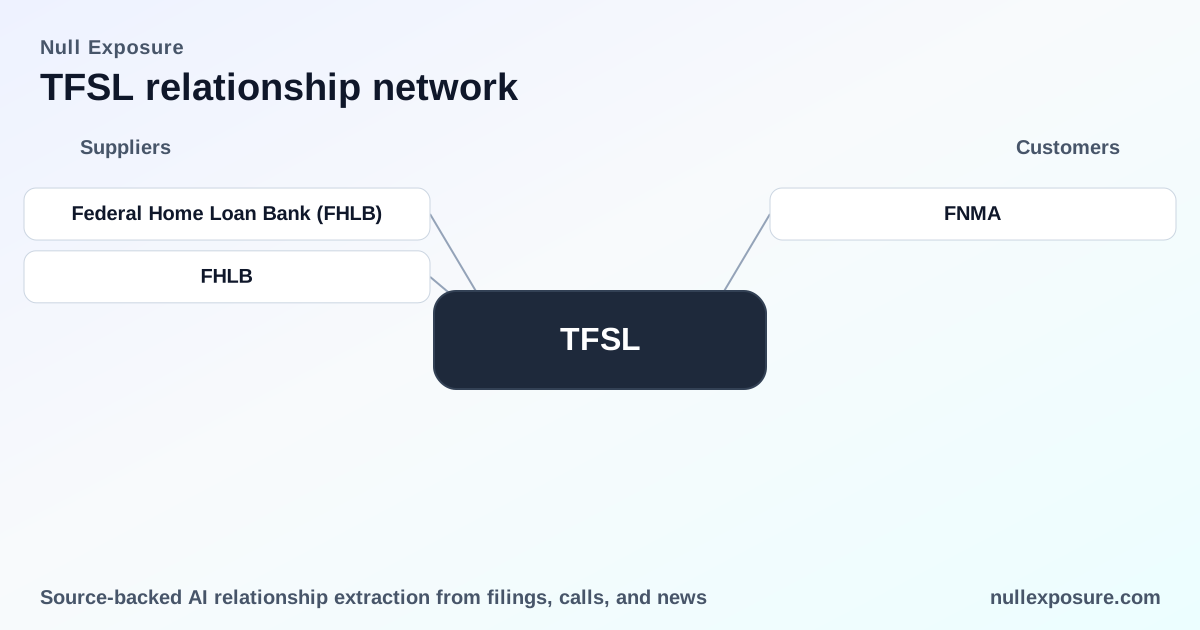
TFS Financial Corporation (TFSL): funding relationships that shape margin and risk
TFS Financial Corporation is a retail-focused regional bank that monetizes through net interest margin on mortgage and consumer lending, funded by a mix of retail deposits, brokered certificates of deposit, and wholesale borrowings. The company uses interest-rate hedges to extend the effective duration of shorter-term funding while preserving liquidity, and its funding counterparties are a material part of its balance-sheet economics and operational risk profile.
If you evaluate bank counterparties, liquidity posture, or supplier concentration for investments or operations, review this note and the sourcing carefully — and start from the company’s own disclosures at the source linked below.
Explore more supplier intelligence at https://nullexposure.com/
The funding relationship that matters: Federal Home Loan Bank exposure is central
TFS discloses substantial borrowings from the Federal Home Loan Bank system. As of December 31, 2025 the company reported $1.55 billion of long-term advances, $2.95 billion of three‑month advances (hedged via swaps to longer effective durations), and $270 million of overnight borrowings all from the FHLB, plus $150 million of fed funds purchased. Those figures come from the company’s FY2026 first-quarter results disclosed in public filings and summarized in press releases distributed in early 2026. (Company press release, FY2026 Q1; see Morningstar coverage, January 29, 2026.)
Why this is important: those line items indicate high reliance on secured wholesale funding through a government-sponsored counterparty, with material short-term and long-term tranches that are actively hedged. Hedging reduces repricing mismatch but introduces counterparty, margin, and clearing considerations.
How the relationship is structured — implications for funding cost and maturity
TFS uses a mixture of maturity profiles and interest-rate exchange contracts to convert shorter-dated advances into longer effective durations. The company explicitly states the use of interest rate swaps tied to three-month advances to extend duration, and it also uses both longer-term and shorter-term brokered CDs from FHLB of Cincinnati as cost‑effective funding alternatives. (Company FY2026 Q1 statement; Morningstar press summary, Jan 29, 2026.)
Key operational point: all swap transactions are cleared through a registered clearing broker into a central clearing organization, which creates daily margin obligations and potential upfront cash or securities posting requirements in stressed scenarios. That clearing structure reduces bilateral credit risk but creates liquidity pressure if market moves force margin calls.
Company-level supplier constraints and what they signal
- Contracting posture and maturity: Company disclosures place emphasis on longer-term contracts and hedging to lock in funding economics while using shorter-term instruments synthetically extended; this signals an intentional mismatch-management strategy rather than opportunistic short-term funding. The filing specifically names advances from the FHLB of Cincinnati as part of that program.
- Counterparty type: The FHLB is a government-sponsored counterparty, and the company treats it as a principal wholesale funding source — a structural feature that reduces credit-default exposure compared with unrated private counterparties.
- Relationship role and stage: The company characterizes external firms (clearing brokers and other vendors) as service providers and lists them as active vendors for operating and risk-management functions; this is a company-level signal about third-party reliance rather than a document-level statement about any single counterparty.
Operational and market risks investors should monitor
- Liquidity and rollover risk tied to the mix of short-term FHLB advances and overnight borrowings, even when hedged into longer-effective durations. The weighted average maturities provided in the filing (long-term advances ~1.7 years; three-month advances with effective maturity ~2.8 years under swaps) shape refinancing windows.
- Margin and collateral exposure from cleared interest-rate swaps and central clearing margining, which can amplify cash flow volatility in stress.
- Concentration risk from heavy FHLB usage: large, bilateral exposure to a single government-sponsored funding source is a central counterparty risk, even though the FHLB carries government-sponsored status.
- Operational dependence on clearing brokers and external vendors to execute hedging and ongoing operations, which raises vendor management and business-continuity considerations.
Visit https://nullexposure.com/ to view supplier breakdowns and comparative funding profiles across regional banks.
Every supplier and counterparty referenced in public results
Federal Home Loan Bank (FHLB) — The company reported significant borrowings from the FHLB: $1.55 billion of long‑term advances (weighted average maturity ~1.7 years), $2.95 billion of three‑month advances aligned with interest‑rate swaps (effective maturity ~2.8 years), and $270.0 million in overnight borrowings, along with $150 million of fed funds purchased. This disclosure appears in TFS’s FY2026 first-quarter results and was summarized in the company press release covered by Morningstar on January 29, 2026, and reiterated in other press summaries in March 2026.
(Those two press sources reference the same underlying company disclosure: the Morningstar-distributed company release for FY2026 Q1 and an international press summary that republished the release.)
Tactical takeaways for investors and operators
- Funding concentration drives valuation sensitivity. Heavy reliance on FHLB advances changes how interest-rate moves and central-counterparty margin shocks translate into liquidity stress for the bank.
- Hedging is deliberate but not costless. Interest-rate exchange contracts extend effective funding duration but create recurring margin needs; investors should model both NII stability and stress-period liquidity drains.
- Operational vendor risk is an ongoing governance priority. Clearing brokers, central clearing memberships, and other external vendors are active suppliers; error, outage, or dispute in those relationships would have operational and liquidity implications.
For a practical next step, institutional investors should reconcile the company’s disclosed maturity ladder and swap collateral policies with scenario analyses; operators should validate vendor SLAs and clearing margin contingencies.
Explore supplier exposure comparisons and deeper counterparty maps at https://nullexposure.com/
Bottom line and recommended actions
TFS’s funding strategy relies on material wholesale borrowings from the FHLB combined with synthetic duration extension via cleared swaps, a configuration that stabilizes net interest income in normal conditions but increases liquidity and margin‑call sensitivity in stressed markets. Active vendor relationships and cleared swaps broaden operational attack surfaces that governance functions must monitor.
If you are assessing TFSL for investment or counterparty risk, prioritize (1) maturity-ladder reconciliation, (2) collateral/margin contingency funding plans, and (3) vendor resilience testing. For comparative supplier intelligence and relationship-level detail, visit https://nullexposure.com/ to see how TFSL’s profile stacks up against peers.