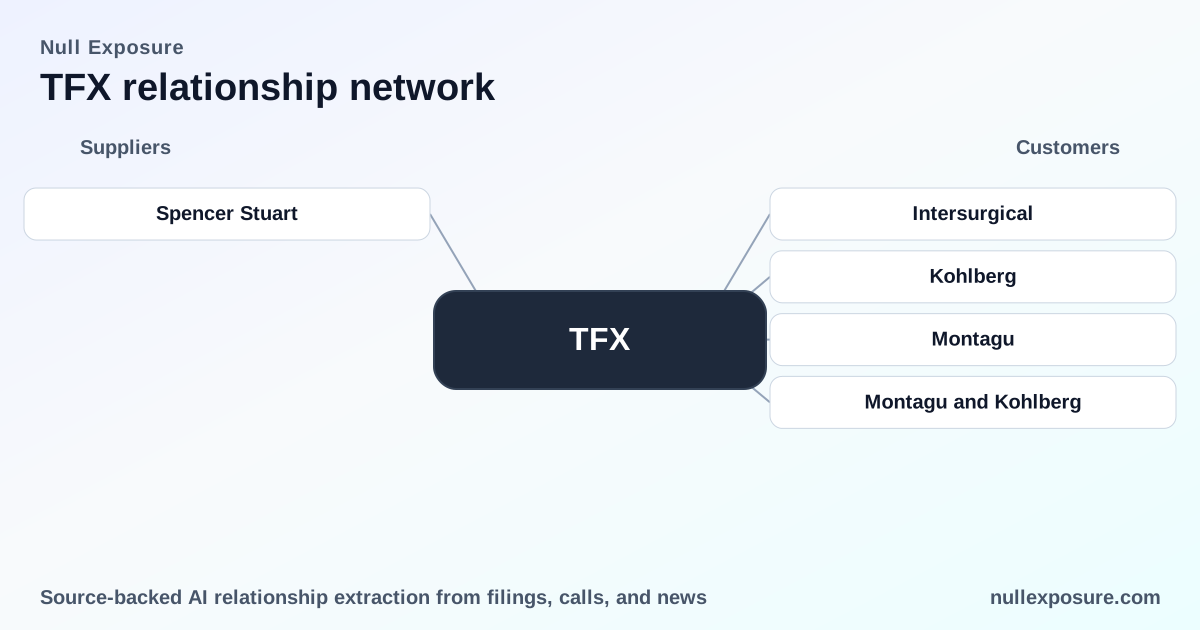
Teleflex (TFX): Supplier relationships and what they mean for investors
Teleflex is a global manufacturer of specialty medical devices that sells products used in critical care and surgery and monetizes through device sales, recurring consumables, and aftermarket sterilization and service lines. The company funds operations with a mix of long-term credit and short-term receivables financing while managing foreign‑exchange and counterparty risk through multi‑party swap arrangements. For investors, Teleflex combines stable healthcare end markets with active financial engineering — the equity trades at a premium multiple while the balance sheet shows both secured working capital programs and material reserves tied to regulatory exposure.
Explore supplier and counterparty signals for other names at https://nullexposure.com/.
Why the board’s CEO search is a supplier‑risk signal for operators and investors
Teleflex’s board engaged Spencer Stuart to run a search for a permanent CEO, a move that changes executive leadership dynamics and has direct implications for supplier contracting posture and strategic continuity. Leadership transition at this scale typically accelerates vendor reviews, potential repricing of service agreements, and shifts in procurement priorities — all items that matter for counterparties and investors focused on supplier stability.
- According to Teleflex’s GlobeNewswire press release dated January 8, 2026, the board formally engaged Spencer Stuart to lead a comprehensive search for the next CEO.
- MassDevice reported on March 10, 2026 that Spencer Stuart was actively assisting Teleflex’s board in the search process, emphasizing the public nature of the transition.
Both notices confirm the board’s choice of a leading executive search firm to manage a planned leadership change, a governance event that will ripple into supplier management and contract reviews.
Each external relationship observed — concise, sourced takes
Spencer Stuart: The board retained Spencer Stuart to conduct a comprehensive executive search for a permanent CEO, signaling an organized and professional approach to leadership succession that will influence strategic priorities and vendor negotiations. (GlobeNewswire press release, January 8, 2026; MassDevice coverage, March 10, 2026)
- GlobeNewswire: “The Board has engaged Spencer Stuart, a leading executive search firm, to assist in a comprehensive search process to identify a permanent CEO.” (January 8, 2026)
- MassDevice: Coverage confirmed the board’s engagement of Spencer Stuart and framed it as part of the company’s leadership transition. (March 10, 2026)
What the constraint signals tell investors about Teleflex’s operating model
Teleflex’s public filings and disclosures reveal a nuanced supplier and financing posture that investors and operators must parse together.
-
Contracting posture — diversified maturity mix. Teleflex runs both long‑term and short‑term financing programs: a five‑year revolving credit and term loan package that matures in November 2027 provides committed liquidity, while a $75 million accounts‑receivable securitization facility supplies flexible short‑term working capital. This combination signals an intentional split between committed credit capacity and dynamic working‑capital management.
- Evidence: the Third Amended and Restated Credit Agreement (five‑year facility to November 4, 2027) and the $75 million receivables conduit noted in recent annual disclosures.
-
Concentration — vendor dispersion, but regulatory pockets of exposure. Teleflex reports that it purchases manufacturing and sterilization materials from a large number of suppliers across diverse geographies and is not dependent on any single supplier for a substantial portion of inputs. That lowers supplier concentration risk. However, regulatory exposure to government payback schemes in specific markets introduces localized revenue risk and reserve volatility.
- Evidence: company disclosure of broad supplier sourcing and a $22.1 million reserve taken related to Italy’s payback measure (reflecting government counterparty exposure).
-
Counterparty credit and criticality — relationships with large finance institutions. For hedging and liquidity, Teleflex uses cross‑currency swap agreements with multiple, large, well‑established financial institutions — a setup that reduces single‑counterparty credit risk while exposing the company to systemic market and counterparty events common to major banks.
- Evidence: cross‑currency swap arrangements with nine different counterparties as described in filings.
-
Geography and operational maturity — global sourcing, mature supply base. Procurement and sterilization services are global, indicating a geographically dispersed supply chain and a mature vendor network that supports scale manufacturing and distribution.
- Evidence: explicit statement that materials and sterilization services are purchased from a large number of suppliers in diverse geographic locations.
Collectively, these signals describe a company with established supplier relationships, diversified sourcing, and active financial management — but also exposed to localized regulatory risk that has produced material revenue adjustments.
How these relationship dynamics affect commercial counterparties
Leadership transitions, established credit facilities, and global sourcing policies create distinct negotiation dynamics for suppliers and partners:
- A board‑level CEO search typically produces a short‑term period of vendor reassessment and contract rebalancing, which can accelerate renegotiations or procurement consolidations under new strategic priorities.
- Long‑term committed credit to 2027 paired with receivables financing implies stable liquidity to honor supplier contracts, while also incentivizing suppliers to optimize payment terms given the company’s active working‑capital programs.
- The company’s assertion of low supplier dependence is a negotiating lever for Teleflex in price and service discussions; conversely, suppliers with unique sterilization capabilities or regionally constrained inputs retain negotiating power.
If you evaluate counterparties to medical device OEMs, these are the dynamics that should shape commercial terms and risk pricing. Visit https://nullexposure.com/ to compare Teleflex’s supplier posture across peers.
Investment implications and risk checklist
For investors and supplier operators, the emergent picture supports a measured stance:
- Upside: Stable end markets for critical‑care devices, diversified supplier base, and committed credit capacity support operational continuity. Teleflex’s forward P/E of 16.78 (vs trailing 83.38) suggests earnings expectations on the horizon consistent with current guidance and analyst targets.
- Downside: Leadership turnover introduces execution risk; the Italian government payback outcome already forced a $22.1 million revenue reduction and reserve — a reminder that regulatory counterparty risk is real and can hit revenue unexpectedly.
- Operational watch items: supplier concentration metrics (confirming immaterial dependency), currency swap counterparty exposure, and the timeline for CEO appointment are immediate monitoring priorities.
Final verdict and next steps
Teleflex operates with a mature supplier base and layered financing that supports commercial continuity, but regulatory exposures and governance transition are active risk vectors. Investors should treat supplier contracts as relatively low concentration risk but load balance exposure to European regulatory shifts and leadership execution.
For a broader view of supplier intelligence and to compare Teleflex against peer supplier networks, visit https://nullexposure.com/. For tailored supplier risk assessments and relationship benchmarking, our platform aggregates disclosure signals and market reporting to inform commercial and investment decisions — start at https://nullexposure.com/.