The Generation Essentials Group (TGE): underwriting ties, ownership concentration, and what suppliers and investors should price in
Thesis: The Generation Essentials Group (TGE) is a publicly listed operator that, per its corporate description, provides crude oil transportation services across Wyoming, Colorado and Kansas and monetizes through fee-based transportation contracts and capacity commitments; its public-market financing to date has been structured through a boutique underwriting relationship for a $150 million offering. Investors and counterparties should treat TGE as a small-cap, founder-controlled business with modest institutional support, where financing relationships and ownership concentration materially shape contracting posture and access to capital.
Explore the company profile and relationship map at https://nullexposure.com/ for deeper due-diligence and monitoring.
Why the underwriting relationship matters to investors and counterparties
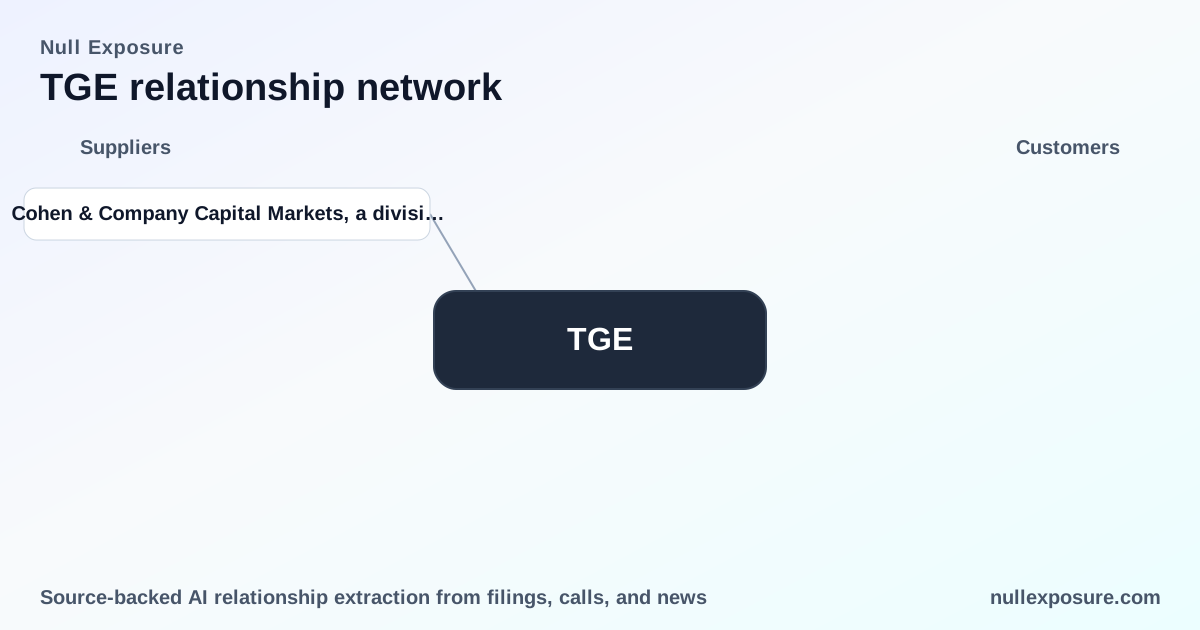
Underwriting partners tell a clear story about how a company sources capital and positions itself with the market. TGE’s use of Cohen & Company Capital Markets as sole underwriter and book-runner for its $150 million offering signals a boutique-led capital raise rather than a syndicate-led transaction. That structure typically points to a targeted placement strategy, potential limits on distribution depth, and a financing run that leans on specialized placement capabilities rather than broad institutional coverage.
A boutique sole underwriter can result in faster execution and greater control for insiders, but also means less breadth of sell-side coverage after the deal — an important factor for suppliers evaluating counterparty stability and payment risk.
The reported supplier/underwriter relationships — every item in the record
-
A PR Newswire release distributed via The Manila Times reported that Cohen & Company Capital Markets, a division of Cohen & Company Securities, LLC, acted as the sole underwriter and sole book‑running manager for the $150 million offering. This public announcement frames the transaction as a single-manager IPO/financing execution. (PR Newswire/The Manila Times, Dec 23, 2025) — https://www.manilatimes.net/2025/12/23/tmt-newswire/pr-newswire/first-the-generation-essentials-group-sponsored-spac-announces-successful-closing-of-150-million-ipo/2248367
-
Vietnam-based coverage replicated the underwriting disclosure, noting Cohen & Company Capital Markets served as sole underwriter and book-runner for the offering, reinforcing that market communications were distributed across international outlets. (Vietnam Investment Review online report summarizing the IPO closing, FY2025) — https://vir.com.vn/generation-essentials-spac-closes-150-million-dollar-ipo-143506.html
-
An international investor news feed likewise relayed the same point: Cohen & Company Capital Markets acted as sole underwriter and sole book-running manager for the offering, emphasizing consistency across press distribution channels. (Futunn/English investor news summary, FY2025) — https://news.futunn.com/en/post/66556764/first-the-generation-essentials-group-sponsored-spac-announces-successful-closing
Each of the three items repeats the same underwriting fact in independent press venues; treat them as corroborating distribution of the same transaction message rather than separate underwriting arrangements.
Company-level constraints and what they reveal about contracting posture
TGE’s public financials and ownership signals should be read as characteristics of its operating and business model rather than isolated statistics:
-
High insider ownership (approximately 75.8%) combined with low institutional ownership (~6.5%) indicates concentrated control, which produces a contracting posture that favors fast decision-making and insider-aligned terms but reduces the buffer of institutional governance. Suppliers should expect negotiation with a dominant insider group rather than a diffuse investor base.
-
Small market capitalization (~$64.9M) and thin float (shares float ~7.45M of ~29.18M outstanding) create limited liquidity and elevate the importance of discrete financing events (like the $150M offering) for balance-sheet flexibility. That amplifies the criticality of each capital raise to ongoing operations and supplier payment confidence.
-
Valuation multiples are compressed (trailing P/E
2.27; price-to-book$34.5M) show the company generates operating cash but trades at a steep discount to book. This points to either market skepticism about growth/margins or structural risks priced into equity — a material factor for counterparties evaluating long-term contract pricing and security requirements.0.098), while trailing revenue ($130.2M) and EBITDA (
These are company-level operating signals; no constraint excerpt in the record assigns them to a specific supplier relationship.
What this means for suppliers, operators, and investors
-
Counterparty risk is concentrated. With a dominant insider base and limited institutional support, suppliers are effectively contracting with a company whose governance and operational levers are tightly held — expect less public oversight and fewer covenant concessions driven by institutional investors.
-
Financing strategy is boutique-focused. The sole-underwriter relationship suggests TGE will rely on targeted capital partners when it needs liquidity rather than broad syndication. For suppliers, that implies financing windows can be discrete and timing-sensitive.
-
Valuation and cash generation are asymmetric. The company produces revenue and EBITDA but trades at low multiples, so suppliers should price in the possibility of operational tightening or renegotiation if market sentiment remains weak.
If you are evaluating TGE as a supplier or counterparty, factor in concentrated ownership when negotiating payment terms, collateral, and escalation clauses.
Discover relationship maps and provider signals relevant to your diligence at https://nullexposure.com/.
Tactical recommendations for counterparties and investors
- Require contractual protections (advance payments, shorter payment terms, or performance bonds) given ownership concentration and limited public-market depth.
- Set triggered review clauses tied to financing events; the company’s reliance on discrete underwriting relationships makes those events high-leverage moments.
- Monitor press distribution for replication of financing messages — consistent multi-outlet coverage, as seen here, confirms intent but not necessarily distribution depth.
Final read: concentrated control, boutique financing, and the margin for error
The underwriting disclosures show a single, boutique underwriting partner executed a $150 million offering — a clear signal about how TGE accesses capital. Combined with heavy insider ownership, small market cap, and compressed valuation metrics, the company’s profile favors fast, centralized decision-making but elevates execution risk for suppliers and investors. Contract terms and capital-event clauses should be calibrated accordingly.
For ongoing monitoring, relationship mapping, and provider-level intelligence, visit https://nullexposure.com/ to integrate these signals into your counterparty risk framework.