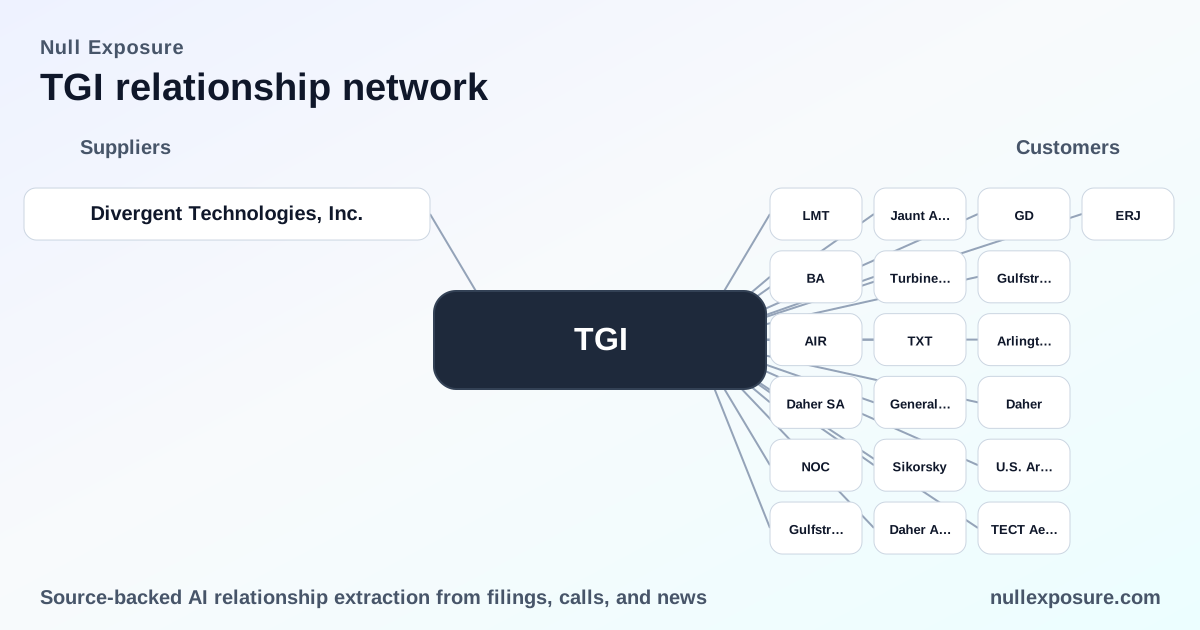
Triumph Group (TGI) — Supplier Landscape & What the Divergent Tie Signals for Investors
Triumph Group operates as an aerospace supplier and engineering integrator that monetizes through the design, production and aftermarket support of airframe structures, assemblies, and mission-critical components for commercial and defense customers. The company generates revenue by contracting for engineering and manufacturing services, delivering qualified components into production lines, and capturing aftermarket aftermarket spares and MRO revenue streams tied to installed equipment. The supplier footprint and the ability to transition prototypes into production quickly are direct drivers of margin and contract win rates.
Learn more at https://nullexposure.com/.
Why this supplier news matters to investors: a short read
Triumph’s public interactions with advanced manufacturing suppliers are not cosmetic partnerships; they reflect procurement choices that accelerate qualification timelines and protect production schedules. Winning first-time-right qualifications reduces cost overruns and shortens ramp-to-revenue — a direct P&L lever for an OEM supplier like Triumph.
What the public disclosures show about Divergent Technologies
Divergent Technologies — PR Newswire disclosure (FY2025 / Mar 2026)
Triumph used Divergent’s fully digital toolchain to design, prototype and qualify a gearbox component for a manned aircraft, delivering production-fidelity structures that achieved first-time-right performance and enabled a smooth transition to production. According to the PR Newswire release dated March 10, 2026, the collaboration covered design, engineering, prototyping and qualification phases and emphasized production-readiness. (PR Newswire, March 10, 2026)
Divergent Technologies — VoxelMatters coverage (FY2025 / Mar 2026)
VoxelMatters’ reporting on the same partnership reiterated that Divergent’s end-to-end digital processes produced production-fidelity test articles that removed barriers between prototype testing and production release, reducing iteration cycles and qualification friction. VoxelMatters published this coverage on March 10, 2026. (VoxelMatters, March 10, 2026)
What these relationship entries imply about Triumph’s operating posture
There are no explicit contractual constraint records in the data set, but company-level signals are clear from the supplier engagements. Investors should treat the following operating-model characteristics as structural signals of how Triumph runs its supply chain and captures value:
- Contracting posture — strategic and capability-focused. Triumph is selecting suppliers that offer capability expansion (digital design-to-production workflows) rather than purely commodity supply, indicating a supplier strategy that prioritizes speed-to-qualification and technical differentiation.
- Concentration and vendor selection — targeted, not broad-brush. The visible evidence shows targeted partnerships with specialist manufacturers; Triumph’s approach is to integrate niche technology providers to de-risk new-product qualification timelines rather than replace established large-scale vendors.
- Criticality — production-critical interfaces. The supplier relationship centers on qualification of a gearbox component, a safety- and schedule-critical item for manned aircraft. Supplier performance on qualification directly affects delivery windows and revenue recognition.
- Maturity — advanced but adoption-stage for digital manufacturing. The partners deliver production-fidelity outcomes, which signals an industrialized digital workflow, but the market proof comes from successful qualification and ramp outcomes, which remain the final maturity test.
Strategic implications — risks and upside for investors
Triumph’s use of specialized digital suppliers produces concrete operational advantages and concentrated risks.
- Upside: Faster qualification cycles and “first-time-right” engineering reduce schedule slippage and cost-to-serve; this improves margins on new contracts and strengthens competitive positioning for follow-on production awards. Reliable qualification is revenue-accretive.
- Risk: Dependence on specialist suppliers for qualification of complex components increases supplier management complexity and execution risk during ramp. If a supplier underperforms, the cost of late fixes on production-critical hardware can be high. Procurement and program management execution are material governance vectors.
- Operational leverage: Successfully integrating digital toolchains into manufacturing flow creates a durable advantage by lowering unit cost of design iteration and shortening time-to-market for variant introductions.
Practical checklist for analysts and procurement teams
When evaluating Triumph’s supplier relationships, focus on a narrow set of actionable items that track program delivery and financial implications:
- Confirm qualification milestones and acceptance criteria cadence for the component in question.
- Monitor ramp schedules tied to revenue recognition triggers and aftermarket warranty exposure.
- Assess supplier redundancy plans and escalation clauses in large-ticket production contracts.
- Track follow-on awards that use the same supplier technology as a signal of durable vendor integration.
How investors should act on this information
- Re-rate Triumph’s operational execution if subsequent filings show accelerated qualification-to-production timelines and early production volumes; improvements in ramp execution translate directly into cash-flow visibility.
- Add supplier execution metrics to your watchlist (time-to-qualification, first-pass yield on test articles, ramp units delivered) as leading indicators of margin expansion.
Visit https://nullexposure.com/ for supplier mapping and watchlist tools.
Final takeaways
- The Divergent relationship is evidence of Triumph’s deliberate move toward capability-driven suppliers that shorten the path from engineering to production. Public reporting shows that Triumph achieved first-time-right production-fidelity structures with a partner offering a fully digital toolchain. (PR Newswire; VoxelMatters, March 10, 2026)
- This operating stance improves upside from new-contract wins but raises execution and vendor-management risk that investors should monitor closely. Focus on qualification milestones, ramp volumes, and contract terms in subsequent reporting cycles.
For deeper supplier intelligence and ongoing monitoring, go to https://nullexposure.com/.
By tying procurement strategy to measurable qualification outcomes, Triumph’s supplier choices become a leading factor for near-term revenue and medium-term margin trajectory. Investors should treat successful digital-manufacturing partnerships as both an operational catalyst and an execution risk that requires active monitoring.