TGNA (Tegna Inc.) — supplier relationship brief for investors
TEGNA is a local news and technology company that monetizes through a mix of local broadcast advertising, national ad products (including streaming/app inventory via its Premion unit), retransmission fees, and content/talent contracts with material multi-year commitments. The business relies on long-term programming and talent commitments at scale, strategic commercial partnerships for digital ad distribution, and distribution through major app stores and network affiliations to reach audiences. For a practical supplier-risk read on TGNA, review how commercial partners, platform relationships, and talent/programming contracts concentrate spend and create operational leverage. Learn more at https://nullexposure.com/.
How TGNA makes money and why supplier relationships matter
TEGNA operates a portfolio of local television stations and a growing digital/streaming stack. Revenue mixes local spot advertising and national streaming inventory sales, underpinned by content costs and multi-year talent/programming commitments that are large relative to annual cash flow. Financials show Revenue TTM $2.71B, EBITDA $555M, and operating margin ~17.9%, while quarterly revenue and earnings growth have been negative year-over-year, signaling the business is sensitive to advertising cycles and distribution shifts. The supplier footprint therefore directly affects cost structure (programming and talent commitments) and distribution reach (app stores, network affiliations, and third-party ad-delivery partners). If you manage counterparty exposure or underwriting, these relationships determine both disruption risk and upside from product distribution.
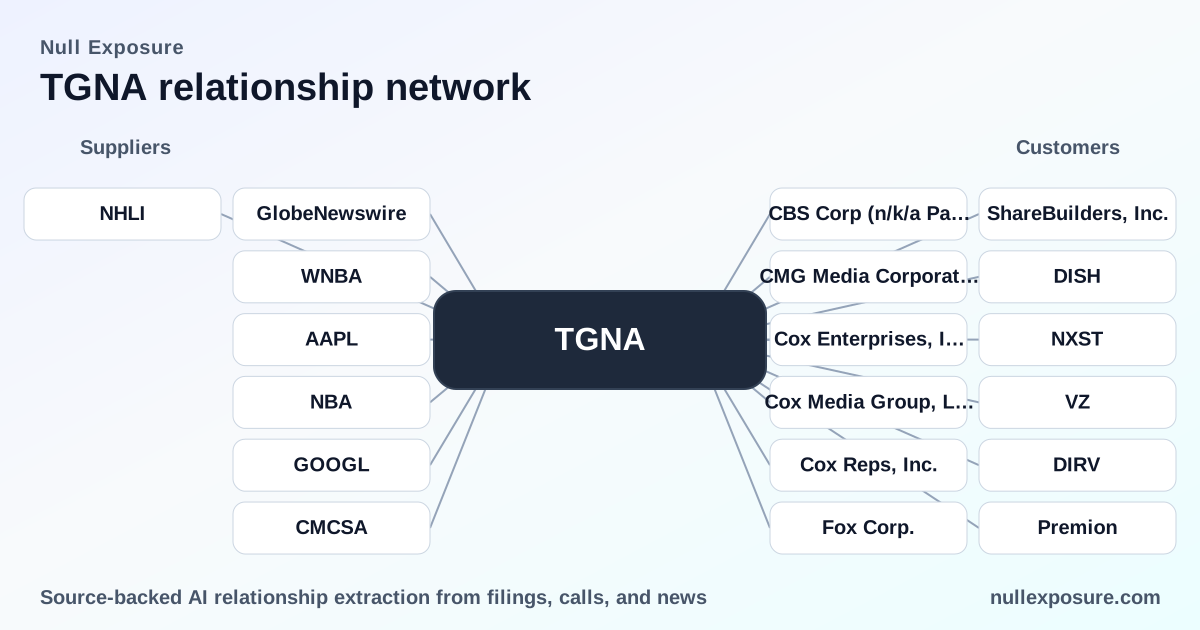
Relationship map: who TGNA is working with and why it matters
Below I cover every relationship in the source results; each entry is a one- to two-sentence plain-English summary with the citing source.
GlobeNewswire — company press releases and product launches
TGNA used GlobeNewswire to distribute a corporate press release announcing a new mobile app rollout across 50 markets and associated engagement metrics. According to the GlobeNewswire release (distributed Jan 28, 2026), the company highlighted the app launch and expanded local news distribution through mobile channels.
Quiver Quant (reporting on GlobeNewswire) — amplification of product metrics
A QuiverQuant news item summarized the GlobeNewswire announcement, reporting TGNA’s claim of a 10x increase in video consumption as the new mobile app scaled. The QuiverQuant summary referenced the GlobeNewswire press release (first seen Mar 10, 2026).
Yahoo Finance (SG) — App Store and Google Play distribution
TGNA’s new mobile app launched in beta markets and is available in both the App Store and Google Play Store, indicating platform distribution agreements and reliance on mobile store ecosystems for audience reach. Yahoo Finance (SG) covered the rollout and the staggered market launches (article referenced Mar 10, 2026).
App Store (Apple, AAPL) — distribution channel
TGNA’s product availability in Apple’s App Store is material to digital reach and monetization of streaming inventory; the App Store listing was explicitly referenced in coverage of the app launch. The Yahoo Finance piece noted the app’s availability on the App Store during the Jan–Mar 2026 rollout.
Google Play Store (Alphabet, GOOGL) — distribution channel
TGNA’s Android distribution through Google Play is likewise cited as the other primary mobile channel for the new app, enabling broader audience capture for local news and video ad inventory. Yahoo Finance reported Google Play availability in the same Jan–Mar 2026 coverage.
NBC (WXIA / Comcast, CMCSA referenced) — local network affiliation
TGNA’s WXIA (11Alive) in Atlanta operates as an NBC affiliate, and press coverage cited WXIA’s editorial recognition (e.g., a Dupont-Columbia award) as part of TGNA’s local station portfolio. The Manila Times reprinted a GlobeNewswire item noting WXIA’s role and award recognition (reported Jan 29, 2026).
NBA / WNBA / NHL — sports rights relationships and programming value
Reporting about potential industry consolidation noted that TGNA holds local broadcast deals with sports leagues including NBA, WNBA and NHL teams, which increase the value of its live-sports inventory and heighten programming commitments. An Awful Announcing article covering consolidation scenarios referenced these local sports rights in the context of a Nexstar-Tegna merger discussion (coverage first seen Mar 10, 2026).
(Each of the above items was derived from the mapped news items and press coverage aggregated in March 2026, reflecting TGNA’s announced app rollout, platform distribution, local station affiliations, and local sports rights.)
What the constraints tell investors about TGNA’s operating model
The disclosed constraints in filings and press material give clarity on contracting posture, concentration, criticality, and maturity of supplier relationships:
- Long-term contracting posture: TGNA documents multi-year contracts that “cover a period of up to five years,” demonstrating a preference for multi-year commitments that lock in programming and distribution economics and create predictable near-term cash outflows.
- High-cost, concentrated programming and talent commitments: Company disclosures show total programming commitments of $2.53 billion (with $911.4 million payable within 12 months) and multi-year talent/employment agreements with amounts due of approximately $227.3 million (about $136.1 million payable within 12 months). This establishes programming and talent as high-impact, fixed-cost supplier categories.
- Material commercial relationship with MadHive (service provider): TGNA holds equity in MadHive and incurred $58.1 million in expenses under commercial agreements in 2024, where MadHive supports Premion’s streaming app ad inventory acquisition and ad delivery/tracking. That is an explicit service-provider relationship combining strategic partnership and meaningful spend (company-level signal: mid-to-high spend band).
- Maturity and criticality profile: The combination of long-term contracts for programming/talent and multi-year commercial agreements with ad-technology partners signals that suppliers are critical to both content delivery and monetization, with medium-to-high maturity (established partnerships rather than experimental pilots).
Investment implications — risk, leverage, and catalysts
- Risk profile: High fixed commitments for programming and talent create downside cashflow sensitivity if advertising revenue softens; TGNA’s recent quarterly revenue and earnings declines underscore this vulnerability. Concentration in large multi-year commitments increases refinancing and renegotiation risk during cyclical advertising downturns.
- Operational leverage and growth vectors: The Premion/MadHive relationship and the new mobile app distribution through App Store/Google Play present upward leverage: better streaming ad yield and audience aggregation can boost national digital revenue with lower incremental programming spend.
- Catalysts to monitor: Uptake of the app (reported 10x video consumption gains) and monetization of streaming inventory; any changes to sports-rights contracts; and the progress of potential M&A activity in the local-broadcast sector that would revalue local-sports inventory.
If you are modeling counterparty exposure or assessing supplier concentration, prioritize programming/talent commitments and the MadHive commercial agreement as high-impact items. For a structured third-party supplier risk assessment and to benchmark TGNA’s supplier posture against peers, visit https://nullexposure.com/.
Bottom line and recommended next steps
TEGNA’s supplier footprint is a hybrid of large, long-dated content/talent commitments and strategic digital-ad technology partnerships that jointly determine profit sensitivity and growth optionality. Investors should treat programming and talent contracts as primary fixed-cost exposure, with MadHive and app-store distribution as strategic enablers of higher-margin digital revenue. For due diligence or to map counterparties and contractual risk in greater depth, start with a supplier exposure scan at https://nullexposure.com/.
Bold, focused action on supplier visibility will materially clarify downside risk and upside optionality for TGNA’s investment case.