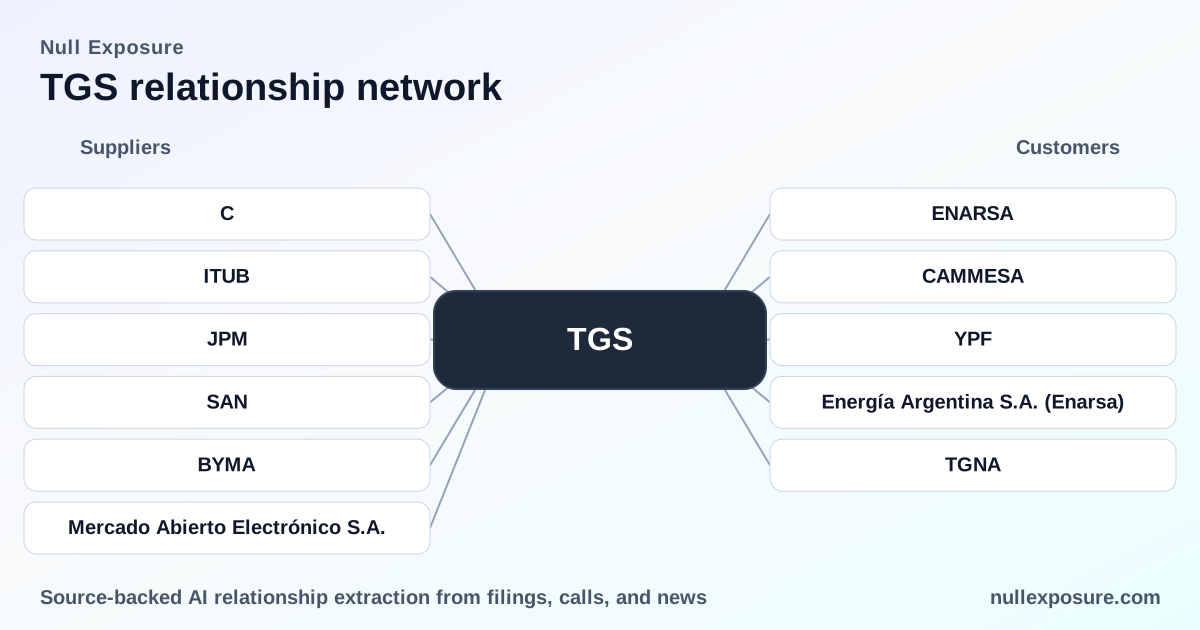
Transportadora de Gas del Sur (TGS): what the supplier-side capital markets activity tells investors
Transportadora de Gas del Sur (TGS) operates and monetizes a regulated and contracted natural gas transportation and midstream business in Argentina, collecting tariff-style transportation revenues and merchant fees tied to volume throughput and processing operations. The company funds infrastructure and liquidity through capital markets — including the March 2026 $490 million global bond offering and concurrent tender offer — which surfaces important supplier and counterparty relationships that influence refinancing flexibility and market access. For a deeper look at counterparties and what they imply for operational counterpart risk, visit https://nullexposure.com/.
Business model and operating posture in plain business terms
TGS is an infrastructure-oriented energy supplier: stable, tariff-linked cash flows dominate revenue, with the company reporting Revenue TTM of 1.72 trillion ARS and an Operating Margin of 45% as of the December 2025 quarter, indicative of a mature midstream operator with predictable cash generation. The firm’s business model is commodity-light relative to upstream producers because it earns fees for moving and processing gas rather than selling commodity volume directly. That creates a contracting posture focused on long-term network agreements and regulated tariffs rather than spot-market exposures.
Concentration and criticality are meaningful: TGS is deeply concentrated in the Argentine market and functions as a critical piece of national gas infrastructure, so political and FX risk translate directly into cash-flow volatility and capital markets access sensitivity. Institutional ownership is modest (about 14% institutional holdings), reinforcing the need for active banking relationships to underwrite public debt issuance and tender processes.
Why the March 2026 bond deal matters for supplier relationships
The March 2026 transaction is not just a financing — it is a relationship signal. TGS appointed a syndicate of major global banks as initial purchasers and dealer managers for the offering and tender, and the notes are slated to list domestically. That combination preserves foreign capital access while anchoring securities in local trading venues, which is a practical choice for an Argentine infrastructure issuer balancing dollar funding needs and domestic investor liquidity.
The direct implication for supplier and operator counterparties is twofold: first, banking partners are central to funding and liability management, and second, domestic listing venues shape secondary market liquidity and investor base composition. Both influence negotiating leverage with suppliers and the company’s ability to smooth capital-intensive maintenance and capex cycles.
Who the company dealt with in the recent transaction
Citigroup Global Markets Inc.
Citigroup Global Markets acted as one of the initial purchasers and as a dealer manager in TGS’s $490 million global bond offering and the concurrent tender offer, demonstrating Citi’s role in underwriting and liability-management workflows for the issuer. This is documented in a Cleary Gottlieb announcement dated March 10, 2026.
Itau BBA USA Securities Inc.
Itau BBA USA Securities participated as an initial purchaser and dealer manager on the same transaction, signaling regional bank syndicate strength in Latin American sovereign and corporate issuance for TGS’s financing needs. The participation is noted in the Cleary Gottlieb March 10, 2026 release.
J.P. Morgan Securities LLC
J.P. Morgan Securities served as an initial purchaser and dealer manager in the offering and tender, contributing to distribution reach and execution capability for the $490 million issuance, according to the Cleary Gottlieb announcement from March 2026.
Santander US Capital Markets LLC
Santander US Capital Markets joined the syndicate as an initial purchaser and dealer manager, representing another global bank channel used by TGS to place its bonds and manage the concurrent tender, as described by Cleary Gottlieb on March 10, 2026.
Bolsa y Mercados Argentina S.A. (BYMA)
TGS expects the new notes to list on the Bolsa y Mercados Argentina S.A. (BYMA) for trading; that domestic listing choice positions the securities for local market participation and regulatory visibility, per the Cleary Gottlieb statement (March 2026).
Mercado Abierto Electrónico S.A.
The transaction also contemplates listing on Mercado Abierto Electrónico S.A., which complements BYMA listing ambitions and expands domestic trading avenues for the notes, as noted in the Cleary Gottlieb release (March 2026).
What these relationships imply for investors and operators
- Counterparty depth and market access are strong. The involvement of Citigroup, J.P. Morgan, Itau BBA and Santander indicates broad distribution capability and institutional support for TGS’s dollar funding needs. That reduces near-term refinancing risk relative to an issuer without such relationships.
- Domestic liquidity and regulatory profile are prioritized. Choosing BYMA and Mercado Abierto Electrónico listings demonstrates a deliberate strategy to align securities with local investor bases and regulatory frameworks, which improves governance visibility but concentrates exposure to Argentine market conditions.
- Operational risk remains macro-driven. Regardless of bank support, TGS’s cash flows are exposed to tariff-setting, political decisions, and FX regimes that can shift economics for suppliers and operators; bank-led financing is a mitigant for liquidity, not a hedge against sovereign policy shifts.
Investors should treat the bank syndicate participation as a positive signal of execution capability, while treating domestic listing as a reminder of concentrated market risk.
Visit https://nullexposure.com/ for comparison and deeper counterparty analysis.
Practical due diligence checklist for supplier and investor relationships
- Review the bond prospectus and tender-offer mechanics for covenant language, cross-default triggers, and currency clauses.
- Map counterparty exposure: quantify fee and covenant concentration to the major banks and track secondary-market liquidity on BYMA and Mercado Abierto Electrónico.
- Stress-test cash flows under adverse tariff and FX scenarios; simulate covenant breach thresholds given leverage multiples.
- Monitor regulatory filings and local market commentary post-listing for shifts in investor composition and trading liquidity.
Final read: how to position
TGS operates as an infrastructure cash-flow engine with strong operating margins and clear capital markets engagement. The March 2026 $490 million transaction and the roster of global banks as initial purchasers provide execution confidence for refinancing and liability management, while BYMA and Mercado Abierto listings tie the company to domestic market dynamics. For investors and operators, the balance is straightforward: capitalize on predictable tariff-style revenue but underwrite concentrated market and policy exposure when sizing positions or contracting counterparties.
If you evaluate supplier networks or need a comparative view of counterparties across issuers, start with a focused counterparty review at https://nullexposure.com/. For ongoing monitoring of these relationships and execution signals, see https://nullexposure.com/ for curated market commentary and relationship mapping.