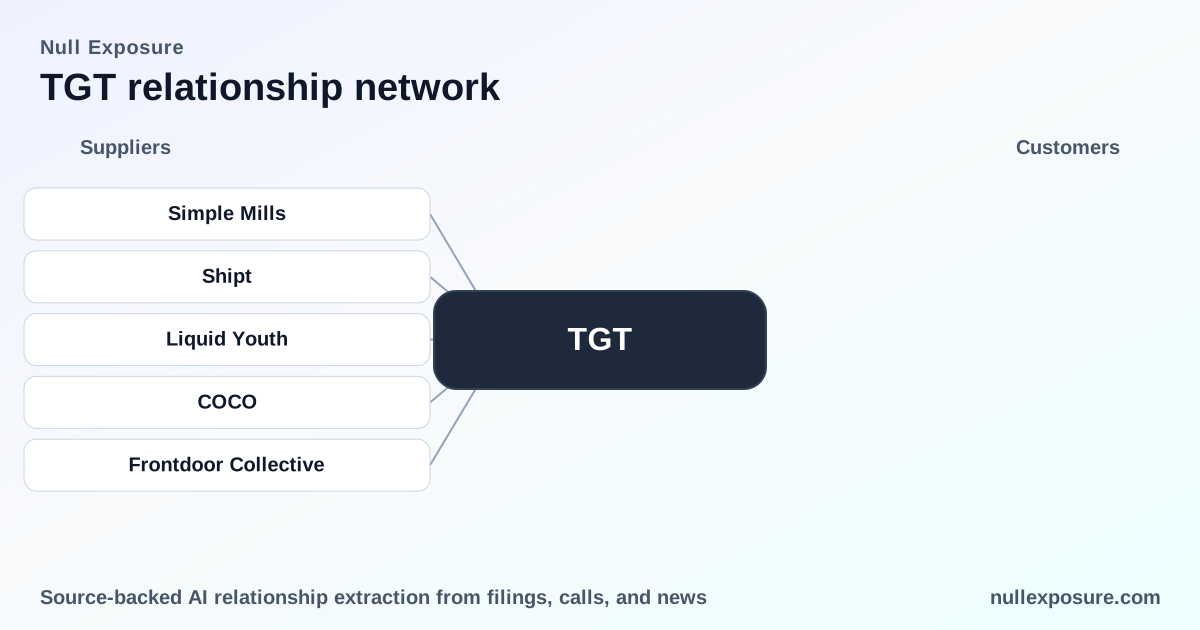
Target (TGT) supplier landscape — what investors and operators need to know
Target operates as a mass-market retailer that monetizes through merchandise sales, owned brands, and increasingly through fulfillment and delivery services, combining large-format stores with digital channels and a same-day delivery capability via its Shipt subsidiary. Revenue derives from product margins, private-label premium positioning, and operational leverage across its store and distribution footprint; incremental monetization comes from services that improve customer frequency and share-of-wallet. For a concise view into supplier exposures and partner motion, see https://nullexposure.com/.
How Target’s supply chain converts into economic value
Target’s business model depends on three linked drivers: product assortment (including owned brands), store and digital fulfillment, and logistics-driven service differentiation. Revenue TTM of roughly $105 billion and gross profit of roughly $29.3 billion underline that merchandise margins are the dominant profit engine, while delivery and distribution investments support customer retention and higher-frequency spend.
- Contracting posture: Target operates with short-term supplier arrangements and early-payment programs that give the company flexibility and bargaining power; vendor early-payment options do not change the company’s remittance obligations and can be terminated with up to 120 days’ notice, which compresses supplier leverage.
- Concentration and sourcing: A significant portion of merchandise is sourced from outside the U.S., with China as the single largest import source, so procurement and logistics decisions track global trade and APAC sourcing dynamics.
- Role diversity and maturity: Target engages suppliers as sellers, distributors, and service providers (including common carriers and third-party distributors), reflecting a mature, multi-channel supply base rather than single-purpose vendors.
- Financial scale and spend posture: Vendor obligations and confirmed early-payment programs signal vendor spend in excess of $100 million, indicating that Target’s supplier relationships are material and commercially strategic.
These structural signals make Target’s supplier book highly transactional but highly strategic—flexible contracting and large-scale spend deliver negotiating leverage while APAC sourcing concentration creates geopolitical and logistic risk.
Suppliers and partners in the public record
Simple Mills
Simple Mills is a branded consumer packaged goods partner whose products are sold in Target’s grocery assortment alongside other major grocers and e-commerce platforms. According to a Baking Business profile (March 2026), Simple Mills grew into a category-leading brand that is listed at Target and other national retailers. (Baking Business, Mar 10, 2026)
Shipt
Shipt operates as Target’s delivery subsidiary and handles last-mile fulfillment in many markets, with Target routing store-pulled orders through sortation centers and delivering to neighborhoods via Shipt or third-party carriers. FreightWaves reported on Target’s next‑day delivery rollout to additional cities and explained how packages are batched and routed for Shipt delivery. (FreightWaves, Mar 2026)
Liquid Youth
Liquid Youth is expanding retail distribution with launches at mass retailers including Target and Walmart, signaling Target’s openness to national CPG rollouts for emerging brands. MarketBeat captured an announcement noting Liquid Youth’s retail footprint expansion into Target in early 2026. (MarketBeat instant alert, Mar 2026)
Vita Coco Company, Inc.
Vita Coco has executed an exclusive flavor launch with Target—an example of Target’s use of retailer exclusives to drive in-store traffic and category differentiation. A Vita Coco promotional release noted a nationwide Target exclusive Cherry Vanilla flavor for Vita Coco Treats. (Sahm Capital / Vita Coco news release, Mar 4, 2026)
Frontdoor Collective
Target is testing electric vehicle delivery and selected Frontdoor Collective as a partner for EV delivery trials, reflecting Target’s experimentation with low-emission last-mile options alongside Shipt and third-party carriers. FreightWaves referenced Frontdoor Collective in coverage of Target’s next‑day delivery expansion and EV tests. (FreightWaves, Mar 2026)
What the company-level constraints mean for supply partners
The public constraint excerpts provide clear operating signals that translate into practical supplier behaviors and investor implications:
- Short-term contracting with early-payment options: Vendors can elect early payment at a discount while Target’s remittance and payment cycles remain unchanged; arrangements are terminable with up to 120 days’ notice. This creates pricing pressure on suppliers but gives Target agility to reallocate shelf space and sourcing if economics shift.
- Large financial counterparties for derivatives: Target’s interest-rate hedging exposes it to large global financial institutions, a corporate finance signal rather than a supplier-level dependency, but relevant when assessing counterparty credit and treasury practices.
- APAC sourcing concentration, primarily China: The supply chain is geographically concentrated, creating exposure to tariffs, logistics disruption, and regulatory shifts that impact margin and inventory velocity.
- Multiple relationship roles: Target sources through sellers, distributors, and service providers, so supplier performance metrics must align with inventory flow, store-level distribution, and digital fulfillment SLAs.
- High vendor spend scale: Confirmed vendor obligations and early-payment pools exceeding several billion dollars indicate material procurement spend, which supports supplier scale but also gives Target leverage in commercial terms.
These constraints indicate a supplier environment that is large-scale, operationally disciplined, and price-sensitive, with strategic opportunities for partners that can deliver scale, reliability, and exclusive product propositions.
Learn more about supplier exposure analysis at NullExposure.
Risk and opportunity implications for operators and investors
Target’s supplier signals create a concentrated set of operational risks and commercial opportunities:
- Risk — Sourcing concentration: Heavy reliance on APAC, particularly China, elevates risk to input cost and lead-time volatility.
- Risk — Contract pressure: Short-term, terminable arrangements and early-payment programs favor buyers and compress supplier margins.
- Opportunity — Private-label and exclusives: Brands like Vita Coco and Simple Mills demonstrate the value of retailer exclusives for premium positioning and faster shelf adoption.
- Opportunity — Fulfillment partners: Shipt and EV pilot partners like Frontdoor Collective create differentiated delivery economics and customer experience advantages.
Investors should underweight suppliers that cannot scale to Target’s financial and service demands and overweight partners capable of delivering exclusives, tight lead times, and logistics integration.
Bottom line: what to act on now
- Target’s supply relationships are strategically material and financially large—expect rigorous commercial terms and short contract cycles.
- Delivery and fulfillment partnerships are becoming a competitive frontier, with Shipt and EV pilots signaling ongoing investment in last-mile economics.
- Sourcing concentration in APAC is the single largest operational risk to margins and inventory resiliency.
For investors and operators focused on supplier risk and opportunity, a targeted review of partner scale, margin tolerance for early-payment programs, and logistics capability will identify the strongest candidates for durable relationships.
Explore fuller exposure analysis and supplier monitoring at https://nullexposure.com/ — and contact NullExposure for bespoke supplier risk mapping and alerts.