TG Therapeutics (TGTX): supplier relationships that determine commercial delivery and upside
TG Therapeutics is a commercial-stage biopharma that monetizes through product sales of BRIUMVI, licensing and milestone receipts (notably the azer‑cel partnership), and royalties. The company’s model blends direct commercial revenue (TTM revenue ~$616.3M) with structured partner economics and milestone payments that de‑risk R&D spend while sharing future upside. For investors and operators, the supplier footprint — contract manufacturers, commercialization partners, and license counter‑parties — is the single most important operational lever behind gross margin, launch cadence, and downside exposure.
Explore supplier profiles at NullExposure
The three supplier relationships that matter for delivery and royalties
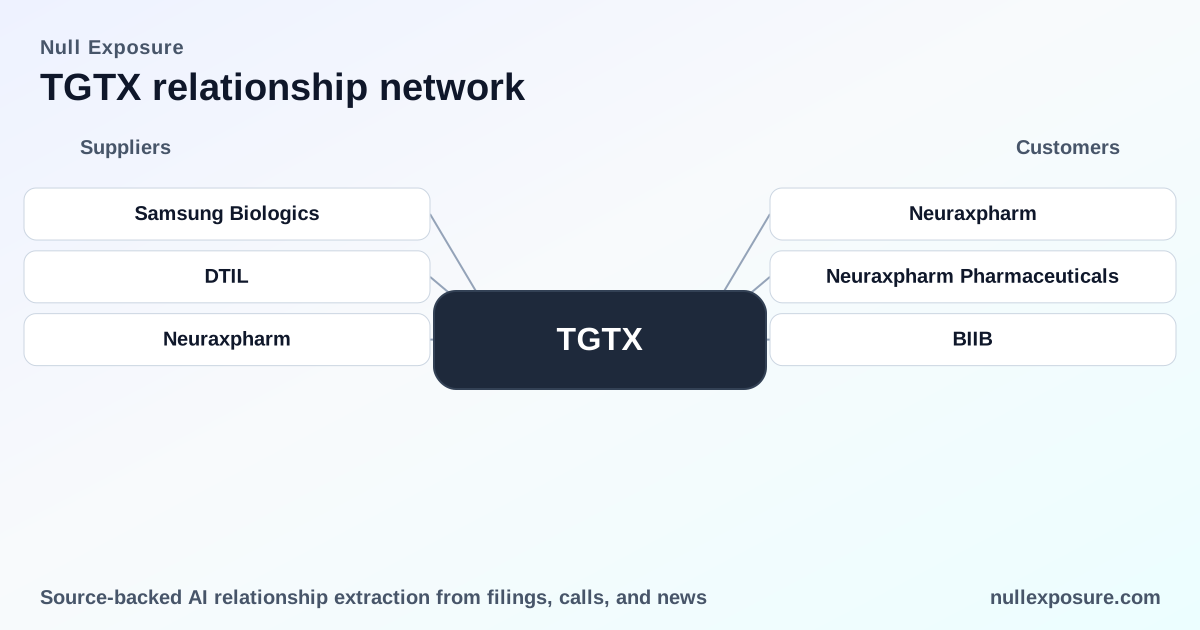
Samsung Biologics — the commercial contract manufacturer
TG Therapeutics has a contract manufacturing relationship with Samsung Biologics for the commercial supply of BRIUMVI, establishing Samsung as a core producer of finished product for market. This relationship is disclosed in TG Therapeutics’ 2024 Form 10‑K as part of the company’s commercial supply chain for BRIUMVI. (Source: TG Therapeutics 2024 10‑K.)
Precision BioSciences (DTIL) — the licensed cell‑therapy partner for autoimmune indications
TG holds an exclusive worldwide license for azer‑cel in autoimmune and non‑oncology settings from Precision BioSciences, and TG paid a reported $7.5M clinical milestone tied to multiple sclerosis work; Precision stands to receive up to $288M in future milestones plus royalties on net sales. Market commentary and deal coverage in March 2026 highlight the milestone payment and the structured milestone/royalty economics that share upside with Precision. (Sources: Sahm Capital commentary, Finviz reporting, Simply Wall St coverage — March 2026.)
Neuraxpharm — commercialization partner for international launches
TG has expanded commercialization of BRIUMVI outside the United States with partner Neuraxpharm, with product approvals and launches reported across the EU, UK, Switzerland, Australia, Kuwait, and the UAE, positioning Neuraxpharm as TG’s route to market in multiple non‑US regions. This expansion was reported in TG’s earnings and related press coverage in early 2026. (Source: Finviz coverage of TG Therapeutics Q4/full‑year 2025 results — March 2026.)
What the supplier disclosures imply about TG’s operating model
The company filing and public reports together create a consistent portrait of a supplier strategy that is long‑term, concentrated, and operationally critical:
- Long‑term contracting posture with fixed obligations. The 10‑K documents aggregate non‑cancelable purchase commitments of $214.7M, with predictable outlays scheduled across 2025–2027 and explicit “take or pay” minimum purchase provisions in the long‑term supply agreement for BRIUMVI. This demonstrates a commitment to sustained manufacturing relationships and predictable cost of goods sold. (Company filing: FY2024/10‑K disclosure on purchase commitments.)
- Concentration and criticality. TG states that several third parties are sole source suppliers for materials and drug substance, and that the loss of a supplier could significantly harm the business, flagging the supply chain as a single‑point critical dependency rather than a diversified network. (Company filing risk disclosures.)
- Manufacturer and service‑provider reliance. TG explicitly contracts with single contract manufacturers under cGMP for commercial product and uses third parties for clinical operations and IT/security monitoring, signaling a reliance on external operational capabilities rather than vertically integrated manufacturing. (Company filing: manufacturing and third‑party service disclosures.)
- Active relationships and material spend. Supplier relationships are active and embedded in ongoing commercial operations; the $214.7M non‑cancelable commitments place total contracted supplier spend well within a $100M+ band, indicating material budget allocation to external manufacturing and supply. (Company filing: purchase commitments; company disclosures on active contracts.)
Collectively, these signals describe a company that buys predictability (through take‑or‑pay and multi‑year contracts) but trades away flexibility and exposes itself to concentrated supplier risk.
What investors and operators should watch next
The supplier posture creates a mix of operational leverage and concentration risk that defines TG’s near‑term upside and downside:
- Upside drivers: predictable COGS and contractually secured capacity support scaling sales of BRIUMVI internationally and give clarity to gross margin modeling; milestone economics from the azer‑cel license provide non‑dilutive upside.
- Key risks: single‑source manufacturing and material suppliers are the principal operational single points of failure; take‑or‑pay commitments increase fixed cash outflows if demand underperforms; international commercialization depends on partner execution in fragmented markets.
Investors and operators should prioritize three actions:
- Conduct counterparty due diligence on CMOs (capacity, quality track record, and geographic risk).
- Model scenarios where contractual minimums collide with slower demand and stress cash flow under the $214.7M commitment schedule.
- Assess partner effectiveness for international launches and the timing/likelihood of azer‑cel milestones.
For deeper supplier risk analytics and relationship tracking, visit NullExposure to review the full supplier map.
Practical takeaways for deal teams and procurement
- Negotiation focus: use milestone payments and licensing revenues as leverage to renegotiate supply terms or obtain contingency capacity commitments in exchange for longer commitments.
- Operational hedging: pursue secondary sourcing or qualified backups for critical starting materials to convert single‑source dependencies into managed dual‑source arrangements.
- Balance sheet planning: incorporate the $214.7M non‑cancelable purchase commitments into liquidity planning and covenant modeling; treat take‑or‑pay exposure as near‑term fixed cost.
A concise investor checklist: assess supplier counterparty credit, validate manufacturing slots against demand curves, and quantify the probability and financial impact of a supply disruption.
Explore supplier profiles at NullExposure for a structured walkthrough of counterparties and contract exposures.
Final assessment
TG Therapeutics operates a commercially viable, partner‑heavy model where product sales, licensing royalties, and milestone receipts generate revenue while contracted manufacturing and distribution are outsourced to a small set of mission‑critical suppliers. That outsourcing buys speed and reduces capex but creates concentrated operational risk and material contractual obligations — a tradeoff that investors must value explicitly in scenarios and multiples. The Samsung Biologics manufacturing relationship, the Precision BioSciences azer‑cel license, and the Neuraxpharm regional commercialization agreement together define TG’s ability to convert clinical and licensing assets into durable cash flow. For active investors and corporate operators, the priority is quantifying and stress‑testing those supplier exposures against demand, milestones, and regulatory timelines.
Review TG Therapeutics supplier risk and counterparties at NullExposure to convert these insights into actionable monitoring and due‑diligence workflows.