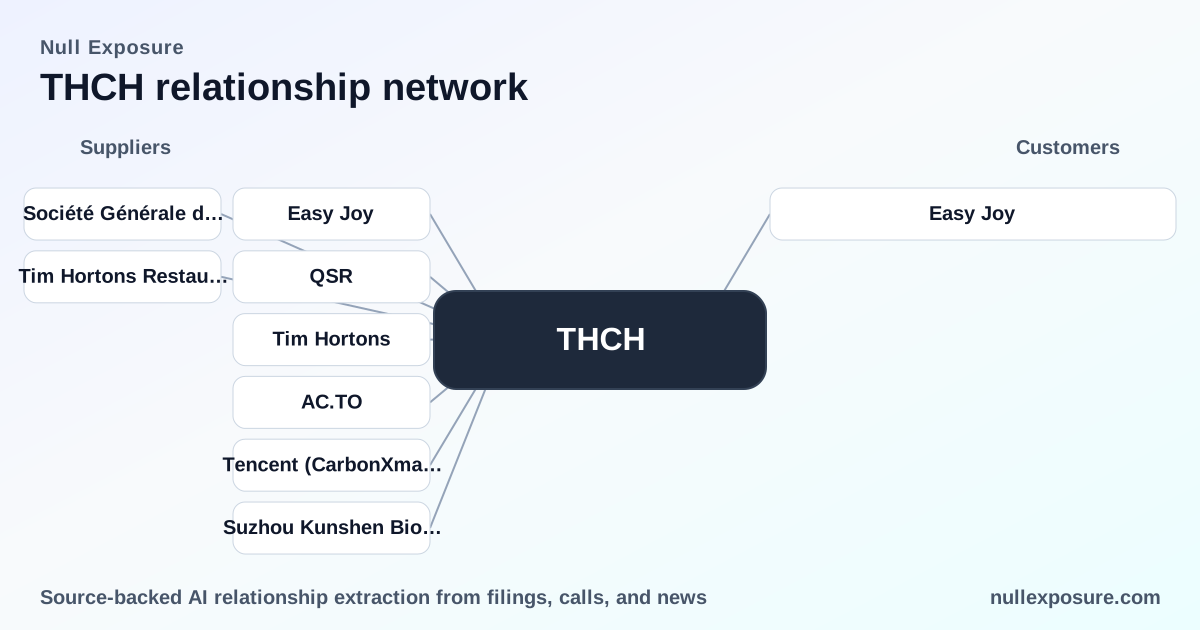
TH International (THCH): supplier relationships, commercial posture, and what partners reveal about growth prospects
TH International Limited (NASDAQ: THCH) is the exclusive master franchise operator of Tim Hortons in mainland China, Hong Kong and Macau and monetizes through company-operated and franchised coffee shops, product sales, and strategic partnerships that drive store traffic and product differentiation. Revenue is generated at the store level and augmented by licensing/franchise economics and co‑marketing arrangements; the company’s near‑term growth thesis is execution of rollouts and partner-led promotions while margin recovery hinges on scale and operating leverage. For a concise supplier and partner map, see our coverage below — or explore more on the company and counterparties at https://nullexposure.com/.
How THCH operates and the constraints that shape decision-making
TH International operates under an exclusive master franchise agreement with Restaurant Brands International and its Tim Hortons subsidiaries, giving it territorial rights and brand dependence rather than owning the Tim Hortons brand itself. This contracting posture creates a two-way criticality: THCH needs the Tim Hortons brand to attract customers in China, and Restaurant Brands International relies on THCH to execute locally. The company’s financials show meaningful revenue (USD 1.34B TTM) but negative profitability (EBITDA: -$108.97M; diluted EPS: -1.54), which positions THCH as a growth operator under margin pressure until scale and unit economics improve.
Additional company-level signals: institutional ownership is relatively high (about 59%), insiders hold roughly 12%, and market capitalization is modest (~$70M), indicating a small‑cap operator with concentrated investor interest and limited balance sheet cushion. These characteristics mean partnerships and supplier terms play an outsized role in near‑term cash flow and reputational risk.
Supplier and partner map: the relationships that matter (every named counterparty)
Below is a concise, one‑to‑two sentence plain‑English summary for each relationship referenced in public coverage, with source context.
-
Easy Joy
TH International opened three Tim Hortons Express kiosks inside Easy Joy convenience stores in Beijing, signaling a convenience-store distribution push to capture quick-service transactions and incremental foot traffic. This expansion was reported by Yahoo Finance on March 10, 2026. (Yahoo Finance, March 2026) -
Restaurant Brands International Inc. (QSR)
TH International is the exclusive master franchisee for Tim Hortons in China, Hong Kong and Macau and operates under licensing and founding relationships tied to Restaurant Brands International and its Tim Hortons Restaurants International unit. That foundational relationship is referenced in multiple releases including a GlobeNewswire business-combination announcement. (GlobeNewswire, Sep 2022; Yahoo Finance, Mar 2026) -
Tim Hortons (brand)
THCH runs the Tim Hortons brand locally — product launches such as nationwide rollouts are executed by TH International, reflecting brand stewardship and product localization responsibilities. The company’s national product launches were publicized in a Yahoo Finance release in March 2026 and related investor notices in late 2025. (Yahoo Finance, Mar 2026; Quiver Quant, Dec 2025) -
Air Canada
TH International partnered directly with Air Canada on a promotional “Maple Journey” campaign, showing the use of travel and airline co‑marketing to raise brand awareness and reach affinity customers. This promotion was described in Travel and Tour World coverage in early 2026. (Travel and Tour World, 2026) -
Tencent (CarbonXmade)
THCH collaborated with Tencent’s CarbonXmade initiative to develop an eco‑friendly straw incorporating captured CO2, demonstrating a sustainability partnership that positions the operator on ESG matters and consumer eco‑credentials. The program launch was detailed in a GlobeNewswire release on December 3, 2025. (GlobeNewswire, Dec 3, 2025) -
Suzhou Kunshen Biodegradable New Material Co., Ltd.
TH International worked with Suzhou Kunshen alongside Tencent’s CarbonXmade to produce the eco‑friendly straw, indicating supplier selection for packaging innovation rather than an in‑house manufacturing approach. The collaboration was reported in the same GlobeNewswire announcement (Dec 3, 2025). (GlobeNewswire, Dec 3, 2025) -
Société Générale de Surveillance (SGS)
SGS provided certification that quantifies carbon capture per batch of straws, giving third‑party verification for THCH’s sustainability claim and reducing reputational risk in green marketing. That certification detail appeared in the December 2025 GlobeNewswire release. (GlobeNewswire, Dec 3, 2025) -
Tim Hortons Restaurants International
Tim Hortons Restaurants International is named as a founding partner (with Cartesian Capital Group) of Tims China, anchoring the company’s strategic pedigree and international operating model. This origin story is cited in Yahoo Finance coverage of product rollouts and historical filings. (Yahoo Finance, Mar 2026)
What these relationships signal for operators and investors
-
Brand licensing is the core contract driver. THCH’s business is a franchised operating model where store economics, product acceptance, and branded promotions determine revenue velocity. The exclusive master franchise setup compresses pathway options — growth requires execution rather than brand creation.
-
Partnerships are tactical growth levers. Collaborations with convenience chains (Easy Joy), airlines (Air Canada), and digital/ESG platforms (Tencent CarbonXmade) show a deliberate strategy to widen customer acquisition channels and strengthen sustainability credentials. These partners materially affect foot traffic and brand perception at low capital cost.
-
Third‑party validation mitigates reputational risk. SGS certification for the eco‑straw reduces buyer skepticism and supports corporate ESG communications, which is important given consumer sensitivity in China’s urban markets.
Explore our platform for deeper counterparty analytics at https://nullexposure.com/.
Key risks to monitor and operational priorities
- Concentration risk: exclusive territorial exposure to Greater China means macro or policy shifts in that region directly affect THCH’s entire revenue base.
- Margin pressure: negative EBITDA and EPS indicate recovery depends on same‑store sales growth, menu margin expansion, and disciplined unit economics.
- Partner execution: rollouts inside convenience chains and co‑marketing programs are high‑leverage but require flawless logistics and brand control; any supply or certification issue (for example with the eco‑straw) escalates quickly.
- Balance sheet and scale: modest market cap and negative operating cash flow increase sensitivity to capital costs and slow unit openings.
Monitor: unit openings cadence, same‑store sales trends, announcements from Restaurant Brands International about licensing, and SGS or supplier certification updates.
Bottom line and investor action
TH International is a brand‑dependent operator using distribution and sustainability partnerships to accelerate growth while wrestling with negative profitability and small‑cap balance sheet constraints. For investors and operators evaluating supplier relationships, the practical takeaway is that partnerships (convenience chains, airlines, and ESG suppliers) are central to growth and reputation management, and each counterparty materially affects unit economics and marketing reach.
To track counterparties, results, and new partnership filings, visit https://nullexposure.com/ for continued monitoring and analysis. If you’re evaluating supplier risk or partnership opportunities for THCH, start your diligence at https://nullexposure.com/ — the next material announcement will determine whether scale overcomes the current margin gap.