TryHard Holdings (THH): Supplier relationships and what they mean for investors
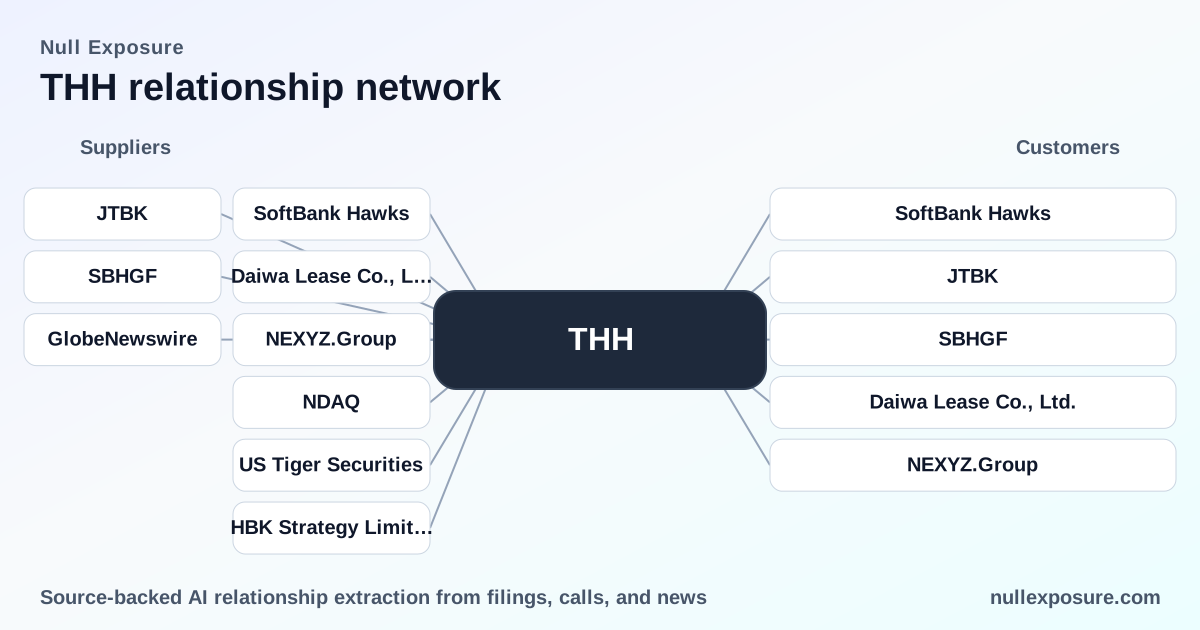
TryHard Holdings operates live entertainment venues, festivals and lifestyle hospitality services in Japan and monetizes through ticketing, venue operations, branded festivals, sponsorships and tourism partnerships. The company drives revenue by converting large-scale live events and experiential IP into recurring hospitality and tourism contracts, and it leverages branding partnerships to extend event economics into travel and corporate sponsorship channels. For an at-a-glance supplier and partner map, visit https://nullexposure.com/.
Why this matters: TryHard’s commercial model depends on an ecosystem of venue operators, travel and lease partners, media/distribution channels and capital-market intermediaries; those relationships determine its ability to scale events, secure venue capacity and capture sponsorship margins. Below I map the principal relationships disclosed in public reporting and discuss the operational implications for investors.
Financial snapshot and how relationships inform the operating model
TryHard reported Revenue TTM of 3.54 billion and Gross Profit TTM of 670 million, while showing negative operating margins and EBITDA losses as it scales event production and marketing. Insider ownership is very high (58.7%) and institutional ownership is negligible (0.105%), which signals a concentrated capital structure and operational control that influence contracting posture and partner negotiation leverage.
From an operating-model perspective, key characteristics are:
- Contracting posture: project-driven, partnership-heavy. TryHard’s business is built around time-bound festivals and venue deals, so the company contracts repeatedly with event promoters, venue owners and travel partners rather than relying solely on recurring subscription revenues.
- Concentration: strategic alliances rather than broad supplier diversification. The presence of major tourism and venue partners indicates a preference for deep, high-profile alliances rather than purely dispersed supplier lists.
- Criticality: partner relationships are operationally material. Access to stadiums, tourism distribution and corporate sponsors directly affects revenue realization for flagship events.
- Maturity: early public-stage scaling. The company listed on Nasdaq in 2025 and is still demonstrating rapid top-line growth with negative operating results as it invests in brand and scale.
- Constraints: no explicit supplier constraints were published in the provided feed, which is a company-level signal that there are no surfaced contractual exceptions or material supplier covenants in the scraped relationship data.
Partnership map — who TryHard is working with (what the public record says)
-
SoftBank Hawks — TryHard hosted MUSIC CIRCUS FUKUOKA at the Fukuoka PayPay Dome in partnership with the SoftBank Hawks, creating Japan’s first all-night dome festival and giving TryHard access to premium venue capacity and sports-facility logistics. According to EARMILK coverage (Dec 29, 2025), the Hawks partnership underpinned a marquee festival deployment.
-
Daiwa Lease Co., Ltd. — TryHard lists Daiwa Lease as a partner in initiatives to develop cultural tourism offerings, providing equipment and lease infrastructure that support large-scale event staging. EARMILK reported the partnership in December 2025 as part of TryHard’s cultural tourism positioning.
-
NEXYZ.Group — As a named partner in TryHard’s tourism and event ecosystem, NEXYZ.Group supports local logistics and guest services that feed TryHard’s experiential offerings, according to EARMILK (Dec 29, 2025).
-
JTB (JTBK) — TryHard has strategic ties with JTB to package events with travel itineraries and tourism distribution, extending event monetization into hospitality and visitor services; that collaboration was reported by EARMILK in December 2025.
-
SBI Holdings — TryHard collaborated with SBI Holdings to rebrand and scale the Senshu Dream Fireworks Festival into a traveling entertainment product called SBI Mai Fireworks, blending traditional production with contemporary show design as reported by EARMILK (Dec 29, 2025).
-
Nasdaq Stock Market (Nasdaq) — TryHard completed a Nasdaq listing and staged a closing-bell ceremony to mark its IPO, which is a liquidity and visibility event that materially affects capital access and investor relations; this was covered in a company release and reported by Yahoo Finance and Finviz in March 2026.
-
US Tiger Securities — US Tiger was listed among the underwriters for TryHard’s IPO, positioning the firm as a capital-market intermediary that structured public market access; the underwriter list appears on Renaissance Capital’s IPO profile (2025).
-
HBK Strategy Limited — HBK Strategy is cited repeatedly as TryHard’s investor relations contact and retained IR advisor for international investor communications, according to GlobeNewswire (Sept 26, 2025) and other press placements in 2026.
-
GlobeNewswire — TryHard distributed its Nasdaq-listing announcement and investor-facing releases through GlobeNewswire, establishing a formal PR channel for corporate disclosures; the GlobeNewswire release is dated Sept 26, 2025.
What these relationships imply for risk and upside
TryHard’s partner set is purposefully curated to secure venues, tourism distribution and sponsorship reach. Partnerships with stadium operators (SoftBank Hawks), leading travel companies (JTB), and financial sponsors (SBI) create a multiplier effect on event scale and monetization potential. The company’s reliance on marquee partners is an upside driver: access to large venues and travel channels accelerates audience growth and sponsorship revenue.
At the same time, this structure creates concentrated operational risk. Event cancellations, venue availability constraints, or weakened sponsor appetite would have an outsized impact on quarterly results because a meaningful portion of revenue is tied to discrete events. High insider ownership and low institutional float increase governance centralization, which supports decisive partnership deals but reduces the breadth of institutional oversight. TryHard’s Nasdaq listing and underwriter engagement improve capital-market access but also raise disclosure and compliance expectations as it scales.
For more detailed supplier-risk monitoring and partner intelligence, see the company overview and relationship feeds at https://nullexposure.com/.
How to watch TryHard over the next 12 months
- Track announced festival schedules and venue bookings from partners like SoftBank Hawks and JTB; cancellations or expansions will show up in near-term revenue and margin swings.
- Monitor PR and IR distribution through GlobeNewswire and HBK Strategy for guidance changes and capital-market communications.
- Watch sponsorship deals and touring formats (e.g., SBI Mai Fireworks) as early indicators of scalable IP that can be monetized beyond single events.
If you are evaluating exposure to TryHard as an operator or investor, prioritize calendar visibility for the next two fiscal years and the stability of stadium and travel partnerships. Learn more about supplier and partner analytics at https://nullexposure.com/.
Practical next steps for investors
- Validate event schedules and venue contracts with public partner announcements and ticketing disclosures.
- Assess sensitivity of quarterly revenue to one-off festivals versus recurring hospitality revenues.
- Monitor insider ownership and future primary offerings that could dilute control or change governance dynamics.
For ongoing coverage and supplier intelligence on TryHard and similar listings, visit https://nullexposure.com/.