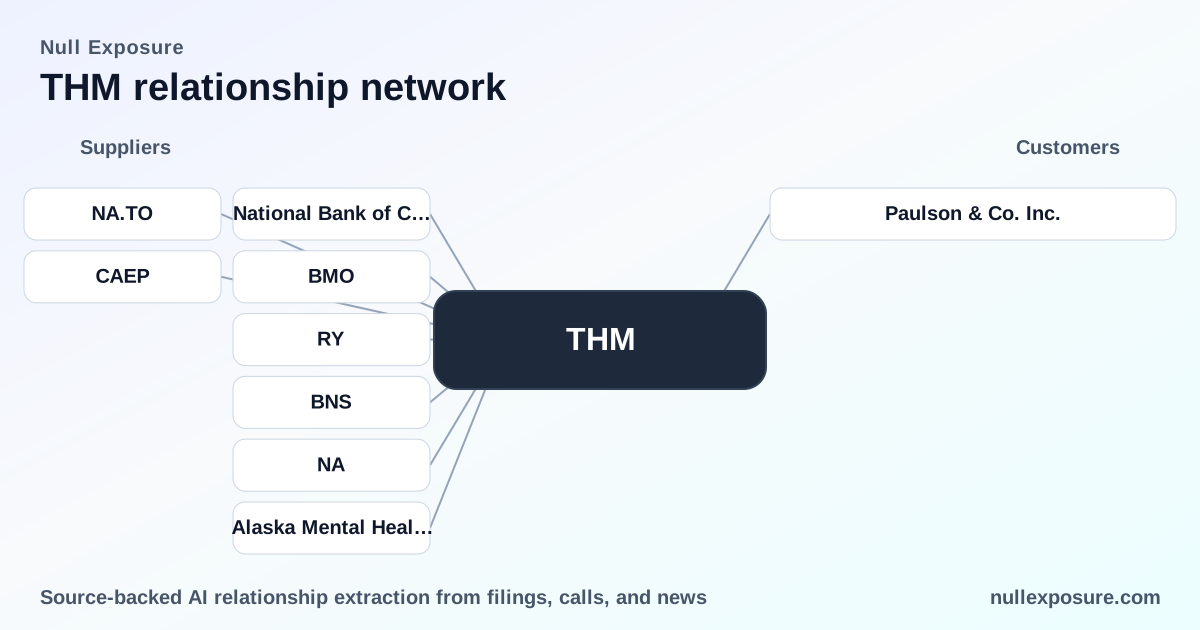
International Tower Hill Mines (THM): Underwriters, Land Lessors and the Supplier Map Investors Need
International Tower Hill Mines (THM) is a mineral exploration company that controls strategic gold assets in Alaska and monetizes primarily through staged exploration and development of mineral properties, equity financings and joint-venture or lease arrangements that convert resource upside into funding. THM funds exploration risk through capital markets activity (recent underwritten equity offerings) while securing operating leverage via long-dated land leases and third‑party service providers that handle technical, IT and compliance functions. For investors evaluating supplier and counterparty risk, the immediate focus is underwriting partners that enable dilutive capital raises and the land/permit counterparties that gate production timelines. Learn more about our supplier intelligence at https://nullexposure.com/.
What matters for investors: business model drivers and supplier posture
THM’s operating model is typical of advanced-stage explorers: no operating revenue, negative earnings, and reliance on capital markets and asset control to create value. The company’s monetization path is equity-led — the March 2026 financing underscores that dynamic — while land access and permitting determine the timeline to production. From a supplier and counterparty perspective, several company-level signals matter:
- Contracting posture is long-term for resource access. THM holds a lease of Alaska Mental Health Trust mineral rights that commenced in 2004 and extends to June 30, 2033 with extension mechanics tied to commercial production or advance royalties, indicating multi-year tenure on a critical land asset.
- Spend profile reflects mid-range exploration budgets. Management’s anticipated 2025 expenditures were ~US$3.7 million, split across lease costs and government fees, consistent with a $1–10M supplier spend band and targeted contracting with service providers rather than large capex vendors.
- Counterparty mix includes government fees and permitting costs. The company explicitly budgets for government mining claim fees and lease payments, signaling direct interaction with public-sector counterparties.
- Operational services are outsourced and critical. THM uses third‑party IT and security tools and relies on external service providers for systems and data security, making those supplier relationships critical to business continuity.
- Relationship maturity and concentration are meaningful. Public filings and press releases treat many of these relationships as active and mission‑critical; institutional ownership sits at ~68%, which shapes access to capital and ongoing investor scrutiny.
These characteristics frame how underwriters, banks and landowners affect THM’s cost of capital, timetable to production, and operational resilience.
Capital markets relationships: who led the March 2026 offering
THM completed an underwritten equity offering in March 2026 that required a syndicate of book‑running managers. The financing underscores how the company monetizes exploration upside through market access and the importance of stable underwriting relationships.
BMO Capital Markets
BMO acted as the lead book‑running manager on the offering, anchoring distribution and market support for the raise. According to a Yahoo Finance press release dated March 10, 2026, BMO capital markets led the syndicate for the offering (https://finance.yahoo.com/news/international-tower-hill-mines-closes-225000287.html).
National Bank of Canada Capital Markets
National Bank of Canada Capital Markets participated as a book‑running manager in the syndicate, providing additional distribution reach into Canadian institutional channels, per the same March 10, 2026 press coverage (https://finance.yahoo.com/news/international-tower-hill-mines-closes-225000287.html).
RBC Capital Markets
RBC Capital Markets served as a book‑running manager and contributed to syndicate placement and order book support for the transaction, as noted in multiple March 10, 2026 news releases (https://finance.yahoo.com/news/international-tower-hill-mines-closes-225000287.html).
Scotiabank
Scotiabank took a book‑running manager role in the offering, adding capability on execution and distribution across North American accounts, with reporting in the March 10, 2026 press release (https://finance.yahoo.com/news/international-tower-hill-mines-closes-225000287.html).
Cantor
Cantor was listed as one of the book‑running managers in the underwriting syndicate, contributing to the offering’s execution and secondary market support, referenced in March 2026 coverage (https://finance.yahoo.com/news/international-tower-hill-mines-closes-225000287.html).
(For a consolidated view of how underwriters affect THM’s cost of capital, see our platform overview at https://nullexposure.com/.)
Land and lease relationships: the Alaska Mental Health Trust
Alaska Mental Health Trust
THM holds land interests that include a long‑term lease of mineral rights from the Alaska Mental Health Trust, which is a material property component of THM’s portfolio; the lease term began July 1, 2004 and runs through June 30, 2033 with extension provisions linked to production or payment of advance royalties. The lease terms and property composition were referenced in March 2026 reporting on the company’s offering and asset disclosures (https://intellectia.ai/news/stock/international-tower-hill-mines-upsizes-offering-to-2929m-shares-raising-over-105m).
Implication: that lease is a strategic, long‑dated supply relationship that underpins THM’s resource control and creates a predictable counterparty exposure to a quasi‑governmental landowner with contractual extension mechanics.
How these relationships translate into risk and optionality
- Capital providers (underwriters) control access to equity capital. Successful syndicate execution in March 2026 demonstrates active market access; however, reliance on underwritten raises means financing risk is a first‑order business risk when exploration milestones slip.
- Land leases are the production gate. The Alaska Mental Health Trust lease is long‑term and conditional, which reduces near‑term title risk but ties future production to either demonstrated commerciality or continued royalty payments.
- Service providers are critical and active. Outsourced IT and specialized services are essential to daily operations and regulatory compliance; failure or misalignment with these suppliers would have operational and disclosure consequences.
- Spending scale limits vendor mix. A ~$3.7M budget implies THM contracts mid‑sized providers rather than large EPC contractors, producing different counterparty concentration and negotiation dynamics.
Relationship inventory — concise takeaways for operators and investors
- BMO Capital Markets — Lead book‑running manager on THM’s March 2026 equity offering; provided primary distribution and execution support (March 10, 2026 press release). https://finance.yahoo.com/news/international-tower-hill-mines-closes-225000287.html
- National Bank of Canada Capital Markets — Book‑running manager in the same syndicate; expanded reach into Canadian institutional buyers (March 10, 2026 press release). https://finance.yahoo.com/news/international-tower-hill-mines-closes-225000287.html
- RBC Capital Markets — Syndicate book‑running manager assisting order book formation and execution (March 10, 2026 press coverage). https://finance.yahoo.com/news/international-tower-hill-mines-closes-225000287.html
- Scotiabank — Book‑running manager participating in the underwriting syndicate (March 10, 2026 press coverage). https://finance.yahoo.com/news/international-tower-hill-mines-closes-225000287.html
- Cantor — Included among book‑running managers, supporting distribution and market making for the offering (March 10, 2026 coverage). https://finance.yahoo.com/news/international-tower-hill-mines-closes-225000287.html
- Alaska Mental Health Trust — Long‑term lessor of mineral rights to THM; lease started in 2004 and runs through June 30, 2033 with extension mechanisms via production or advance royalties, a material property relationship disclosed around the March 2026 offering (intellectia.ai reporting). https://intellectia.ai/news/stock/international-tower-hill-mines-upsizes-offering-to-2929m-shares-raising-over-105m
What investors and operators should do next
- Monitor underwriting continuity and syndicate composition ahead of future financings; underwriter relationships determine execution cost and timing. For platform-level supplier intelligence and syndicated underwriting histories, visit https://nullexposure.com/.
- Track lease extension triggers and advance royalty mechanics with the Alaska Mental Health Trust; these clauses determine the optionality for a production decision.
- Assess third‑party service provider SLAs and security posture given the company’s reliance on outsourced IT and compliance services.
For deeper supplier maps, counterparty scoring, and historical syndicate performance that inform valuation and diligence, visit our research hub: https://nullexposure.com/.
Final note: THM’s model is capital-market dependent, land-anchored and service-outsourced — investors should price exits and dilution against underwriter access, lease economics, and the company’s mid‑level spend profile. Explore our supplier assessment tools at https://nullexposure.com/ for structured diligence and continuous monitoring.