Thryv Holdings Inc (THRY): Supplier relationships, constraints, and investor implications
Thryv is a U.S.-focused provider of cloud-based business software and digital marketing solutions for small and medium-sized businesses, monetizing primarily through recurring software subscriptions and value-added marketing services supplemented by legacy directory and print revenue. The company's scale — roughly $785M in trailing revenue with modest EBITDA — positions it as a middle-market SMB platform that grows through product expansion and tuck-in acquisitions that broaden its SMB addressable market. For a concise vendor-relationship intelligence feed and primary-source references, visit Null Exposure.
How Thryv operates and where supplier relationships matter
Thryv sells a blend of software and services to SMBs: cloud SaaS for CRM/marketing automation, digital advertising services, and directory/print offerings. That hybrid model drives two supplier dynamics important to investors:
- Service and technology suppliers support the SaaS stack, customer onboarding, and marketing channels.
- Physical suppliers and fulfillment partners support the legacy marketing services and directories business — a distinct, lower-growth revenue stream that carries operational dependency on outside vendors.
The company’s public financials show low operating margins relative to size and a capital structure that supports acquisitive growth; those characteristics make supplier cost control and contract stability material to near-term margin improvement and integration economics.
Visit Null Exposure for more supplier-focused intelligence on THRY.
Notable supplier relationship and transaction you must know
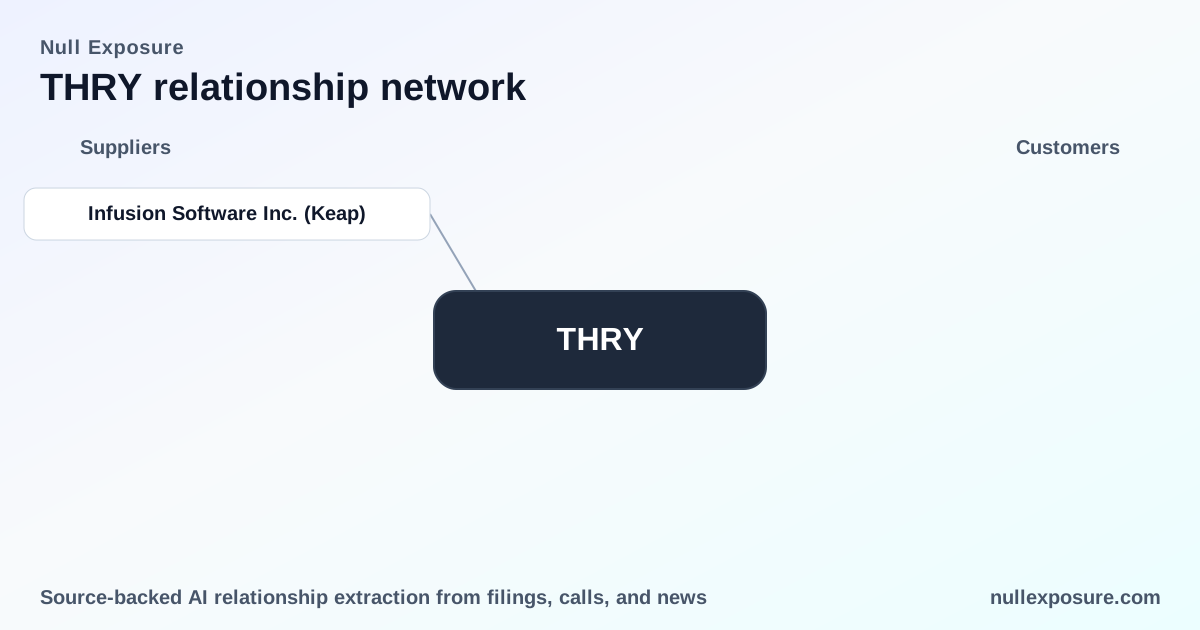
Infusion Software Inc. (Keap) — Thryv closed the acquisition of Keap, a provider of CRM and marketing automation for SMBs, for $80 million in cash. This transaction expands Thryv’s product set for small-business automation and consolidates customer-facing SaaS capabilities into its platform (Dallas Innovates, March 10, 2026). Source: Dallas Innovates coverage of the acquisition, March 2026 — https://dallasinnovates.com/dallas-thryv-holdings-closes-80m-acquisition-of-arizona-based-saas-solutions-provider-keap/.
Why the Keap deal matters to supplier and vendor risk
The Keap acquisition is an operational and strategic supplier-and-product consolidation: Thryv is buying capabilities it previously would have supplied or partnered for, shifting costs from external licensing/partner fees into owned product development and support. That dynamic has three implications:
- Integration economics: Realizing margin accretion depends on successful consolidation of support, billing, and go-to-market for Keap customers into Thryv’s platform.
- Supplier substitution: Owning Keap reduces exposure to third-party CRM suppliers while potentially increasing reliance on internal engineering and new service vendors required to scale.
- Product concentration risk shifts: The deal diversifies Thryv’s product portfolio away from legacy directory services and toward higher-margin SaaS — a net positive for long-term margins if integration succeeds.
Operational constraints: what Thryv itself discloses and what that signals
Thryv’s filings disclose explicit dependence on third parties for its Marketing Services segment: the company relies on outside suppliers to provide paper and to print, publish, and distribute its directories. Treat this as a company-level operational signal rather than tied to any single named vendor.
From that disclosure we infer clear business-model characteristics:
- Contracting posture: Thryv operates with an outsourced fulfillment posture for legacy print services; contracts with physical suppliers are operationally binding and recurrent.
- Concentration: The disclosure implies non-trivial reliance on external printers and distribution networks — a concentration that creates cost and service risk if supplier capacity tightens.
- Criticality: For the Marketing Services revenue stream, these suppliers are functionally critical; interruptions directly affect revenue recognition and client relationships.
- Maturity: The print-related supplier base is likely mature and commoditized, which limits pricing power but increases service continuity risk in the event of industry consolidation or supply shocks.
These constraints underscore why Thryv pursues acquisitions like Keap: to accelerate migration away from supplier-dependent print economics into more controllable, subscription-driven software margins.
Relationship inventory — clear and concise
- Infusion Software Inc. (Keap): Thryv completed an $80 million cash acquisition of Keap, a CRM and marketing automation vendor serving SMBs; the purchase strengthens Thryv’s SaaS portfolio and internalizes capabilities that reduce reliance on external software suppliers (Dallas Innovates, March 2026). Source: https://dallasinnovates.com/dallas-thryv-holdings-closes-80m-acquisition-of-arizona-based-saas-solutions-provider-keap/.
Financial and governance context that colors supplier risk
Thryv’s public metrics indicate $785M revenue and roughly $61M EBITDA, with a market capitalization markedly lower than trailing revenue — suggesting the market prices risk into the stock relative to scale. The firm’s forward P/E and EV/EBITDA multiples indicate expectations for margin improvement tied to operational fixes and growth. Supplier risk feeds directly into those margin assumptions: controlling supplier costs in Marketing Services and achieving synergies from acquisitions like Keap are central to converting revenue scale into higher operating leverage.
What investors and operators should watch next
- Integration milestones for Keap: track customer retention, churn trends, and any reported cost synergies tied to removing third-party supplier fees.
- Supplier contract disclosures: monitor for amendments or one-off costs tied to print and distribution suppliers, especially if paper or logistics inflation accelerates.
- Mix shift metrics: look for progressive disclosure of revenue mix (SaaS vs. Marketing Services) and product-level margins showing migration toward higher recurring margins.
For a focused view on supplier disclosures and vendor-level exposures affecting Thryv’s margin trajectory, visit Null Exposure.
Investor takeaway and action points
- Thryv is executing a clear shift from supplier-dependent print services to owned SaaS capabilities, and the Keap acquisition is consistent with that strategy. Execution risk centers on integration and replacing outsourced economics with internal scale.
- Supplier dependence for directory printing is a tangible operational constraint that bears monitoring; while commoditized, those suppliers are critical to near-term cash flow for the Marketing Services segment.
- For investors evaluating exposure to Thryv, prioritize updates on Keap integration, supplier contract stability, and revenue mix evolution — these are the levers that will drive valuation re-rating.
To keep tracking supplier relationships and primary-source vendor disclosures for THRY and comparable names, return to Null Exposure for ongoing coverage.