Millicom (TIGO): Strategic Consolidation of Latin American Footprint — what investors should know
Millicom (ticker: TIGO) operates and monetizes a subscription-first telecom and cable platform across Latin America and Africa, generating revenue from mobile service subscriptions, fixed broadband and cable TV, and increasingly from scale-driven consolidation of local incumbents. The company is executing an acquisitive growth strategy in key markets — buying controlling stakes and creating joint ventures to capture market share, spectrum and fixed-mobile convergence economics — funded by strong operating cash flow and an active capital allocation posture. For a closer look at how these supplier and counterparty moves change Millicom’s risk profile and upside, visit https://nullexposure.com/.
What the deal flow signals about Millicom’s operating model
Millicom’s recent deal activity reveals a clear playbook: acquire control in strategic national operators, fold assets into Tigo’s distribution and network stack, and partner where regulatory or capital-sharing considerations require it. This is not passive supplier management; it is direct control-seeking to accelerate ARPU expansion and margin capture. Company-level financials support the posture: ~$12.2B market cap, ~$2.8B EBITDA, 22.6% profit margin and a 37.9% ROE, providing internal resources to pursue transactions without overreliance on external equity. At the same time, high insider ownership (~42%) and an active dividend policy (~4.12% yield) shape governance and capital return expectations.
Operational implications:
- Contracting posture: acquisitive and JV-oriented — Millicom executes tender offers and structured JV buyouts rather than simple supplier agreements.
- Concentration and criticality: focus on Colombia and Chile drives country-level exposure but increases control over critical network assets where Tigo operates.
- Maturity and consolidation: moves reflect a mid-cycle consolidation play in LatAm telecoms — acquiring legacy incumbents to accelerate fixed–mobile convergence.
Explore deeper supplier and counterparty intelligence at https://nullexposure.com/ to model integration risk and upside.
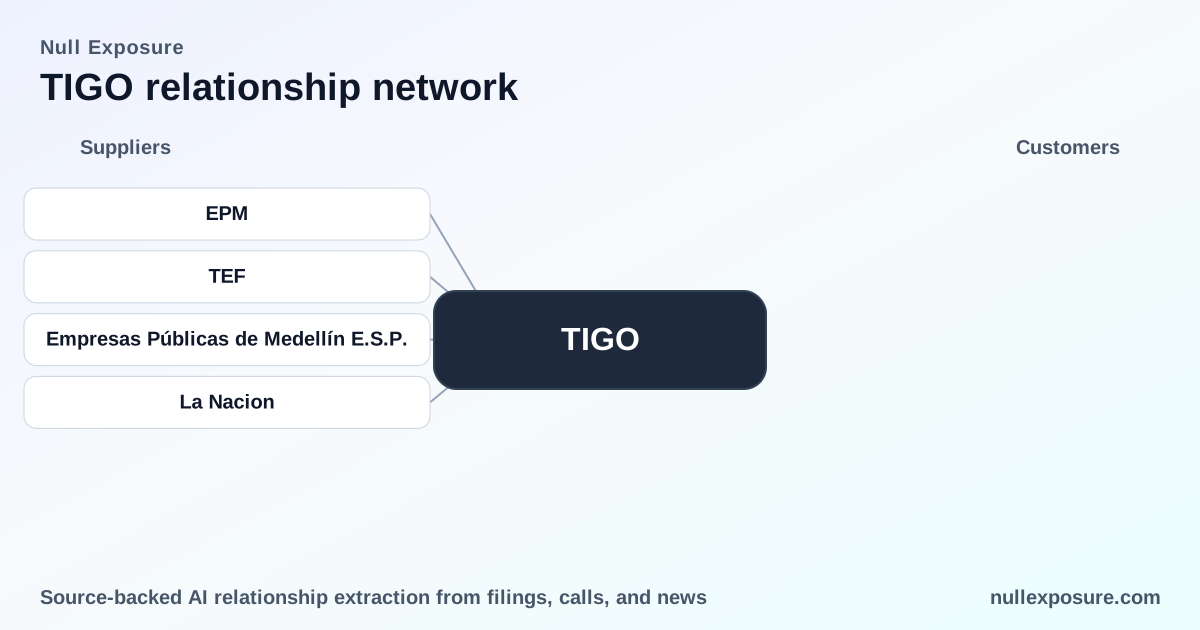
All counterparties and supplier relationships surfaced in public reports
Below are every relationship mentioned in the coverage pulled for this review, each followed by a concise plain-English summary and source citation.
-
EPM (EPM / UNE EPM Telecomunicaciones)
- Millicom agreed to acquire an additional 50.01% stake in UNE EPM Telecomunicaciones from Empresas Públicas de Medellín E.S.P. for COP 2.1 trillion, bringing Millicom to full ownership of Tigo’s Colombia operation in the reported transaction. Source: MarketScreener reporting (CI, Jan. 29, 2026) and related filings cited in Q4 2025 commentary.
-
Empresas Públicas de Medellín E.S.P. (EPM — seller)
- Empresas Públicas de Medellín agreed to sell its remaining stake in UNE EPM Telecomunicaciones to Millicom, providing the municipal utility a cash exit and enabling Millicom to consolidate Colombia operations. Source: MarketScreener (Jan. 15/Jan. 29, 2026 reporting).
-
Telefónica (global / Telefónica S.A. entries)
- Millicom successfully concluded a tender offer to acquire Telefónica’s 67.5% controlling stake in Colombia Telecomunicaciones S.A. E.S.P. (Coltel), adding a large incumbent footprint and subscriber base to Tigo’s Colombia operations. Source: GlobeNewswire press release (Feb. 5, 2026) and MarketScreener coverage (Feb. 06, 2026).
-
Telefónica Hispanoamérica, S.A.U.
- Millicom completed the acquisition of a 67.49937% stake in Colombia Telecomunicaciones S.A. E.S.P. from Telefónica Hispanoamérica, S.A.U., formalizing the transfer of control reported earlier in the tender offer process. Source: MarketScreener notice (CI, Jan. 29, 2026).
-
Telefonica (Chile JV with NJJ referenced)
- Together with investment partner NJJ, Millicom acquired 100% of Telefónica’s Chilean business through a joint venture vehicle where NJJ holds 51% and Millicom 49%, a structure that splits control and aligns capital commitments for Chile operations. Source: InsiderMonkey Q4 2025 earnings call transcript (published Mar. 10, 2026) and corroborating reports (Bitget news summary, Mar. 2026).
-
La Nacion (33% stake referenced)
- Millicom commented on a 33% stake owned by La Nacion that is subject to a formal privatization process with a timeline that sets potential closing in April 2026, representing a pending transaction in Millicom’s Colombian consolidation plan. Source: InsiderMonkey Q4 2025 earnings call transcript (Mar. 10, 2026).
Each of these items comes from public reporting and Millicom’s own investor communications during the Q4 2025 / early-2026 period, and together they depict a concentrated campaign to consolidate key national assets in Colombia and Chile.
How these vendor and counterparty moves change the investment case
The acquisitions and JV structures alter Millicom’s cash-flow profile and risk composition in several material ways:
- Revenue and margin upside through consolidation. Folding incumbent fixed-line and cable assets into Tigo accelerates cross-sell and broadband monetization, supporting the company’s above-industry operating margin (~24.5% operating margin TTM).
- Integration and regulatory risk. Tender offers and privatization processes introduce execution risk and potential regulatory conditions, particularly in Colombia where multiple sellers and public stakeholders are involved — a governance wrinkle investors must model.
- Capital allocation trade-offs. The company’s balance of strong EBITDA and active dividend policy (annual dividend per share $3, yield ~4.1%) indicates management is funding M&A while maintaining returns, implying disciplined but growth-oriented capital deployment.
- Governance and control dynamics. Joint ventures (e.g., the NJJ structure in Chile) change control economics: Millicom secures exposure to market upside while sharing upfront capital and regulatory burden with partners.
For scenario-based cash-flow modeling and counterparty stress testing, see the strategic intelligence hub at https://nullexposure.com/.
Bottom line for investors and operators
Millicom is executing a targeted, control-oriented consolidation strategy in Latin America that increases scale and shortens the path to higher ARPU, while introducing integration and country-specific regulatory risk. The company’s financial profile — solid EBITDA, high ROE and meaningful insider ownership — underpins the ability to transact, but each acquisition brings execution and governance headaches that must be priced into valuation.
If you are modeling Millicom’s next 12–24 months, prioritize: integration timelines for Colombia and Chile assets, regulatory conditions tied to tender offers and privatizations, and JV governance provisions where Millicom shares control. For more granular counterparty analysis and tailored exposure reports, visit https://nullexposure.com/ and request the full supplier-impact briefing.