Interface (TILE): Supply relationships and the operational constraints that drive valuation
Interface generates cash by designing, manufacturing and selling modular carpet and related flooring solutions while outsourcing portions of its resilient flooring supply chain and logistics. The company monetizes through product sales, specialized installation and maintenance services, and margin capture on proprietary carpet lines; Interface’s revenue base of roughly $1.39 billion (TTM) and an operating margin near 9% make supplier continuity a direct driver of near‑term free cash flow. For investors and operators assessing supplier risk, the key questions are concentration, criticality, contractual strength and logistics partners that align on sustainability. Learn more about supplier risk signals at https://nullexposure.com/.
How Interface sources and where supplier risk concentrates
Interface manufactures its core carpet products in house but relies on third parties for key inputs and for resilient flooring such as LVT. Public disclosures indicate dependence on a small set of major global yarn suppliers and on a primary LVT supplier whose principal manufacturing facility is located in South Korea. These arrangements create a bargaining posture where Interface is a large buyer, but supplier concentration gives counterparty leverage that can be material to operations.
- Concentration risk is explicit: Interface discloses principal reliance on two major global yarn suppliers plus significant relationships with at least two others; it also identifies a primary LVT supplier as a single, important source.
- Operational criticality is high: Company disclosures state that an unanticipated termination or interruption of supply for synthetic fiber (nylon) or LVT would have a material adverse effect on the business.
- Counterparty profile skews large: Evidence points to Interface contracting with large‑enterprise counterparties for key inputs, which implies negotiated long‑term arrangements and significant supplier bargaining power.
These company‑level signals frame how investors should value near‑term operational risk versus long‑term growth optionality.
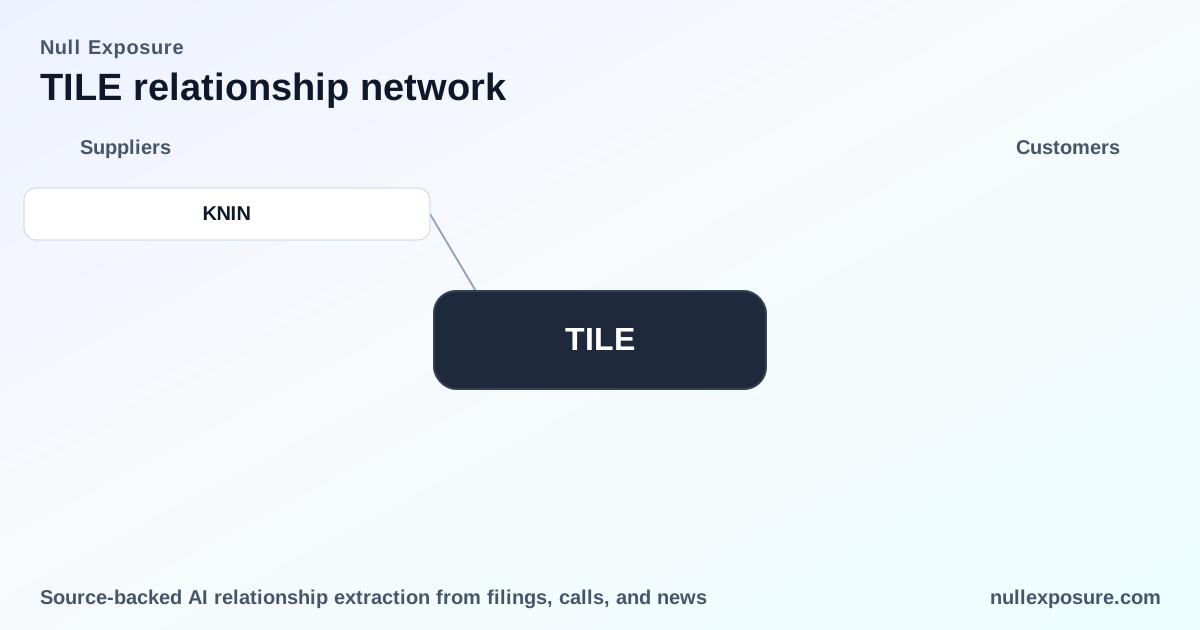
The recorded supplier relationship: Kuehne+Nagel
Kuehne+Nagel — logistics partner
- Interface has publicly signaled the need for logistics partners that share its decarbonization goals; Kuehne+Nagel was chosen for its logistics expertise and alignment on sustainability priorities. According to a Kuehne+Nagel newsroom post dated March 10, 2026, the partner selection emphasized logistics capability and decarbonisation alignment. (Kuehne+Nagel newsroom, 2026)
This relationship is primarily logistics and sustainability‑oriented rather than a raw‑materials supply agreement. Logistics partners that commit to decarbonisation can materially affect both cost structure and ESG positioning, and Kuehne+Nagel’s selection underscores Interface’s priority on reducing Scope 3 emissions associated with freight and distribution.
Why the constraints matter for valuation and operations
Interface’s disclosed supplier constraints imply a specific operating model with clear investment and risk consequences:
- Contracting posture: Interface is predominantly a buyer in its supply chain but also sources finished resilient flooring from third parties; buyer status gives the company commercial recourse, yet concentration reduces negotiating leverage on price and lead times.
- Concentration and geography risk: Reliance on a primary LVT supplier with a facility in South Korea introduces single‑point geopolitical and logistics risk; a regional disruption would transmit quickly into revenue and margin volatility.
- Criticality of supplies: Synthetic fiber (nylon) and LVT are flagged as material inputs — interruptions trigger operational stoppages and could require margin‑damaging spot purchases or product substitutions.
- Maturity of supplier relationships: The supplier universe contains large, established counterparties; that reduces counterparty credit risk but increases the cost and complexity of switching suppliers quickly.
Interface’s financial profile — ~$1.39B revenue, EBITDA of roughly $204M and an operating margin around 9% (TTM) — means supply shocks translate directly into earnings volatility. Investors should expect a premium for companies with concentrated upstream exposure unless mitigated by durable contracts, inventory strategies, or successful dual‑sourcing.
Explore supplier signal intelligence and diligence tools at https://nullexposure.com/ to quantify these exposures.
Operational playbook for investors and operators
To translate supplier constraints into actionable diligence and remediation, focus on these practical items:
- Contract terms and lead‑time protections: verify minimum purchase commitments, force majeure language, and price‑adjustment clauses.
- Dual‑sourcing feasibility: assess technical and quality barriers to alternative yarn and LVT suppliers, including qualification timelines.
- Inventory and manufacturing flexibility: understand buffer inventory strategies and whether finished‑goods modularity reduces outage impact.
- Logistics and sustainability alignment: evaluate contribution of partners like Kuehne+Nagel to freight cost, lead times, and Scope 3 targets.
- Geographic exposure and contingency plans: map single‑facility dependencies (e.g., the cited LVT plant in South Korea) and stress test scenarios.
- Legal and substitution costs: quantify time and expense to requalify alternative inputs to Interface specifications.
These items form the basis of a diligence checklist that links supplier realities to forecast sensitivity in cash flow models.
Bottom line — how to act on supplier signals
Interface combines a resilient end‑market position with tangible supplier concentration risks that are both operationally material and strategically manageable. For investors, the immediate focus is on the company’s mitigation strategy: contract robustness, dual‑sourcing progress, and logistic partners that lower distribution risk while supporting ESG objectives. For operators, prioritize supplier qualification, inventory buffer optimization and stronger contractual protections for critical inputs.
If supplier concentration or single‑source exposure is part of your investment criteria, run targeted supplier dossiers and scenario analysis now. For a guided, data‑driven approach to supplier risk and exposure modeling, visit https://nullexposure.com/ and request a supplier‑level briefing.
Final recommendation: maintain exposure to Interface only with a plan to monitor counterparty concentration and logistics resilience, and to adjust valuation assumptions if supplier diversification does not advance materially in the near term. For direct assistance and detailed supplier mapping, go to https://nullexposure.com/.