TIM Participacoes SA (TIMB): supplier relationships that shape network economics
TIM Participacoes SA operates Brazil’s national mobile and fixed connectivity assets and monetizes through subscription-based service revenue, wholesale anchor-tenancy and infrastructure deals, and dividend streams from asset optimization. The company converts spectrum and network reach into recurring cash flow by anchoring long-term commercial agreements with infrastructure and service suppliers, while selectively buying back or consolidating ownership of critical fibre and tower assets to improve margin control. Learn how these supplier relationships affect capital allocation and operating leverage at https://nullexposure.com/.
Business model and operating posture — what investors need to know
- Anchor-tenant commercial structure is core. TIM consistently acts as the long-term demand generator for third-party fibre and tower providers, locking in usage commitments that convert to predictable network costs and service availability.
- Selective vertical consolidation reduces vendor risk. TIM is actively reacquiring fibre assets and consolidating tower contracts to shift from pure tenant to owner-operator economics, which improves margin control but increases capital intensity.
- Concentration and negotiated pricing matter. Large, multi-year contracts with a small number of suppliers (tower operators, fibre JV partners, strategic systems vendors) create bargaining leverage but also concentration risk if renegotiation fails.
- Maturity and execution risk sit front and center. Agreements that extend to 2034 or involve multi-hundred-million-dollar transactions are operationally transformative; execution on integration and cost control is the principal lever for investors given TIM’s scale and margin profile.
For an in-depth supplier exposure analysis and monitoring tools, visit https://nullexposure.com/.
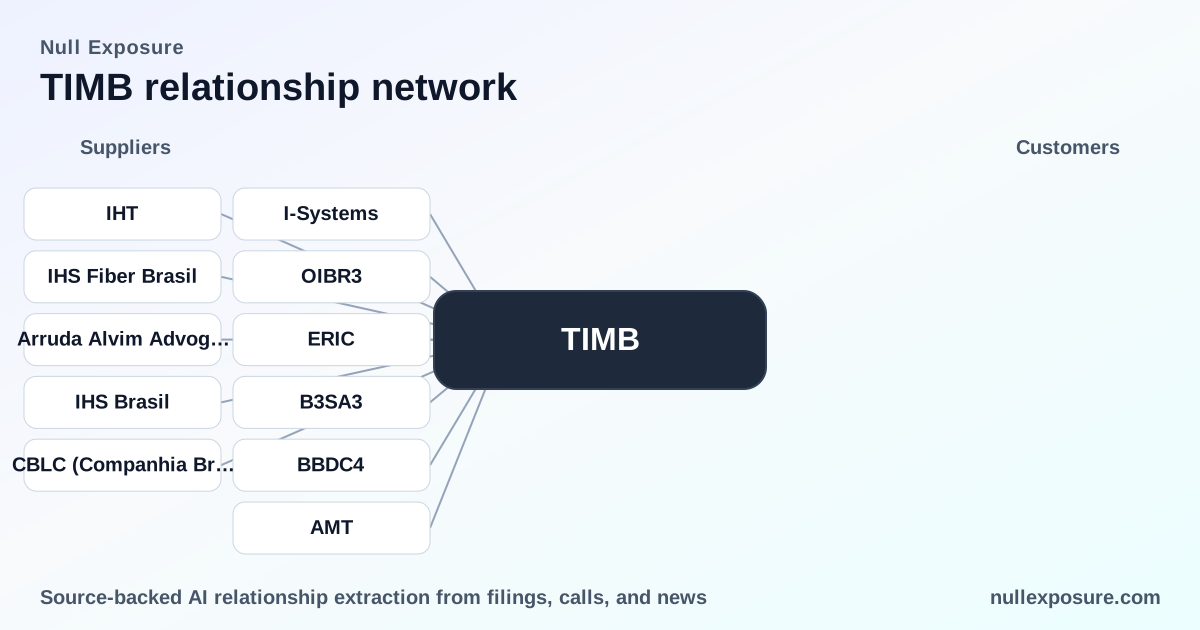
Supplier and partner map: the relationships that move cash and risk
I-Systems I-Systems builds new fibre infrastructure for TIM and handles operations and maintenance while TIM serves as the anchor tenant under a long-term master services agreement, and TIM is pursuing an ownership buy-back of the unit to internalize fibre economics. According to multiple press reports in FY2026, TIM entered negotiations to reacquire the stake in I-Systems to capture more value from its fibre rollout (WHTC; TradingView/Invezz, FY2026).
IHS Towers / IHS Fiber Brasil / IHS Brasil IHS Towers agreed to sell its 51% stake in fibre company I-Systems back to TIM in a transaction valuing the business at roughly US$452.6 million, effectively positioning TIM as full owner of the fibre arm and removing an external JV partner. DevelopingTelecoms reported the divestment and TIM’s move to regain full control of the asset in FY2026.
American Tower / American Tower do Brasil TIM signed a strategic long-term tower framework that consolidates prior contracts and covers about 9,000 towers — roughly 30% of TIM’s tower footprint — with unified terms through 2034 and a clause to cap lease growth around inflation levels. The Globe and Mail and TIM’s FY2026 disclosures cite this consolidation as central to controlling lease inflation and aligning tower costs with revenue growth (Globe and Mail press releases, FY2026).
Ericsson TIM contracted Ericsson for a cloud-native billing consolidation, an upgrade intended to modernize revenue management and billing systems with a strategic vendor partnership. DevelopingTelecoms described the FY2025 agreement as a move to reduce legacy complexity and support new product monetization (DevelopingTelecoms, FY2025).
Oi / Oi SA TIM was one of the bidders in broader market transactions tied to Oi’s mobile operations and participated in price renegotiation discussions over the Oi deal valuation, reflecting competitive market positioning and potential inorganic expansion via asset acquisitions. Economic Times coverage noted TIM’s involvement in FY2022 negotiations over price adjustments for Oi’s mobile assets (EconomicTimes, FY2022). Separately, Valor noted structural market shifts stemming from Oi’s sale of its mobile network, which left Oi focusing on landline broadband (Valor, FY2024).
B3 S.A. - Brasil Bolsa Balcão / CBLC (Companhia Brasileira de Liquidação e Custódia) TIM uses Brazil’s central exchange and custody mechanisms for dividend servicing; dividend payments are routed through B3 and CBLC with custody agents and Banco Bradesco as payment channels, indicating standard market settlement and shareholder distribution infrastructure. MarketScreener’s FY2025 release detailed the dividend payment mechanics and settlement paths (MarketScreener, FY2025).
Banco Bradesco S/A Banco Bradesco is the executing payment agent for TIM’s dividend distributions to shareholders who do not use custody agents, underscoring reliance on Brazil’s incumbent banking network to execute shareholder returns. MarketScreener’s FY2025 communication identifies Bradesco as the payment channel for dividends (MarketScreener, FY2025).
Arruda Alvim Advogados TIM’s fiscal council reviewed responses to recommendations following an external review of TIM’s tax litigation governance conducted by Arruda Alvim Advogados, signaling governance workstreams around tax matters and legal oversight. The company’s FY2026 filings and press disclosures reference the advisory role of Arruda Alvim Advogados in this governance process (Globe and Mail press release, FY2026).
CBLC (Companhia Brasileira de Liquidação e Custódia) As part of TIM’s dividend mechanics, securities held in custody at CBLC are processed for payout through B3 and intermediary banks, confirming reliance on Brazil’s central custody for shareholder distributions. MarketScreener’s FY2025 notice outlines the CBLC role in dividend crediting and settlement (MarketScreener, FY2025).
How these relationships translate into investment-grade signals
- Cost predictability vs. capital intensity trade-off. Consolidation of tower contracts and fibre ownership reduces long-term lease volatility and improves gross margins, but demands near-term cash deployment and integration competence.
- Supplier concentration creates negotiation power and single-point risks. Large, multi-year deals with American Tower and Ericsson improve operational focus but raise counterparty importance; success depends on TIM’s ability to enforce caps and service levels.
- Governance and settlement sophistication lower financial friction. Use of B3/CBLC/Bradesco for dividends and external tax-governance reviews improves investor confidence in cash distribution mechanics and legal oversight.
Key risks and what to watch next
- Execution on I-Systems integration and fibre roll-out economics will determine whether vertical consolidation improves EBITDA conversion or simply swaps operating expense for capital expenditure.
- Lease renegotiation effectiveness with tower partners will decide if TIM achieves the promised alignment of lease growth below revenue growth.
- Billing modernization with Ericsson is an operational catalyst; failure to migrate cleanly introduces churn and ARPU compression risks.
If you evaluate supplier credit, counterparty exposure, or need an ongoing view of TIM’s contract landscape, explore our supplier intelligence and monitoring at https://nullexposure.com/.
Conclusion TIM’s supplier strategy is pragmatic and aimed at converting vendor relationships into stable, recurring cash flows while reducing long-term cost volatility. The company’s recent moves — buying back fibre stakes, consolidating tower agreements, and modernizing billing — signal a clear bias toward owning the levers that drive margin. For investors focused on operating leverage and supplier concentration, TIM’s pathway is execution-dependent: success will expand margin optionality; failure will stress near-term capital returns. For ongoing coverage and supplier risk scoring, visit https://nullexposure.com/.