Tian Ruixiang Holdings (TIRX): Strategic moves that reprice liquidity and licensing
Tian Ruixiang Holdings Ltd (TIRX) is a Beijing-headquartered insurance broker that earns fees by placing and brokering insurance products in China and is actively expanding its licensed footprint through targeted acquisitions and capital raises. Recent transactions—an acquisition of a Hong Kong-licensed broker target, a small registered direct financing, and a Nasdaq reverse split—signal a company prioritizing immediate liquidity and regulatory-compliance remediation over organic scale. If you evaluate supplier relationships with TIRX, treat it as a capital-constrained intermediary positioning for cross-border licensing and short-term balance-sheet repair. For ongoing supplier diligence and alerts, visit https://nullexposure.com/.
What the recent corporate activity means for counterparties and investors
TIRX has executed a blend of corporate actions that change its counterparty profile. A Hong Kong acquisition increases regulatory complexity and cross-jurisdictional operational requirements, while the registered direct offering and warrant repricing inject near-term cash at the cost of equity dilution and altered warrant economics. The company’s reverse stock split is an explicit market-compliance step that reduces share count to stabilize listing status but does not address fundamentals.
These moves transform TIRX from a purely domestic broker to a cross-border operator with heightened settlement, licensing, and compliance touchpoints—factors that directly affect supplier contracting posture and the criticality of service continuity. For deeper monitoring of these developments, see https://nullexposure.com/.
The relationships that matter now
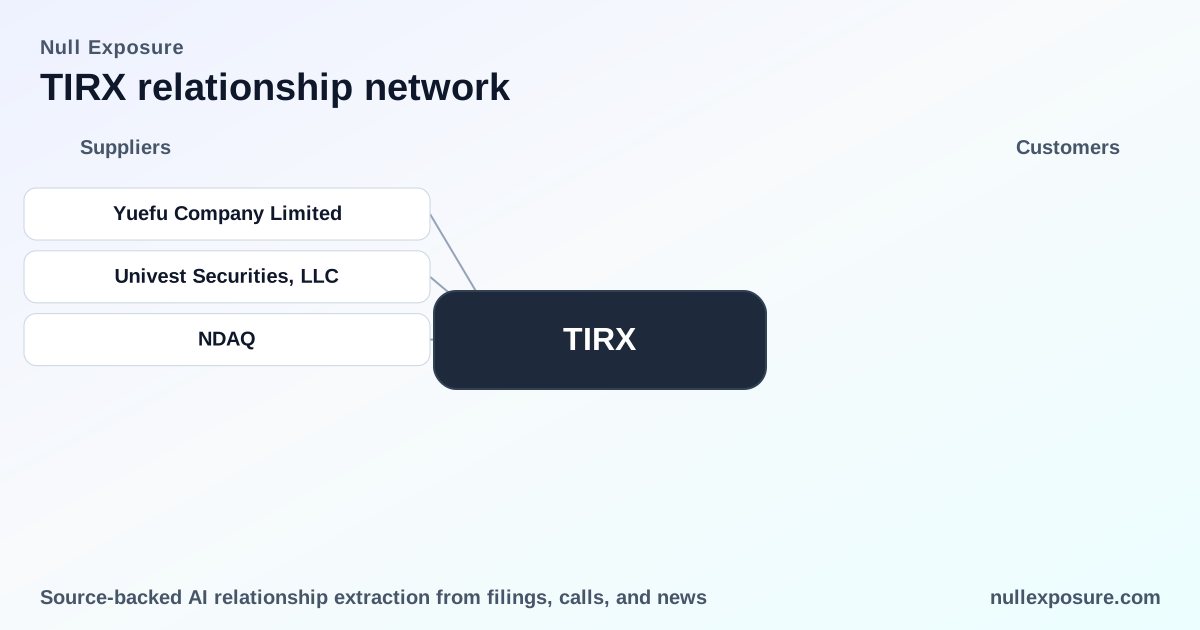
Tian Ruixiang’s public filings and news releases identify three immediate relationships of consequence to suppliers and counterparties:
Yuefu Company Limited — vendor to a Hong Kong broker acquisition
TIRX’s TRX HongKong subsidiary entered into a sale-and-purchase agreement to acquire Peak Consulting Services Limited from Yuefu Company Limited, positioning TIRX to control a licensed insurance-broker entity in Hong Kong. This is an explicit expansion of licensed distribution capacity outside mainland China, increasing regulatory obligations and vendor integration risk. According to a GlobeNewswire release announcing the SPA, the transaction was disclosed in a company communication tied to FY2024 activity (GlobeNewswire, Feb 14, 2024).
Univest Securities, LLC — placement agent for a registered direct offering
TIRX placed a registered direct offering arranged solely by Univest Securities, LLC, with gross proceeds of $900,000 and an option for additional closings; the deal included a reduction in exercise price for previously issued warrants to the same investors. This financing injects working capital while altering investor economics and increasing the likelihood of near-term dilution, a direct signal that liquidity is being managed through equity capital markets rather than operating cash flow. The placement and its terms were reported via the TipRanks/The Globe and Mail notice tied to FY2026 disclosures and an expected close on or about Feb 4, 2026 (TipRanks via The Globe and Mail, Feb 2026).
Nasdaq Capital Market — venue and compliance processing for reverse split
The company announced an expected effective date for a previously disclosed 1-for-50 reverse stock split to occur on the Nasdaq Capital Market during the week of March 16, 2026. The reverse split is a tactical move to regain or maintain listing standards and to compress the outstanding share count; it does not change economic ownership but alters per-share metrics and trading liquidity. Details were published by the company in a GlobeNewswire release tied to FY2026 compliance updates (GlobeNewswire, Feb 27, 2026).
Operating-model characteristics and company-level signals
There are no specific external constraints listed in the supplier relationship feed; therefore, we treat constraints as company-level signals derived from public data and the recent transactions:
- Capital-constrained contracting posture: Market capitalization is approximately $2.7 million while trailing EBITDA is negative (~-$2.85M), indicating that TIRX is dependent on equity financings and asset transactions to meet working capital needs rather than free cash flow. This explains the registered direct offering and warrant reprofiling.
- High insider concentration and a thin public float: Insiders own roughly 57% of shares, while institutional ownership is recorded as 0% and the public float is limited (about 7.54 million shares reported). This concentration raises the risk that strategic decisions reflect majority insider priorities and can increase counterparty exposure if control holders shift strategy quickly.
- Liquidity and listing sensitivity: The 1-for-50 reverse split and the small market cap are classic remediation actions to sustain Nasdaq listing eligibility and restore tradability; suppliers should treat the company as operationally functional but market-liquidity fragile.
- Early-stage cross-border maturity: The acquisition of a Hong Kong-licensed broker signals an acceleration into regulated international markets, increasing compliance complexity and vendor onboarding requirements for technology, payment settlement, and regulatory reporting.
Risk and commercial implications for suppliers
- Payment and credit risk: Negative EBITDA and recent equity financing indicate constrained operating cash flow; suppliers should tighten payment terms and consider milestone-based delivery for onboarding and systems integration.
- Contracting leverage: With high insider control and a small public float, counterparties may face one-directional renegotiation risk if the company reprioritizes local strategic objectives.
- Regulatory and onboarding cost: The Hong Kong acquisition elevates compliance expectations—suppliers providing audit, KYC, or IT services should price for additional certification and cross-border data protection work.
- Liquidity events will change economics: Warrant reprofiling and future capital raises will dilute stakeholders and could shift incentives across service partners; model multiple dilution scenarios when underwriting long-term supplier credit.
How to act now
- If you supply critical services (brokerage platforms, regulatory reporting, claims processing), update contract covenants to include cash-monitoring triggers and shorter payment cycles.
- For non-critical suppliers, limit exposure size and require pre-funded milestones until trading liquidity normalizes post-reverse-split.
- Monitor filings and market notices for the completed reverse split and any follow-on capital raises; these actions materially change counterparty credit and ownership structure. For tracking these developments, check https://nullexposure.com/.
Bottom line
Tian Ruixiang is executing a short-term survival and strategic expansion playbook: acquire licensed capacity in Hong Kong while patching near-term liquidity through equity placements and a reverse split to preserve Nasdaq listing. For suppliers, that combination upsizes compliance obligations and compresses payment certainty. Investors and operators should prioritize contractual protections, insist on clear regulatory-compliance roadmaps post-acquisition, and treat TIRX as a small-cap broker with concentrated insider control and active financing needs.
For ongoing supplier intelligence and to receive alerts on TIRX and comparable counterparties, visit https://nullexposure.com/ and subscribe for updates.