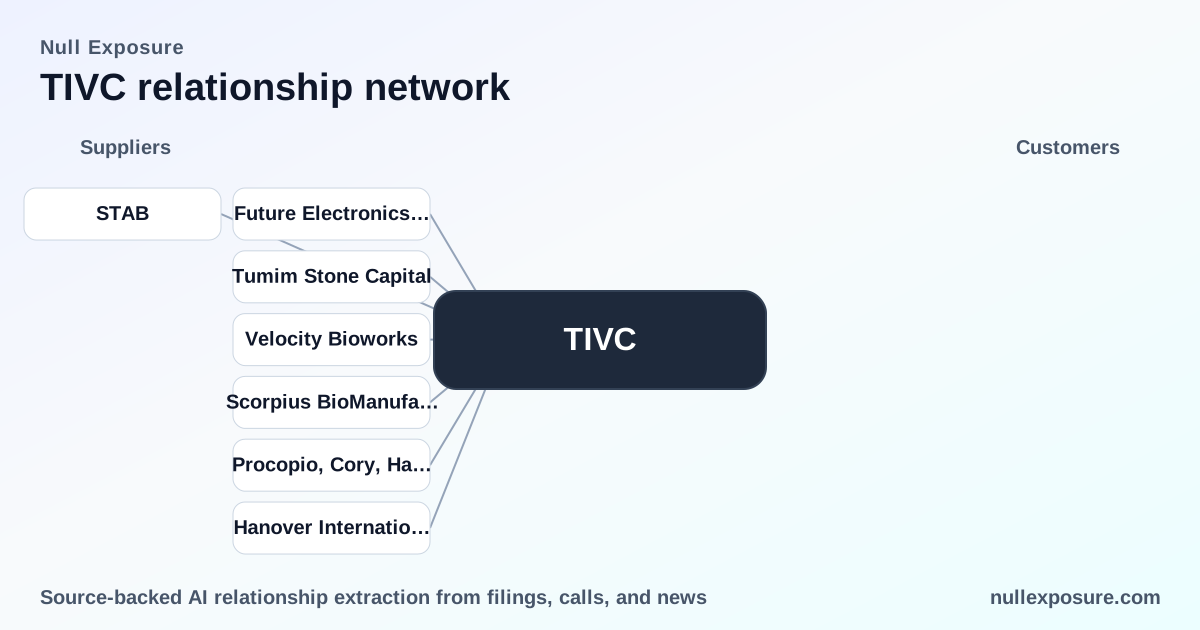
Tivic Health Systems: supplier relationships that shape near-term execution risk and upside
Tivic Health Systems (TIVC) sells non‑invasive bioelectronic therapies and is monetizing through device sales and an expanding drug development pipeline built on licensed TLR5 agonists; management supplements cash through financing arrangements and transactional capital raises. The company’s operating profile blends device manufacturing and distribution with a nascent biologics supply chain—a hybrid that concentrates execution risk around a small set of manufacturing and financing partners while offering optionality if drug programs advance. For a focused supplier-risk brief and continuous monitoring, visit NullExposure.
Quick thesis: hybrid device company running a lean supplier network
Tivic generates revenue from device sales and is executing a strategic pivot into drug development via licenses and third‑party manufacturing partnerships. Revenue today is modest and negative margins persist, but the company’s value vector is tied to successful scale-up of Entolimod and related TLR5 assets coupled with disciplined capital access. Management mitigates component price and availability risk through distributor agreements while outsourcing biologics-scale work to established CDMOs.
Who Tivic works with — the relationship map investors need
Below are the supplier and partner relationships disclosed in company filings and public releases, with a plain-English summary and source reference for each.
Future Electronics, Inc.
Tivic keeps a supply agreement with Future Electronics to stabilize sourcing and pricing for electronic components used in its devices; Future acts as a global distributor that reduces volatility in procurement. According to the company’s FY2024 Form 10‑K, Tivic “maintain[s] an agreement with Future Electronics, Inc., one of the largest global electronic component distributors.” (FY2024 10‑K)
Tumim Stone Capital
Tivic established an equity line of credit and related investor rights with Tumim Stone Capital to provide flexible financing capacity and immediate access to public equity capital. A TradingView report covering March 2026 noted that Tivic “signed multiple financing‑related agreements with Tumim Stone Capital, establishing an equity line of credit and related investor rights.” (TradingView, March 2026)
Velocity Bioworks
Tivic leverages Velocity Bioworks’ manufacturing capabilities to support its drug pipeline and to pursue vertical integration that could lower costs and secure supply for biologics production. Multiple press releases and conference notices in early 2026 describe Velocity as a San Antonio‑based CDMO providing in‑house manufacturing capability for Tivic’s programs and potential new revenue streams. (AccessWire / The Globe and Mail, January–March 2026)
Scorpius BioManufacturing
Scorpius is engaged to perform GMP manufacturing validation work for Entolimod, supporting regulatory and scale‑up milestones for the acute radiation syndrome program. During the company’s Q2 2025 earnings discussion, management stated that work with Scorpius began on GMP manufacturing validation in May. (Q2 2025 earnings call transcript, InsiderMonkey)
Procopio, Cory, Hargreaves & Savitch LLP
Tivic retained Procopio’s capital markets practice to manage a public offering and related securities work, reflecting standard legal support for equity transactions. Procopio reported managing the transaction on behalf of Tivic in FY2024 materials on the firm’s site. (Procopio client release, FY2024)
Hanover International, Inc.
Hanover International is listed as investor relations contact for Tivic, serving an investor‑communications role rather than an operational supplier function. Yahoo Finance’s coverage of Tivic’s press release identifies Hanover International as the investor contact via Tivic’s public materials. (Yahoo Finance press release coverage, FY2025)
Statera Biopharma / Statera
Tivic acquired exclusive licensing rights to Statera’s TLR5 agonist program (Entolimod) and has transferred two INDs; the arrangement supplies Tivic with late‑stage assets and options on additional indications. Company disclosures and press coverage in 2025–2026 describe the February 2025 License Agreement and subsequent IND transfers and planned Phase II/III development work. (Company release and earnings materials, FY2025–FY2026; BioSpace, AccessWire)
Operating model and constraint signals that matter for investors
Tivic’s supplier footprint and the constraints extracted from public documents reveal a compact, concentrated operating model with several actionable characteristics:
-
Contracting posture — selective outsourcing with distributor cushions. Tivic explicitly uses a global distributor (Future Electronics) to stabilize electronics procurement and has entered license agreements to acquire drug assets rather than building them entirely in‑house; this reflects risk‑transfer via contracts where possible while retaining control over core clinical programs. (FY2024 10‑K; License Agreement disclosures)
-
Geographic sourcing concentration — dual exposure (China and North America). Electronic components, plastic enclosures, and some packaging are produced or sourced in China while final assembly, test, warehousing and distribution are based in North America. That split creates supply‑chain arbitrage benefits on cost, but political/regulatory exposure to China and logistics vulnerability for key components. (Company disclosures on sourcing and manufacturing)
-
Criticality — manufacturing partners are mission‑critical for biologics scale‑up. CDMO relationships (Velocity Bioworks, Scorpius) are central to advancing Entolimod from license to clinic; any disruption or failure in GMP validation will directly delay regulatory timelines and value realization. (Q2 2025 transcript; AccessWire)
-
Concentration and maturity — small spend footprint, early stage for drugs. Some service engagements (e.g., product development consulting tied to a significant shareholder) have been immaterial in spend terms (single‑digit thousands in FY2023–2024), while major revenue drivers for drug assets remain preclinical/early clinical; supplier concentration is high and supplier maturity varies from experienced CDMOs to small legal/IR firms. (FY2024 disclosures on consulting spend and license terms)
-
Contract lifecycle signals — active, terminated, and licensed relationships. The company has both active agreements (Statera license; current CDMO engagements) and terminated arrangements (the Fulfillment Services Agreement with ALOM was ended in August 2024 as part of cost‑reduction moves), indicating management is actively reshaping supplier relationships for cost and control. (FY2024–2025 disclosures)
Key risk takeaway: Tivic’s upside requires successful scale‑up of biologics manufacturing and continued access to capital; both are highly dependent on a small number of external partners and financing agreements.
For a dynamic supplier risk scorecard and live tracking of partner events, see NullExposure.
Investment implications — what investors and operators should watch next
- Monitor progress and milestones with Velocity Bioworks and Scorpius: any GMP validation delays or capacity shortfalls will be the fastest route to timeline slippage for Entolimod.
- Watch Tumim Stone Capital financing terms and draw activity for dilution and liquidity implications; equity lines are useful but can compress share value if overused.
- Track component pricing and lead‑times managed through Future Electronics; abrupt changes in China‑US relations or component availability are an existential operating risk given the hybrid manufacturing footprint.
- Confirm that legal and IR providers (Procopio, Hanover) are aligned with capital strategy and investor communications ahead of clinical inflection points.
For an actionable supplier monitoring framework tailored to life‑science supply chains, visit NullExposure.
Bottom line
Tivic Health runs a lean supplier base that supports both a device business and an early‑stage biologics program. The company’s path to value is binary: controlled, successful scale‑up of Entolimod and disciplined financing unlock upside; supply‑chain disruption or undercapitalization compresses it. Investors should prioritize operational milestones at CDMO partners and the cadence of equity financing as the clearest signals of program viability.