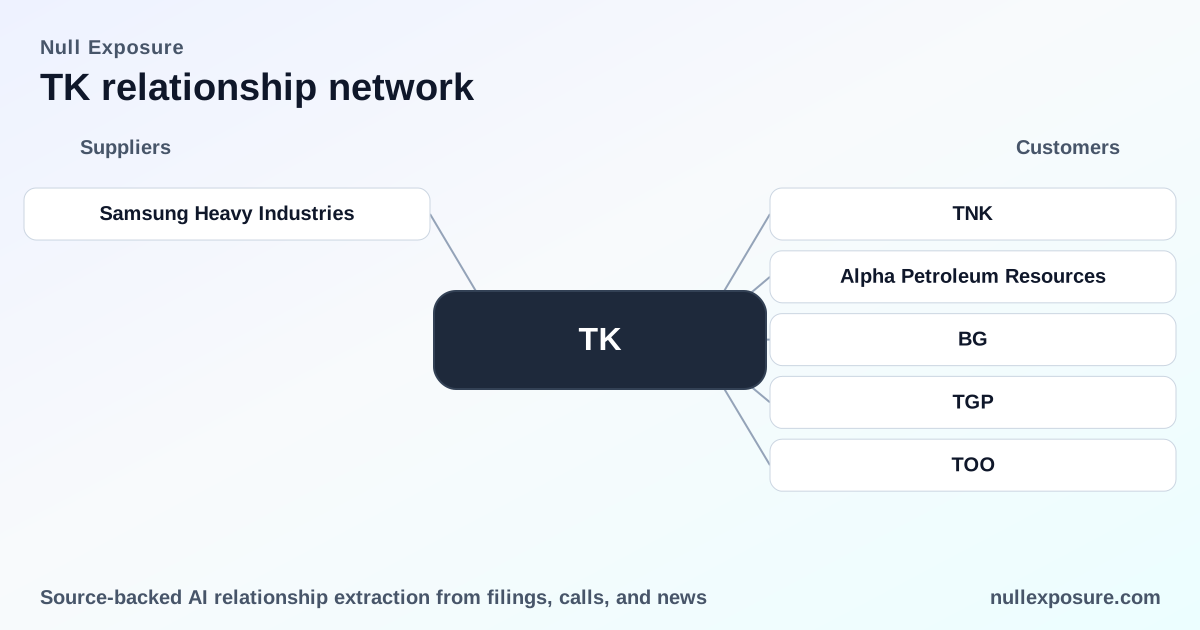
Teekay Corporation (TK) — Supplier Map and Strategic Implications for Investors
Teekay Corporation operates and monetizes as an asset-centric marine energy transportation company: it owns and manages vessels that it charters to energy producers and traders, generating revenue through time and voyage charters, technical management fees and occasional asset sales. Cashflow is driven by charter rate realization on contracted fleets and the replacement-cycle economics of capital-intensive ships, making counterparty stability and shipyard relationships critical to long-term value. For investors evaluating supplier exposure, the vendor profile centers on shipbuilders and repair yards that enable fleet renewal and delivery timelines. Learn more about supplier risk and relationship mapping at https://nullexposure.com/.
Quick financial snapshot and what it signals about supplier risk
Teekay’s trailing twelve-month revenue sits near $992.5 million with EBITDA of about $247.0 million and a market cap around $855 million. A mid-single-digit return on assets and positive operating margin indicate an operating business that converts vessel utilization into meaningful cashflow, but capital intensity and concentrated supplier dependencies amplify delivery and capex timing risk. The firm’s Price-to-Book (~1.43) and P/E (~11.3) reflect a market pricing that discounts growth but recognizes steady cash generation.
What the supplier relationships say — one-by-one review
Below I cover every supplier relationship identified in the available results.
Samsung Heavy Industries — shipbuilder and delivery counterparty
Samsung Heavy Industries delivered Teekay’s Petrojarl Knarr (delivered in Geoje, South Korea and sailed to Norway in September of the vessel’s delivery year), indicating Teekay’s reliance on large South Korean yards for newbuilds. The gCaptain news article reporting the Knarr sailaway connects Teekay to Samsung Heavy Industries in the context of vessel delivery and launch activities (gCaptain report; first-seen March 2026 referencing an FY2014 delivery excerpt). This relationship underscores Teekay’s exposure to lead times and construction risk typical of major shipbuilders.
How these supplier links shape Teekay’s operating profile
Shipyards like Samsung Heavy Industries are not interchangeable components of cost — they determine vessel delivery schedules, technical specification fidelity, and often warranty and post-delivery support. For Teekay:
- Contracting posture: Teekay’s economics depend on long-form chartering and scheduled newbuild deliveries; the company’s supplier posture is therefore long-term and strategic rather than transactional. Long lead times for newbuilds make supplier predictability essential.
- Concentration and criticality: Major shipyards represent a high-concentration, high-criticality supplier class. A delay or defect from a primary yard directly affects revenue through missed charters or increased downtime.
- Maturity and bargaining: Shipyards servicing large fleets are mature, high-capacity suppliers with their own backlog dynamics; Teekay negotiates with established industrial players rather than small contractors, which offers both reliability and limited pricing leverage during global booms in shipbuilding demand.
- Operational dependency: Technical management and retrofit work also link Teekay to specialized yards and service providers; maintaining scheduled maintenance windows is a direct operational dependency.
These are company-level signals rather than relationship-specific constraints because no constraint excerpts in the available material explicitly tie operational constraints to any single supplier.
Investment implications and risk checklist
Investors should view supplier exposure through three practical lenses:
- Timing risk: Delivery delays at major yards translate directly into deferred revenue and increased working capital needs; monitor reported shipyard backlogs and delivery announcements. A visible example is the Samsung-delivered Knarr referenced in industry coverage.
- Counterparty stability: Large yards reduce counterparty credit risk but increase exposure to cyclical capacity constraints that elevate build costs; diversification across yards and secondhand acquisition strategies mitigate this.
- Operational continuity: Maintenance and repair windows are operationally critical; procurement continuity with key yards underpins uptime and charter reliability.
Key takeaway: Supplier relationships with large shipyards are strategically critical to Teekay’s ability to monetize its asset base and sustain charter revenues; investors must price in construction cycles and yard-specific risk into valuation and scenario analysis.
What to watch next (actionable signals)
- Track vessel delivery notices and sailaway reporting from major yards for signs of schedule slippage or accelerated deliveries.
- Watch Teekay’s fleet renewal announcements and capex guidance for shifting reliance between newbuild orders and secondhand purchases.
- Monitor regional shipbuilding backlogs and pricing trends in South Korea and Japan to anticipate cost inflation and lead-time shifts.
Explore deeper counterparty maps and supplier concentration analytics on the platform: https://nullexposure.com/.
Bottom line: sourcing risk is a value driver for TK
Teekay’s business model converts capital-intensive ship ownership into recurring cashflow, but that conversion is tightly coupled to a small set of high-impact suppliers — principally major shipbuilders and yards. Supplier performance and delivery cadence translate directly into realized revenue and balance-sheet timing, making supplier surveillance an essential component of investment due diligence. For a practical supplier-risk readout and ongoing monitoring tools, visit our research hub at https://nullexposure.com/.
By maintaining focus on delivery schedules, yard backlogs and contract structures with shipbuilding partners, investors can convert supplier intelligence into sharper earnings and cashflow forecasts for Teekay.