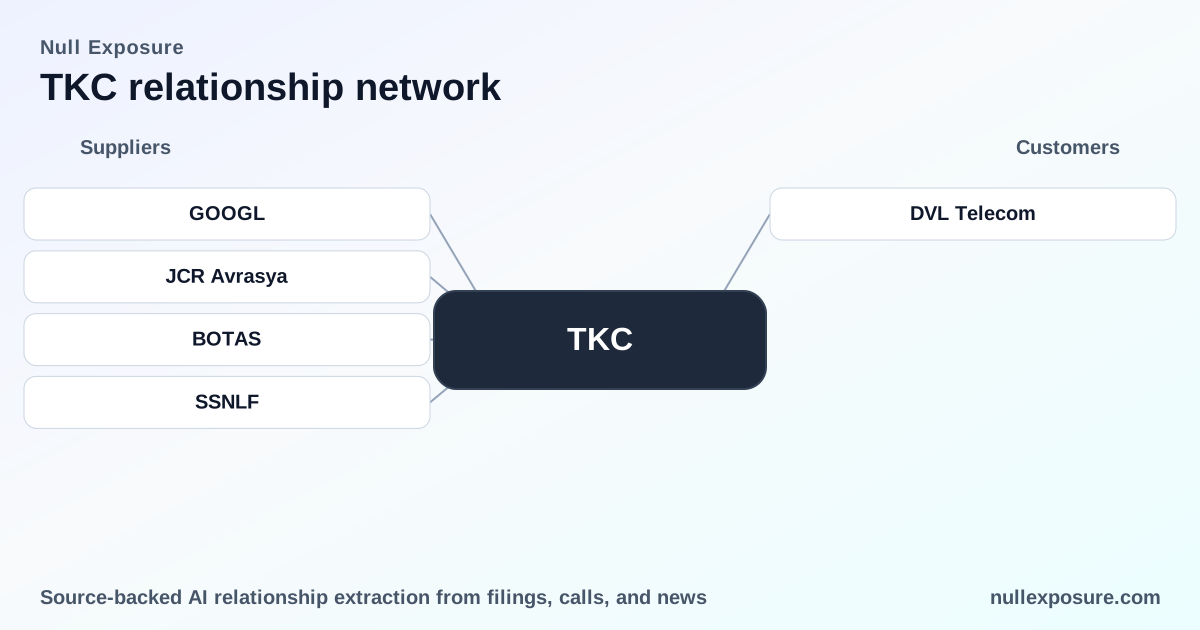
TKC Supplier Map: Turkcell’s Strategic Vendor Relationships and What Investors Should Expect
Turkcell Iletisim Hizmetleri AS (TKC) is Turkey’s leading integrated telecom operator that monetizes through mobile subscriptions, enterprise digital services, data-center and cloud offerings, and wholesale infrastructure contracts across Turkey and adjacent markets. The company converts network scale into recurring cash flow while layering higher-margin digital services — most notably through partnerships that expand its data-center footprint and enterprise cloud go-to-market. For investors, the vendor mix is as important as subscriber trends: hyperscaler alliances and domestic infrastructure contracts materially reshape capital allocation and EBITDA cadence.
For a concise map of these relationships and how they move the P&L, visit https://nullexposure.com/.
Why supplier relationships are central to TKC’s investment case
Turkcell is executing a dual strategy: defend core connectivity revenues and accelerate higher-margin enterprise and cloud services. That strategy relies on a small set of strategic suppliers that provide hyperscale cloud capability, device ecosystem scale, and domestic infrastructure access. The quality and structure of these supplier agreements influence capital intensity, timing of EBITDA contribution from new services, and the company’s ability to monetize 5G and data-center investments.
Quick snapshot metrics that matter
- Market capitalization ~ $5.4 billion and trailing revenue ~TRY 185.1 billion (reported TTM).
- Profit margin ~7.3% with notable EBITDA contribution expected from recent data-center initiatives.
These figures underline Turkcell’s status as a mature telecom operator that is reorienting incremental growth toward enterprise cloud and data services.
Visit https://nullexposure.com/ to track updates to these supplier exposures and earnings-driven inflection points.
Relationship rundown — who supplies what and why it matters
Below are the supplier relationships surfaced in public reporting and transcripts, with concise takeaways and source references.
-
Google Cloud — Turkcell announced a strategic alliance with Google Cloud that includes plans to host a Google Cloud Region in Türkiye and to resell Google Cloud solutions to enterprise customers; the arrangement supports low-latency cloud services and is cited as a driver of data-center EBITDA beginning in 2026. According to Finviz (reporting March 10, 2026) and coverage in The Globe and Mail (March 2026), the partnership includes a hyperscale-region element and reselling arrangements that expand Turkcell’s enterprise cloud offerings. (Sources: Finviz, March 10, 2026; The Globe and Mail, March 10, 2026; SimplyWall.St narrative update, FY2025–FY2026)
-
BOTAS — An infrastructure agreement with BOTAS enhances Turkcell’s fiber footprint, giving the company additional backbone capacity for both retail and wholesale services and supporting its data-center and 5G rollouts. The Globe and Mail’s FY2026 coverage highlights BOTAS as a domestic infrastructure partner that strengthens Turkcell’s network reach. (Source: The Globe and Mail, March 2026)
-
JCR Avrasya — JCR Avrasya’s national rating is an enabler of Turkcell’s local debt access: the company’s financing profile is supported by a AAA (Trk) long-term national rating from JCR Avrasya as of May 29, 2025, which sustains investor confidence for short-term bond markets. That rating was cited in Turkcell press material carried by The Globe and Mail. (Source: Turkcell press release via The Globe and Mail, March 2026; rating dated May 29, 2025)
-
Samsung — Turkcell’s collaboration with Samsung reflects device-channel scale for 5G migration; management disclosed purchases of 100,000 5G-enabled devices, signaling handset ecosystem support for commercial 5G launches and consumer upgrade cycles. The detail is drawn from the Q3 2025 earnings call transcript reported by InsiderMonkey. (Source: InsiderMonkey Q3 2025 earnings call transcript)
What the supplier map implies about Turkcell’s operating model
- Contracting posture: strategic and multi-year — The Google Cloud regional and reselling deal plus infrastructure agreements indicate long-term, high-commitment contracts rather than spot purchases; these relationships are structured to secure capacity and co-marketing for enterprise sales.
- Concentration: moderate with hyperscaler dependence — A small number of large partners (notably Google Cloud and domestic infrastructure providers) drive a disproportionate portion of the enterprise and data-center strategy, concentrating execution risk while accelerating scale if successful.
- Criticality: supplier relationships are core to strategic transition — Hyperscaler and infrastructure agreements are critical to Turkcell’s move up the value chain; execution hiccups would delay expected EBITDA from data centers and enterprise services.
- Maturity: transitioning from utility to platform — Turkcell is a mature telecom in subscriber metrics but in the middle of a multi-year transition to platform-oriented enterprise revenues, evidenced by announced cloud-region plans and device partnerships that support 5G monetization.
These operating-model signals should be read as company-level characteristics that shape capital allocation and execution risk, not as a claim tied to any single vendor beyond what public citations specify.
Investment implications and risks
- Upside: The Google Cloud partnership and new data-center capacity are direct EBITDA levers; management has flagged material contributions starting in 2026. That is a structural upside to earnings if enterprise adoption follows.
- Downside: Execution and concentration risk — dependency on a few strategic suppliers increases delivery and timeline risk, and delays would compress forward multiple expansion. Domestic rating support (JCR Avrasya AAA (Trk)) eases refinancing risk but does not obviate operational execution exposure.
- Tactical: Follow near-term announcements on the Google Cloud region commissioning and BOTAS-linked fiber capacity availability; these will be the inflection points for the digital-services monetization story.
For a deeper supplier-risk monitoring workflow and to get alerts on partner-driven inflection events, go to https://nullexposure.com/.
Bottom line and next steps for investors
Turkcell is executing a credible move from connectivity-only toward a cloud-enabled enterprise champion in Türkiye. Hyperscaler partnerships (Google Cloud), domestic infrastructure agreements (BOTAS), and device relationships (Samsung) are the scaffolding for that strategy, while national-rating support (JCR Avrasya) keeps financing options open. Investors should focus on timing and delivery of the Google Cloud region and the early EBITDA contribution from data centers as the primary catalysts.
To stay updated on supplier-driven catalysts and earnings implications for TKC, visit https://nullexposure.com/ for ongoing coverage and alerts.