Talon Capital (TLNC): Supplier footprint and what it says about execution risk
Talon Capital Corp. is a Nasdaq-listed blank check / shell vehicle headquartered in Houston that monetizes primarily through sponsor-led dealmaking: it raises capital via IPO units, lists Class A shares and warrants, and delivers value by sourcing, structuring, and closing a business combination or returning capital to holders. The economics are driven by sponsor control of transaction flow, the timing of a qualifying acquisition, and the conversion/separation mechanics for units, shares and warrants. For investors evaluating supplier and service relationships, the immediate signals are operational readiness for listing and shareholder services rather than ongoing operating revenues.
For deeper supplier intelligence on TLNC, review full profiles at https://nullexposure.com/.
The near-term operational profile investors need to know
Talon’s public profile and financials reflect a pre‑deal SPAC posture: zero operating revenue, negative book value per share, and no earnings metrics, while market capitalization and share float show active public investor interest (Market Cap ≈ $427m; Shares Outstanding ≈ 25.7m). The company’s primary vendor relationships—market listing venue and transfer agent—are transactional but critical: they enable liquidity, secondary trading, and the mechanical separation of units into tradable securities. These supplier links are therefore essential to the corporate lifecycle rather than to product or service delivery.
Visit https://nullexposure.com/ for ongoing supplier relationship monitoring and alerts.
What the disclosed relationships reveal
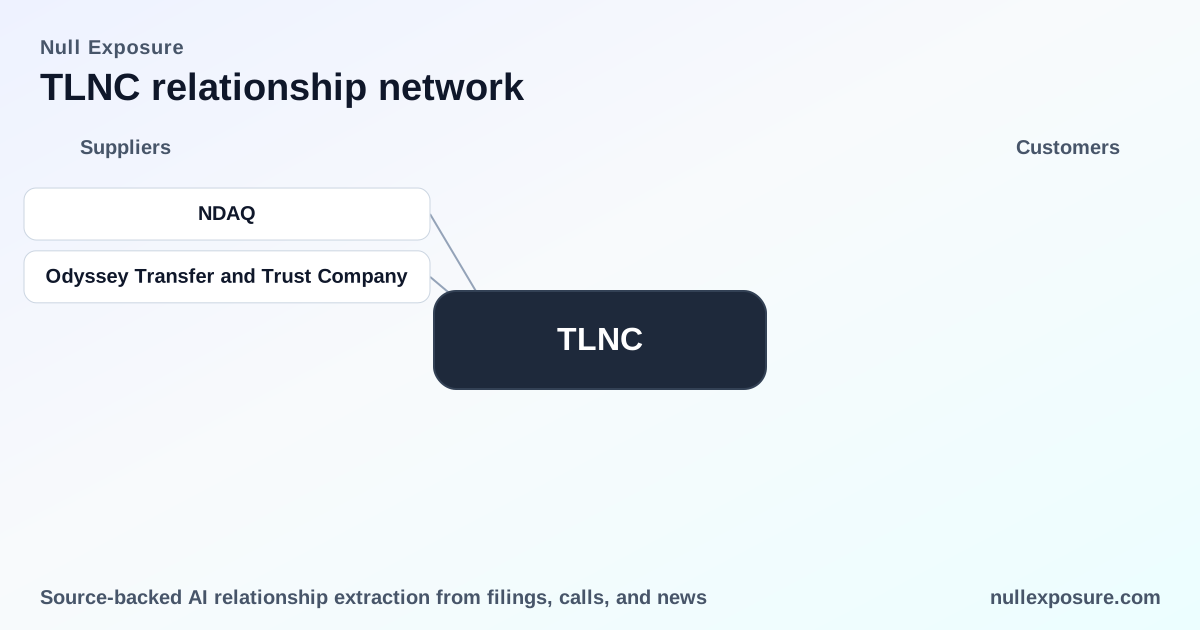
Two supplier relationships surface from public filings and press materials: the listing venue on the Nasdaq Global Market, and the transfer agent handling unit separation. Both are routine for a newly listed blank-check company, but they are operationally essential and time-sensitive ahead of any unit separation or de‑SPAC activity.
Nasdaq Global Market (Nasdaq)
Nasdaq will host the company’s Class A ordinary shares and warrants under the tickers TLNC and TLNCW, establishing the public trading venue and liquidity framework that underpins investor exit optionality and warrant/option mechanics (press release published on Yahoo Finance, March 10, 2026).
Odyssey Transfer and Trust Company
Odyssey Transfer and Trust Company has been identified as Talon’s transfer agent, responsible for processing broker requests to separate units into the listed Class A shares and warrants and maintaining shareholder records—an operationally critical task when units are distributed and separated (press release published on Yahoo Finance, March 10, 2026).
Constraints and company-level operating signals
There are no explicit contractual constraint excerpts provided for TLNC in the public summary. Absent named contractual constraints, present company-level signals are derived from the corporate posture and disclosed facts:
- Contracting posture: Standard market arrangements with exchange and transfer agent indicate TLNC uses market-standard service agreements; vendor relationships are transactional with limited bespoke dependency.
- Concentration and criticality: Supplier concentration is low in number but high in criticality—few vendors (exchange, transfer agent) provide indispensable infrastructure for trading and shareholder mechanics.
- Maturity and readiness: The presence of Nasdaq listing and a named transfer agent signal readiness to operate as a public vehicle, a necessary condition before unit separation and any downstream M&A activities.
- Operational exposure: Because TLNC has no operating revenue, supplier relationships are governance and execution risks, not product-delivery dependencies.
Risk implications for investors and counterparties
- Execution risk is front‑loaded. Failures in transfer-agent processes or listing mechanics would disrupt unit separation and secondary market liquidity, potentially compressing investor optionality.
- Limited supplier diversification creates single-point operational exposure. While relationships are conventional, their failure would have outsized effects given the company’s lack of operating substitutes.
- Commercial risk remains sponsor-driven. The business model’s success depends on the sponsor’s ability to source and close an acquisition; supplier relationships only enable market mechanics, not deal quality.
Read the relationships in context
Investors evaluating TLNC should treat supplier disclosures as operational enablers: Nasdaq provides the trading venue that sets price discovery and liquidity; Odyssey manages the administrative processes that convert unit holders’ economic interests into tradable securities. Both functions are foundational but not revenue-generating, and both create event-driven operational risk around separation dates and any transaction timelines (press release on Yahoo Finance, March 10, 2026).
For an investor-grade supplier map and ongoing tracking of TLNC counterparties, see https://nullexposure.com/.
Bottom line and next steps
Talon Capital is positioned as a public blank‑check vehicle with essential, market‑standard supplier relationships that enable trading and shareholder mechanics. The short to medium-term investor focus should be: monitor sponsor activity toward a business combination, track unit separation execution, and watch for any changes to transfer-agent or listing arrangements that could affect liquidity. Operational risk is concentrated but measurable; your assessment should weigh sponsor execution capability above vendor sophistication.
For continuous monitoring of supplier relationships and to receive alerts when TLNC updates counterparties or filings, visit https://nullexposure.com/.