Talphera Inc. (TLPH): Supplier relationships, operating posture, and what investors should price in
Talphera operates as a small-cap biotechnology company developing peptide-based and nafamostat-derived therapeutics for rare and high-need indications. The company monetizes by advancing clinical-stage candidates to regulatory approval and commercial launch while outsourcing manufacturing and certain development services to third parties; revenue will depend on successful approvals and scaled commercial supply agreements. For investors, the supplier footprint is a direct lever on development timelines, regulatory readiness, and commercial scalability. Learn more about supplier intelligence and counterparty risk at https://nullexposure.com/.
How Talphera sources the drugs that create value
Talphera does not internalize large-scale manufacturing. The company relies on contract manufacturing organizations (CMOs) and other third-party service providers to produce active pharmaceutical ingredients (APIs) and finished drug product for its lead candidate Niyad and other pipeline programs. That outsourcing model preserves capital but concentrates operational risk: single-source APIs or single-source finished product arrangements compress time-to-market assumptions and raise failure-mode exposure if a supplier has quality or regulatory issues.
From a business-model view:
- Contracting posture: Talphera uses CMOs under commercial supply agreements to move from development batches to potential commercial supply; these are relationship-driven, legally anchored contracts rather than ad hoc purchases.
- Concentration: The company discloses dependence on single contract manufacturers for key inputs for nafamostat-based candidates, producing a high concentration of supply risk.
- Criticality: Suppliers are mission-critical — a disruption to a CMO for the API or finished product will delay regulatory submissions and commercialization.
- Maturity: The supplier ecosystem is in the transition from development-stage support to commercial readiness; current revenue is negligible and the supplier network is being positioned for scale pending approvals.
These dynamics amplify the value of supplier diligence and contingency planning for buyers of the equity. For more on how to quantify supplier concentration into valuation and operational risk, visit https://nullexposure.com/.
Who Talphera works with (what the public record shows)
Below are the supplier and partner relationships disclosed in Talphera’s public materials. Each relationship is summarized plainly with a concise source reference.
-
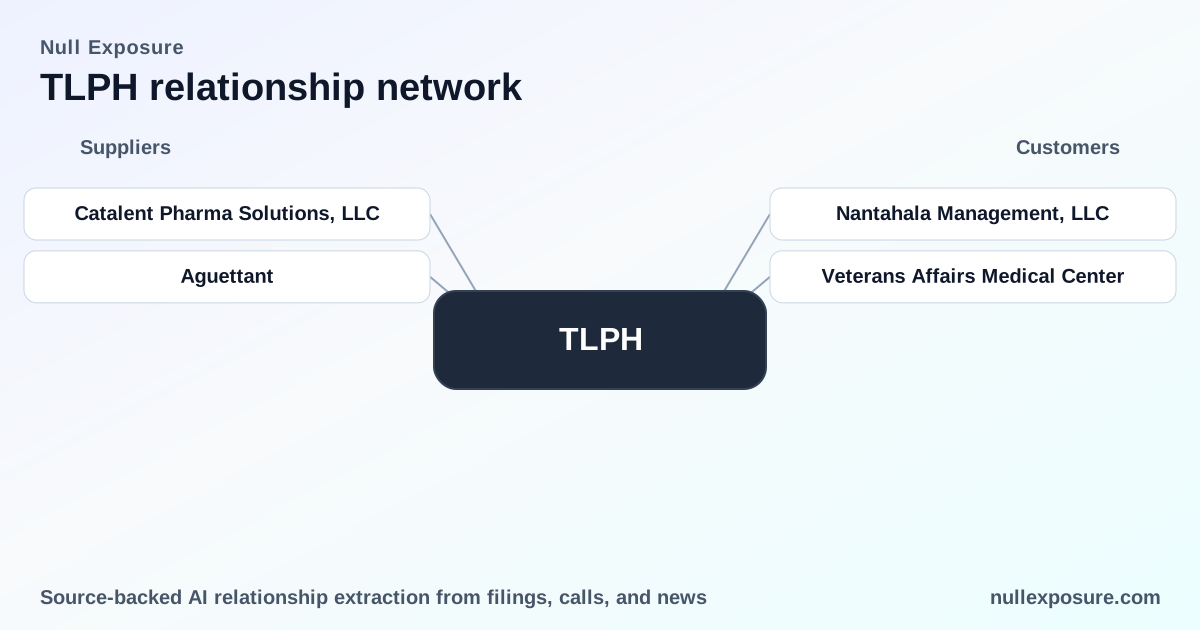
Catalent Pharma Solutions, LLC — Talphera has a Commercial Supply Agreement with Catalent, effective March 31, 2021, which is recorded in the company’s regulatory filings. This contract establishes Catalent as a named counterparty for supply services under Talphera’s commercial planning. According to Talphera’s 2024 Form 10‑K, the company lists a commercial supply agreement with Catalent Pharma Solutions, LLC (FY2024 disclosure).
-
Aguettant — Talphera is developing two pre-filled syringes that were in‑licensed from Aguettant: Fedsyra™ (pre-filled ephedrine) and PFS‑02 (pre-filled phenylephrine), positioning Aguettant as a development partner for specific product formats. A PR Newswire release describing Talphera’s product programs references these in‑licensed pre-filled syringes from partner Aguettant (PR Newswire, company release).
What the constraints and disclosures imply for investors and operators
The company-level disclosures and constraint signals create a clear operational profile that investors must price.
- Geographic sourcing footprint: Talphera states reliance on third‑party manufacturers and suppliers in both Asia and the United States. This dual-region sourcing introduces cross-border regulatory, logistical, and political vectors into supply continuity planning.
- Single-source dependence for key inputs: Talphera discloses single contract manufacturers for the API and for finished product related to its nafamostat-based candidates. That single-sourcing is material and elevates the probability that a supplier problem will delay development and commercialization timelines.
- Primary supplier roles: The filings identify external manufacturers (CMOs) as primary operational partners and also note the use of third-party service providers for ancillary needs such as cybersecurity, legal, and CRO work; these are operational enablers rather than revenue partners.
- Active relationships in place: The company reports active CMOs producing development batches and positioned to support commercial needs, which means the supplier relationships are operational rather than prospective.
Those signals translate into concrete risk exposures: timeline risk, through supply interruptions or regulatory inspection findings at a CMO; concentration risk, through single-sourced APIs/finished product; and geographic/regulatory risk, through cross-border reliance.
Practical actions for investors and operating teams
For portfolio managers and operators assessing exposure and mitigation, prioritize these actions:
- Require contract visibility and term review: evaluate exclusivity periods, supply ramp commitments, quality warranties, and change‑of‑control clauses.
- Stress-test timeline assumptions: model the valuation impact of 3–12 month delays from a single‑supplier disruption and price those scenarios explicitly into risk-adjusted upside.
- Insist on dual-sourcing or validated second sources before commercial launch where feasible, or ensure inventory and regulatory bridging strategies are contractually guaranteed.
- Monitor regulatory inspection histories and quality metrics for named CMOs and proxied suppliers in Asia and North America.
These steps convert qualitative supplier signals into actionable risk-management and valuation inputs.
For more supplier intelligence and to benchmark Talphera against peers on supplier concentration, visit https://nullexposure.com/.
Bottom line: suppliers are not an operational footnote for TLPH — they are a valuation driver
Talphera’s business model scales through third-party manufacturing and in‑licensing partnerships, which conserves capital but concentrates operational exposure. Investors must treat supplier contracts, single-source dependencies, and geographic supply footprints as primary drivers of development timelines and realized value. Operators should accelerate contingency planning, contractual protections, and second-source validation ahead of any commercialization milestone.
If you want a structured supplier risk profile and comparative analysis across the sector, explore available resources at https://nullexposure.com/.