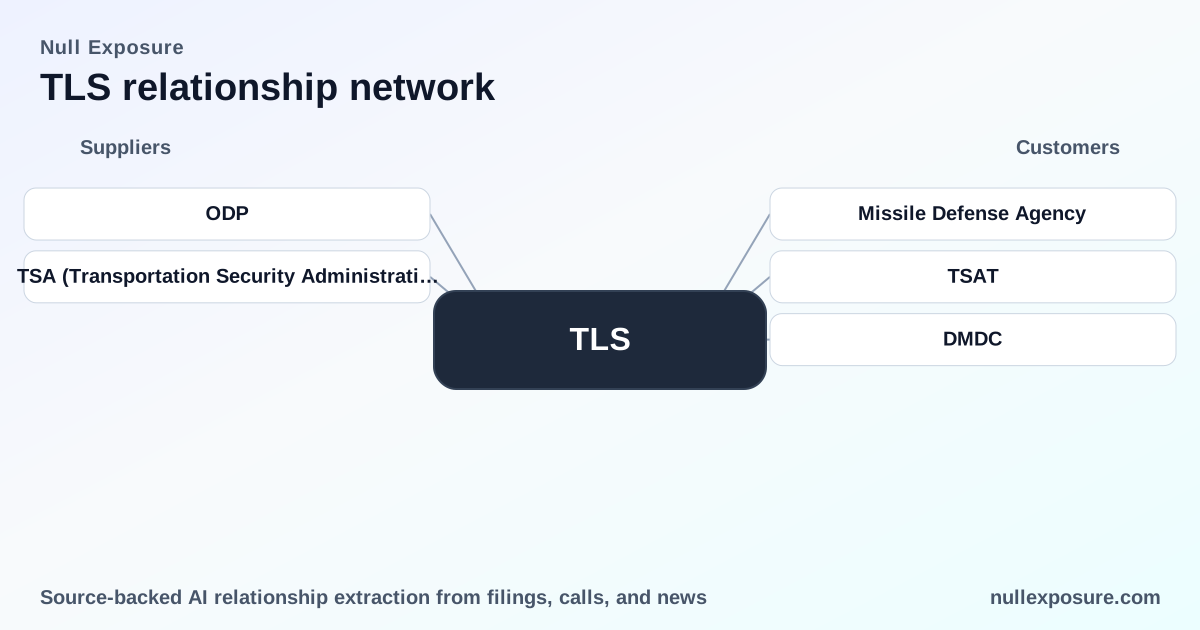
Telos (TLS) as a Supplier: How enrollment services and retail partners drive a services-oriented revenue stream
Telos Corporation operates as a government-focused IT and services company that monetizes through a mix of contract services, recurring program fees and third‑party retail distribution for consumer-facing programs. The company captures revenue by operating authorized enrollment services (notably TSA PreCheck® enrollment) and by integrating those services into partner retail footprints, converting government program access into steady transactional fees and channel revenue; this complements Telos’s broader government IT contract work. For investors and operators evaluating TLS as a supplier, the central question is whether these partner relationships scale the program profitably given Telos’s current margin profile and dependence on subcontractors.
Explore deeper supplier analytics at https://nullexposure.com/ for benchmarking and relationship diligence.
How Telos makes money and why these relationships matter to investors
Telos reports $164.8M in trailing twelve‑month revenue with a market capitalization near $304M, but the company runs at a negative net margin (-22.2%) and negative EBITDA, signaling that top‑line growth is not yet translating into consistent profitability. Its core monetization model is services and contracts: fixed and per‑transaction fees from government programs and professional services revenue from IT and cybersecurity contracts. The TSA PreCheck® enrollment program converts consumer foot traffic in retail partners into an outsourcing revenue stream that is operationally scalable but requires retail distribution and secure subcontractor operations to maintain service levels.
Company financials show high quarterly revenue growth (≈77% YoY on reported recent quarters), which supports expansion but also stresses operational controls. Institutional ownership is high (~70%) while insider holdings are substantial (~30%), a governance signal that investors should interpret alongside management’s execution track record.
Supplier and partner map — what the public reporting shows
Below I cover every relationship referenced in the public results and what each connection implies for Telos’s supplier posture and revenue generation.
TSA (Transportation Security Administration)
Telos is an authorized TSA PreCheck enrollment provider and expanded enrollment locations across multiple states in October 2025, increasing direct access for consumers to the government program. According to a GlobeNewswire release in October 2025, the rollout included new locations in California, Florida, Louisiana, Michigan, North Carolina and Texas, underscoring Telos’s role as a direct contractor to a federal agency. (Source: GlobeNewswire, Oct 15, 2025)
Office Depot (multiple notices)
Telos leverages retail partnerships with Office Depot to place enrollment kiosks and staffed locations inside stores, broadening consumer reach and driving per‑transaction fee revenue. A Yahoo Finance notice referencing FY2024 listed specific Office Depot locations in states including Florida, Kentucky and Pennsylvania, and a GlobeNewswire release in October 2025 reaffirmed that Office Depot stores are part of a 42‑state partner footprint. (Sources: Yahoo Finance, Mar 10, 2026; GlobeNewswire, Oct 15, 2025)
OfficeMax (retail footprint example)
OfficeMax locations are one of the retail placements Telos uses to host TSA PreCheck enrollment services in select markets; public reporting lists OfficeMax addresses as active enrollment sites. A Yahoo Finance article in March 2026 included OfficeMax as a named enrollment location in Arizona, reflecting Telos’s strategy of using large office‑retail chains to scale consumer access. (Source: Yahoo Finance, Mar 10, 2026)
Operational constraints and the company-level signals investors need to know
Telos’s public excerpted disclosures emphasize reliance on subcontractors and suppliers to deliver core services, which is a company-level operational constraint rather than a relationship‑specific weakness. The filing language states that Telos depends on subcontractors to provide materials, components and to perform portions of services, which translates into several practical signals:
- Contracting posture: Telos functions as a prime contractor for government work but outsources execution elements; this increases vendor management complexity and requires strong contractual protections and continuity planning.
- Concentration and criticality: The TSA PreCheck relationship is strategically critical because it is a high‑visibility, consumer‑facing program that supports predictable transactional revenue, but it is also concentrated around a limited set of government and retail partners for distribution.
- Operational maturity: Rapid rollouts across states and retail channels demonstrate scale ambition, yet negative margins and negative EBITDA indicate the operational model is still maturing and integration costs (retail partnerships, staffing, security) undercut near‑term profitability.
- Supply chain dependence: The subcontractor language signals execution risk if third parties underperform, and it increases the importance of contract terms, SLAs, and contingency plans.
These are company-level constraints extracted from public commentary and financial disclosures, and they should shape diligence on vendor agreements, insurance, and escalation pathways.
Investment implications and a practical risk checklist
Investors and operators should weigh the following high‑conviction points:
- Growth lever: Retail partnerships (Office Depot/OfficeMax) materially expand addressable customers for the TSA PreCheck business and convert program availability into revenue scale.
- Profitability gap: Top‑line growth has not yet produced positive net or operating income, so investor focus should be on margin improvement levers — yield per enrollment, cost of retail operations, and subcontractor management.
- Operational dependency: Subcontractor reliance is a structural execution risk; contracts and redundancy in critical supplier functions are essential to protect service continuity.
- Government counterparty strength: Working directly with the TSA provides durability and predictable cash flows, but also brings compliance and performance obligations that can be costly.
Actionable checklist for diligence:
- Review enrollment fee economics and retail revenue sharing.
- Validate subcontractor coverage, SLAs and redundancy plans.
- Stress-test profitability under different enrollment volumes and fee scenarios.
For a broader view of supplier footprints and concentration risk across suppliers, see more analysis at https://nullexposure.com/.
Conclusions and next steps
Telos combines government contracting with a consumer‑facing enrollment business anchored in retail partnerships. The TSA relationship is strategically important and retail partners like Office Depot and OfficeMax materially increase distribution, but profitability and execution risk hinge on managing subcontractors and turning volume into margin. Investors should monitor enrollment throughput, per‑transaction economics, and any shifts in retail partner agreements as leading indicators of value realization.
If you are evaluating TLS supplier exposure or preparing operational due diligence, start with a targeted review of contract terms and subcontractor arrangements, then benchmark those risks against peer providers. Learn more about supplier risk analysis and get tailored reports at https://nullexposure.com/.
Bold, verifiable facts above come directly from company financials and the cited public releases; for transaction‑level diligence contact Telos filings and the referenced news releases for the full notices.