TriSalus Life Sciences (TLSIW) — supplier relationships and contract risk profile
TriSalus is an early commercial-stage immunotherapy developer focused on nelitolimod for liver and pancreatic tumors. The company monetizes through future product sales and related royalties, having acquired the nelitolimod intellectual property and trial drug substance from Dynavax in 2020 and routing development and manufacturing through third-party contractors. TriSalus’s reported mid-single-digit-to-tens-of-millions revenue run-rate and negative EBITDA reflect a company still investing toward regulatory milestones and commercial scale, while contractual obligations to third parties create a material contingent liability profile investors must model into valuation and liquidity planning.
Explore supplier intelligence on Null Exposure
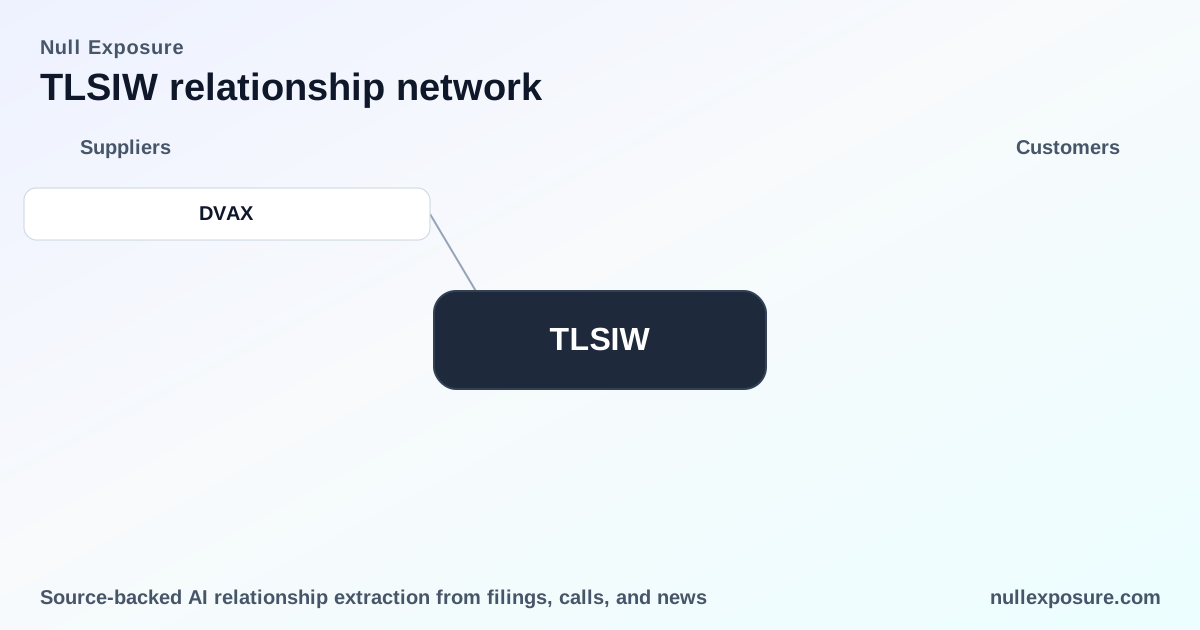
One vendor supplies the core asset: Dynavax Technologies is the IP source
TriSalus purchased the nelitolimod intellectual property and the trial drug substance from Dynavax Technologies, making Dynavax the primary counterparty for the core therapeutic asset. The Dynavax Agreement is the central supplier/licensing relationship that governs downstream payments and royalties tied to nelitolimod commercialization. According to TriSalus’s FY2024 Annual Report on Form 10‑K, the purchase occurred in 2020 and remains an active contractual relationship (FY2024 10‑K).
What the Dynavax deal actually requires (plain English)
- TriSalus has paid $12.0 million to date under the Dynavax Agreement, composed of upfront/reimbursement and milestone disbursements recorded through FY2024.
- The agreement exposes TriSalus to large contingent payments: up to $158 million in development and regulatory milestones and up to $80 million in commercial milestones, plus royalties on net sales (the filings specify a royalty arrangement).
These terms are stated explicitly in the company’s Annual Report on Form 10‑K (FY2024) and form a core cash‑flow constraint for the business.
Relationship-by-relationship detail (each listed counterparty)
Dynavax Technologies — TriSalus acquired all nelitolimod intellectual property and the trial drug substance from Dynavax in 2020; that agreement remains active and governs upfront, milestone and royalty payments tied to future regulatory and commercial events (TriSalus FY2024 Annual Report on Form 10‑K).
The contract obligates TriSalus to material milestone payments and royalties, creating significant future cash commitments that scale with development progress and commercial success (TriSalus FY2024 Annual Report on Form 10‑K).
What contract terms and corporate constraints tell investors
TriSalus’s public filings reveal a licensing-heavy contracting posture and a dependence on external manufacturing and service providers rather than in‑house production. The firm explicitly describes its Dynavax Agreement as a licensing/asset purchase with staged payments and ongoing royalty obligations, and the company discloses reliance on contract manufacturing organizations (CMOs) and other third‑party service providers for manufacturing, testing and storage of nelitolimod. These statements collectively describe:
- High financial leverage to milestone outcomes: the Dynavax Agreement creates conditional liabilities well into the low‑hundreds of millions of dollars if clinical and commercial triggers are met. That places a premium on financing and milestone‑timing forecasts. (Source: FY2024 10‑K)
- Operational concentration and outsized criticality: nelitolimod IP and drug substance came from a single supplier transaction, and TriSalus confirms it relies on third‑party CMOs for supply — meaning supplier disruptions or single‑source manufacturers could have outsized operational impact. (Source: FY2024 10‑K)
- Maturity profile and timing pressure: milestone schedules and royalty terms are multi‑year and effectively long‑dated contractual relationships; debt maturities such as the OrbiMed credit facility (maturing in 2029) further shape liquidity timelines. (Company filings, FY2024)
These are company-level operating signals presented in the Annual Report, and they should be reflected in any scenario analysis for valuation, covenant testing, or procurement continuity planning.
Explore supplier intelligence on Null Exposure
Risk and reward implications for operators and investors
The upside is clear: owning exclusive IP for a novel immunotherapy gives TriSalus leverage to capture high-margin sales if nelitolimod reaches approval and market adoption. The downside is equally concrete: contractual milestone and royalty obligations are large enough to affect capital needs and effective gross margins after commercialization. Key implications:
- Cash‑flow forecasting must include contingent payments: the $158M/$80M milestone structure plus royalties will materially change free cash flow profiles in positive and negative scenarios; planning must reflect staged funding or dilution risk to fund milestone payments.
- Margins will be structurally affected by royalty and COGS: a stated royalty rate (the filing references royalty obligations) and ongoing CMO costs imply that gross margins in commercialization will be lower than a fully‑integrated manufacturer.
- Supply chain concentration is a tangible execution risk: the company’s stated reliance on CMOs and sole‑source suppliers increases operational risk during scale‑up and commercialization.
What investors and procurement teams should verify in due diligence
- Build milestone‑aware cash models that incorporate the Dynavax payment schedule and the likelihood/timing of each trigger.
- Confirm the number, geography and contract status of CMOs and sole‑source suppliers to quantify concentration risk and potential single points of failure.
- Review patent expiry and royalty‑term mechanics to estimate the effective duration of royalty payments and the point at which net‑sales economics improve.
- Assess TriSalus’s debt maturities and covenant profile (e.g., OrbiMed credit agreement through 2029) to align financing needs with milestone timing.
Bottom line — what this means for supplier risk exposure
TriSalus operates a licensing-first, outsource-heavy model centered on a single material acquisition from Dynavax. That structure creates straightforward upside if nelitolimod achieves regulatory and commercial success, and clear, quantifiable downside in the form of large contingent payments and outsized supplier concentration. Investors and operators should treat the Dynavax Agreement as the principal counterparty risk to model and validate the company’s manufacturing and financing plans before underwriting exposure.
For a deeper, transaction-level view and ongoing monitoring of TriSalus supplier relationships and contract constraints, visit Null Exposure.