Tillys (TLYS) supplier footprint: what investors need to know
Tillys is a specialty apparel retailer that monetizes through brick-and-mortar and online sales of proprietary and third‑party casual apparel, footwear, and accessories; it collects margin across retail channels while owning critical inventory and logistics functions that drive working capital needs. With trailing revenue of $545.7 million and a gross profit base of $234.1 million, the company’s path to restoring profitability runs through tighter inventory turns, margin management and lower operational drag from leases and logistics. Supplier and service relationships are therefore strategic levers for cost and working‑capital improvement. For a focused supplier-risk and opportunity view, review extended supplier intelligence at https://nullexposure.com/.
How Tillys buys and moves merchandise — the operating baseline investors should accept
Tillys explicitly operates on a purchase‑order basis for its branded and third‑party merchandise: “We operate on a purchase order basis for our proprietary branded and third‑party branded merchandise and do not have long‑term contractual relationships with our suppliers.” This contracting posture gives the company procurement flexibility and limits long-term supplier lock‑in, but it also exposes Tillys to spot-price volatility and last‑mile availability when inventory is tight. The company sources primarily from vendors based in the United States that either own factories or contract with factory owners, establishing a supplier base that is operationally domestic but commercially global in sourcing. Tillys also runs a mixed distribution model: it uses its own fleet for Southern California deliveries and third‑party distributors for out‑of‑area shipments, creating a hybrid logistics posture that is both a control point and a sourcing risk. Finally, Tillys maintains related‑party property arrangements — it leases office and warehouse space from an entity owned by its co‑founders, incurring roughly $2.1 million in rent expense in each fiscal year 2024, 2023 and 2022 — a structural cost item investors must monitor in any margin recovery plan.
Where the supplier relationships sit in the company model
- Contracting posture and maturity: Short‑term purchase order relationships are company‑level signals of a nimble but transactional supply chain. That posture lowers fixed supplier overhead but increases the importance of operational systems (demand forecasting, replenishment) to avoid stockouts or excess markdowns.
- Geographic concentration: Vendor sourcing is concentrated in North America for proprietary product supply, which reduces certain international shipping and tariff risks but concentrates vendor operational risk regionally.
- Roles across the supply chain: Tillys functions as a distributor (own fleet locally, third‑party outside its core area), a brand manager that contracts manufacturers, and a tenant of service providers for real estate — a diversified role set that increases managerial complexity even as it preserves control in critical segments.
For ongoing supplier tracking and to compare Tillys’ supplier posture against peer retailers, consider a deeper review at https://nullexposure.com/.
The Impact Analytics partnership — plainly stated
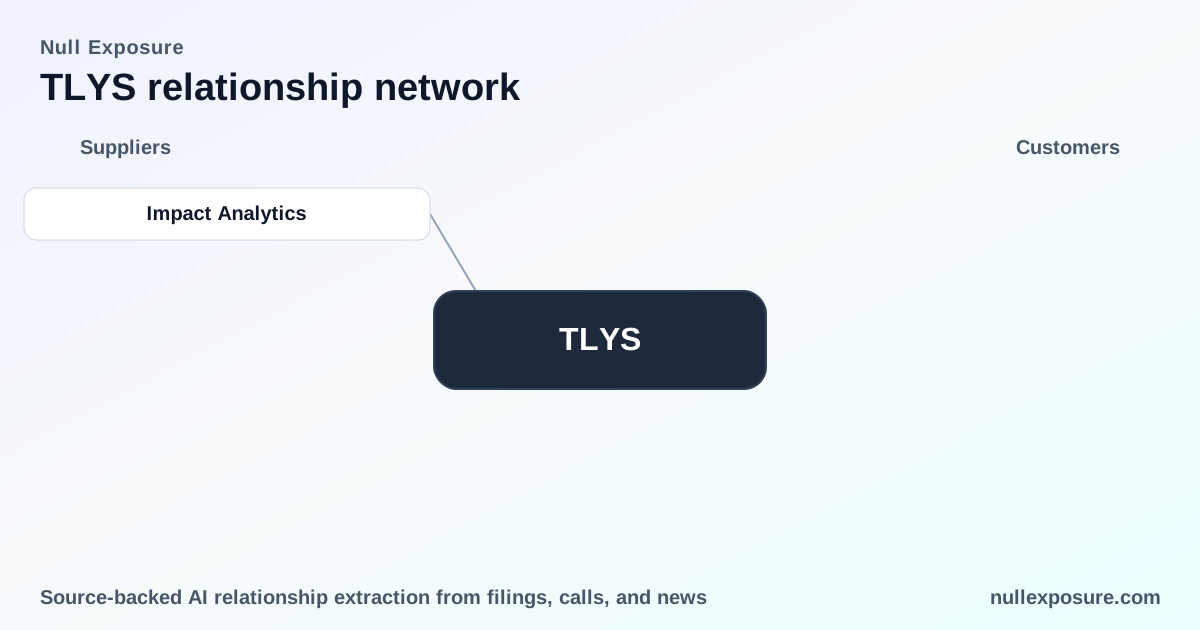
Impact Analytics announced a partnership with Tillys to deliver AI‑native pricing, merchandising and supply‑chain solutions aimed at inventory optimization across stores and distribution centers. According to a press release reported by Yahoo Finance on March 10, 2026, the agreement positions Impact Analytics as a provider of end‑to‑end analytics tools to improve inventory flow and business intelligence. (Source: Yahoo Finance news release, March 10, 2026).
This supplier relationship is a service‑provider engagement focused on analytics and inventory science, and it is the only supplier relationship surfaced in the latest public intelligence set. The partnership speaks to management prioritizing systems investments to compress inventory days and better align assortments across channels.
What the Impact Analytics tie‑up implies for investors
The commercial objective is straightforward: reduce inventory carrying costs, decrease markdown frequency, and improve gross margin dollars through smarter allocation and pricing. Given Tillys’ current profitability profile — negative EPS of -$0.58 and an EBITDA loss in the latest trailing period — operational software that meaningfully improves inventory efficiency is one of the highest‑leverage, low‑capex interventions available. The partnership also signals a shift toward data‑driven merchandising, where a proven analytics stack can quickly change cash conversion if implemented effectively.
All supplier relationships found in the record (one entry)
Impact Analytics — Impact Analytics will provide an end‑to‑end AI‑native platform covering pricing, merchandising and supply‑chain analytics to drive inventory optimization across Tillys’ stores and distribution centers; the partnership was publicized in March 2026 via a company announcement reported by Yahoo Finance. (Source: Yahoo Finance, March 10, 2026).
Supply risks and financial context investors must weigh
- Working‑capital sensitivity: Tillys’ inventory and procurement model is fundamentally short‑term, increasing sensitivity to seasonal demand swings and vendor lead times. Management’s reliance on purchase orders means procurement flexibility but higher operational reliance on forecasting and analytics.
- Related‑party lease expense: The company leases office and warehouse space from an entity owned by its co‑founders and recorded rent expense of $2.1 million in each of fiscal years 2022–2024; this is a recurring fixed cost that constrains margin recovery unless renegotiated.
- Capital and valuation profile: Market cap sits near $82.9 million with negative trailing profitability and a forward P/E implied by consensus estimates; institutional ownership is high at 92.8%, concentrating ownership decisions and potentially reducing share‑liquidity volatility but increasing the likelihood of coordinated portfolio moves.
- Operational concentration: Domestic vendor focus reduces certain global supply risks but concentrates exposure to U.S. manufacturing and logistics disruptions.
Bottom line: the supply‑side levers at Tillys are operational — procurement cadence, inventory intelligence, and distribution control — not large capital investments. The Impact Analytics relationship is aligned with where value can be unlocked most quickly: inventory turns and margin restoration.
Practical next steps for investors
- Monitor deployment milestones and KPIs from the Impact Analytics partnership: inventory days, markdown rate, and same‑store gross margin improvement. These metrics will be the earliest indicators of durable benefit.
- Track quarterly disclosures around procurement commitments and any shifts from purchase‑order sourcing to longer vendor arrangements; any move toward longer‑term supplier contracts would be a material change in risk profile.
- Assess related‑party lease commitments in future filings to determine whether rent remains a structural drag.
For ongoing supplier intelligence, benchmarking and supplier risk dashboards, visit https://nullexposure.com/. If you want a tailored supplier risk briefing for retail portfolios, our platform centralizes supplier signals and vendor news — start on the homepage at https://nullexposure.com/.