TMAC supplier footprint: who shows up in the public record and what it means for investors
TMAC operates as a supplier whose commercial value is realized through contractual engagements with consumer-brand and social-media platforms; it monetizes by delivering goods or services under supplier agreements and realizing recurring or project revenue tied to those contracts. Public news links in TMAC’s supplier profile tie the company to a set of large consumer and social-media names, which is strategically important: relationships with recognizable brands carry both revenue upside and reputational risk. For a fast, structured read of TMAC’s supplier relationships and implications, visit https://nullexposure.com/.
How to read this file: a concise operating thesis
TMAC’s supplier role is captured in news-sentiment extracts that reference consumer electronics, fitness, and social-media platforms as relevant counterparties. The company’s commercial model is straightforward in investor terms: sell services or products under supplier contracts, invoice customers, and retain margin. Given the public references, the company’s go-to-market mixes enterprise or wholesale deals with consumer-channel exposure. Investors should treat these public-name linkages as signaling customer type and market positioning rather than definitive revenue attribution.
What the public record actually shows about counterparties
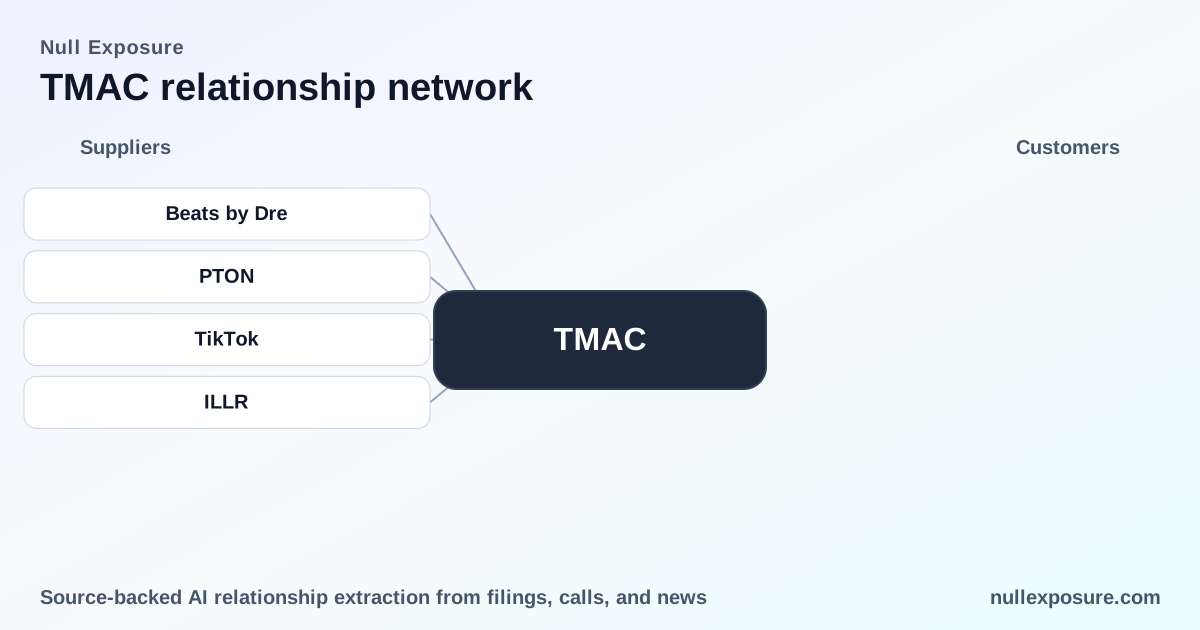
The available results list four named companies linked to TMAC’s supplier-scope coverage: Beats by Dre, Peloton, TikTok, and Triller. All references are drawn from the same industry article and recorded as news-sentiment hits in TMAC’s supplier results. This set of names indicates TMAC’s supplier profile is connected in the public record to consumer-brand and social-media channels, which has operational and commercial implications discussed below. For further context and tracking, see https://nullexposure.com/.
Relationship readout — each public mention, in plain English
-
Beats by Dre — A Variety article (2021) cited Beats by Dre as a consumer-brand example in the context of acquisition targets and market focus; that article is present in TMAC’s news-sentiment results, linking the Beats brand to TMAC’s supplier coverage (Variety, 2021: https://variety.com/2021/music/news/neil-jacobsen-200-million-music-acquisition-company-1234887095/).
-
Peloton (PTON) — The same Variety piece references Peloton as a consumer example; Peloton appears in TMAC’s supplier results with inferred symbol PTON, indicating the public record groups the fitness brand with TMAC’s supplier-scope mentions (Variety, 2021: https://variety.com/2021/music/news/neil-jacobsen-200-million-music-acquisition-company-1234887095/).
-
TikTok — The Variety article lists TikTok as a social-media example; that mention is captured in TMAC’s news-sentiment entries, connecting TMAC’s supplier profile to major social platforms (Variety, 2021: https://variety.com/2021/music/news/neil-jacobsen-200-million-music-acquisition-company-1234887095/).
-
Triller (ILLR) — Triller is named alongside TikTok in the same industry report and appears in TMAC’s supplier-scope results, with inferred symbol ILLR recorded in the extract (Variety, 2021: https://variety.com/2021/music/news/neil-jacobsen-200-million-music-acquisition-company-1234887095/).
What the relationship mix implies for TMAC’s operating model
The mix of consumer-brand (Beats, Peloton) and social-platform (TikTok, Triller) mentions tells investors several concrete things:
- Customer profile breadth: Public references span hardware-oriented consumer brands and platform-driven social-media channels, indicating TMAC’s supplier role serves both product manufacturers/retailers and digital distribution channels.
- Commercial exposure types: Engagements with consumer brands typically imply product- or inventory-driven contracts, while social-media relationships imply content, marketing, or platform-integration services; both categories have different billing cadence and margin profiles.
- Reputational leverage: Association with prominent consumer and social brands increases visibility and can accelerate new commercial opportunities, but it also raises the stakes for compliance, delivery quality, and contract performance.
Constraints and what’s missing from the public record
No supplier-level constraints are reported in the supplied relationship coverage; there are zero disclosed contractual constraints in the dataset for TMAC’s supplier scope. Treat that absence as a company-level signal: the public record contains no explicit contract-limit disclosures, no concentration thresholds, and no explicit exclusivity clauses. For investors, that translates into two actionable readings: either TMAC operates on standard, non-public commercial terms with counterparties, or public disclosure is incomplete — both scenarios increase opacity and warrant verification through diligence.
Risk, concentration, and due-diligence checklist
- Risk concentration: The named counterparts are widely diversified by industry segment, which reduces the immediate concern around single-industry concentration; however, the presence of any single large relationship could be material without published revenue attribution.
- Operational criticality: Relationships with social-media platforms signal potential dependencies on platform performance and policy; relationships with consumer brands signal supply-chain and fulfillment reliability pressures.
- Immediate verification steps for investors and operators: request contract-level evidence for the largest counterparties, confirm revenue attribution and term lengths, and insist on SLAs and contingency plans tied to any platform or brand dependency.
For investors who want a structured source for counterparty coverage and follow-up on supplier relationships, explore detailed tracking at https://nullexposure.com/.
Conclusion — posture for investors and operators
The public-sentiment hits in TMAC’s supplier profile link the company to major consumer and social-media brands, which is strategically valuable but not, by itself, a revenue readout. Key takeaways: the relationship set signals breadth across consumer and platform channels; the absence of disclosed constraints increases information risk; and the next step for underwriters and portfolio managers is contractual verification and revenue attribution. Operators should prioritize solidifying SLAs with any platform or consumer-brand customer because reputation and delivery quality are immediate value drivers.
For direct access to continuous supplier relationship tracking and to request a deeper read on TMAC, visit https://nullexposure.com/.