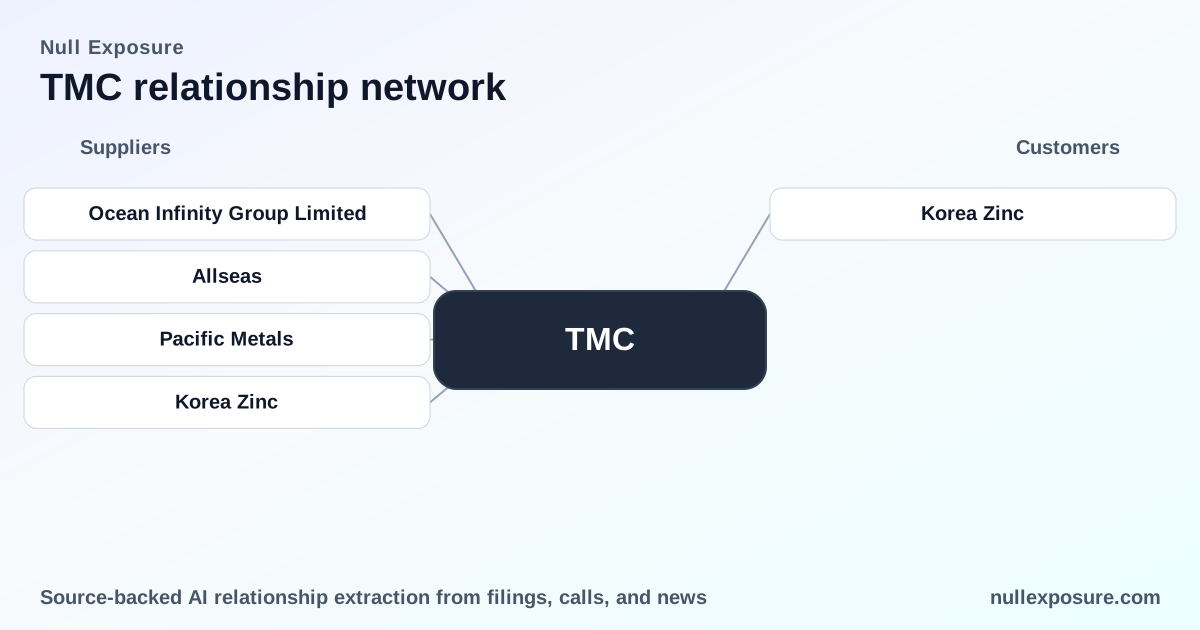
TMC the Metals Company: supplier map and what it means for investors
TMC the Metals Company operates as an upstream developer of polymetallic nodule extraction in the Clarion‑Clipperton Zone, monetizing through the eventual sale of refined critical metals (nickel, copper, cobalt and rare earths), tolling agreements with established smelters, and strategic equity and processing partnerships. The commercial model combines capital raises and partner financing with outsourced vessel, survey, and processing capabilities while the company advances permitting and pilot operations. Investors should view value creation as dependent on successful scale‑up of offshore collection, onshore processing contracts, and a small number of strategic partners that supply vessels, processing capacity and capital. For more supplier maps and counterparty intelligence, visit https://nullexposure.com/.
Who provides the ships, sensors and processing capacity
Ocean and onshore partners are the operational backbone of TMC’s early program. Each relationship below is summarized in plain language with the original source noted.
Ocean Infinity Group Limited — vessel and monitoring contractor
TMC contracted the Island Pride from Ocean Infinity Group Limited for monitoring operations, deploying two ROVs, three AUVs and an array of more than 50 seafloor sensors to support survey and environmental monitoring work (FY2024). According to TMC’s 2024 Form 10‑K, the Island Pride was used for monitoring activities and sensor deployment during the company’s field programs in that fiscal year.
Allseas — offshore engineering and vessel conversion partner
Allseas, the Swiss offshore engineering specialist, provided a ship to TMC and converted a drillship into a deep‑sea mining vessel for operations, serving as a large‑scale marine contractor and vessel provider (FY2025). A climate coverage piece and market reports referenced Allseas’ role in supplying the ship and conversion work for TMC’s operational fleet (Climatica.coop, FY2025; Finviz industry coverage, FY2025).
Pacific Metals — tolling and initial processing agreement in Japan
TMC has an agreement requiring that polymetallic nodules be processed in Japan during an initial period of at least five years, with Pacific Metals identified as the metallurgical partner for that tolling arrangement (FY2025). A news report noted the company’s acknowledgement that initial nodules will be processed in Japan under an arrangement with Pacific Metals (Climatica.coop, FY2025).
Korea Zinc — strategic investor and downstream processor
Korea Zinc made an equity commitment to TMC (approximately $85.2 million in exchange for shares) and conveyed a commercial interest in partnering to process, refine and potentially build manufacturing capacity in the United States to handle nodules and downstream products (reports spanning FY2025–FY2026). Market coverage and subsequent summaries of the transaction describe Korea Zinc’s equity investment and its stated interest in downstream processing collaborations (Finviz news, FY2026; TS2.tech and Reuters summaries, FY2025).
What these supplier relationships reveal about TMC’s operating model
TMC’s supplier map shows a company that combines external engineering capability, downstream tolling, and strategic equity partnerships rather than internalizing heavy industrial processing in the near term. These dynamics imply several company‑level operating characteristics:
- Contracting posture: TMC outsources critical marine and technical capabilities to specialized contractors (vessel providers, ROV/AUV operators, engineering firms) and uses tolling agreements for initial downstream processing. This reduces upfront capital spend but increases reliance on third‑party scheduling and technical delivery.
- Concentration of critical services: Early operations depend on a handful of partners for vessel access, monitoring, and processing — a single partner failure or delay would materially disrupt ramp plans.
- Criticality and maturity: The relationships are high‑criticality but low‑maturity for revenue: they support pilot and pre‑commercial phases rather than sustained production today, so counterparty performance directly affects whether TMC reaches commercial throughput.
- Financing posture and counterparty mix: Company filings show short‑term financing links to insiders (an unsecured credit facility in 2024 with the CEO and a director’s family fund) and active pursuit of strategic corporate investors, illustrating a financing mix of insider credit and strategic partnership equity.
These company‑level signals are drawn from TMC’s disclosures and partner announcements; they reflect how the business is structured around outsourced execution and partner capital rather than immediate, vertically integrated production.
For a deeper counterparty risk breakdown and supplier scoring, see https://nullexposure.com/.
Investment implications: risks and upside centered on supplier execution
The supplier roster creates a concentrated set of execution risks and identifiable upside levers:
- Execution risk is concentrated. Vessel availability and conversion (Allseas, Ocean Infinity) plus tolling capacity (Pacific Metals, Korea Zinc) are the proximate bottlenecks before revenue can be realized. Any delay in vessel conversion, survey delivery, or tolling feasibility will push commercialization timelines and increase cash burn.
- Downstream partnerships reduce capex but create single‑point dependencies. Tolling in Japan provides an accelerated route to refined product but concentrates processing risk geographically and contractually in early years — a regulatory, logistical, or counterparty operational issue there would be material to revenue timing.
- Strategic capital provides optionality. Korea Zinc’s equity investment is both cash and industrial capability: the best‑case scenario compresses the path from nodule collection to refined metals sold into battery and specialty markets. That partnership materially improves the company’s path to industrial scale if execution follows.
- Insider financing signals constrained near‑term liquidity choices. The unsecured credit facility tied to management and an affiliated family fund indicates access to bridge capital but raises governance and refinancing considerations for institutional investors.
Key takeaway: valuation and downside protection for investors hinge on partner‑level execution milestones (vessel conversion, feasibility and tolling success, and regulatory permits) rather than on internal production metrics at this stage.
Practical due diligence checklist for operators and investors
When evaluating TMC as a supplier counterparty or investment, focus on measurable supplier milestones and contractual terms:
- Confirm vessel conversion timelines, certification and insurance terms with Allseas and Ocean Infinity.
- Validate tolling capacity, minimum take provisions, pricing formulas and duration with Pacific Metals and Korea Zinc.
- Monitor regulatory permits and environmental monitoring deliverables tied to deployed sensor fleets and ROV/AUV data.
- Review financing covenants and insider facility terms to understand liquidity and dilution pathways.
If you want a custom supplier map or scoring for TMC’s counterparty set, start here: https://nullexposure.com/.
Conclusion and next steps
TMC’s supplier relationships are strategically coherent: marine contractors enable field collection, metallurgical partners enable initial saleable product, and strategic investors provide capital and downstream optionality. Value realization depends on flawless multi‑party coordination across conversion, shipping, and tolling partners — a concentrated but addressable execution challenge.
For tailored counterparty intelligence, supplier scoring, or to commission a report on TMC’s contractual exposures, visit https://nullexposure.com/ and request a supplier analysis.